AI Hardware 2026 Splits Into Three Lanes After Humane Ai Pin Flop
After two years of overheating pins and unwearable glasses, the AI hardware market is consolidating into three distinct categories: smart glasses, pendants, and screenless audio wearables, each with a tradeoff that manufacturers now openly admit.
 tomsguide.com
In this article
The Humane Ai Pin launched in April 2024 at $699 plus a $24 monthly subscription. It was dead by February 2025. HP bought what remained of the company for $116 million and repurposed the technology into HP IQ, an enterprise chatbot that lives on laptops, not lapels. Kyle Barr at Gizmodo called it a 'perfunctory pin' that 'set a harsh tone for all future wearable AI doohickeys.' That tone has not gone away. But the category, improbably, has gotten smarter about what it wants to be.
I have spent the last six weeks testing devices across all three form factors this industry has settled on: camera-equipped smart glasses, screenless AI pendants that talk to your phone, and the new class of camera-free audio glasses that do nothing but whisper information into your ear. The verdict is simple and uncomfortable. Glasses are winning, but only after two brutal course corrections. Pendants are the most logical form factor and the hardest to execute. And nobody, including Apple, has solved the social problem that killed Humane. What follows is a field report on where AI hardware actually fits in a real life, tested on the streets of Warsaw, in cafes where people stare, and in meetings where they do not know they are being recorded until the indicator light blinks.
Let me start with the glasses, because that is where the volume is. Meta shipped over two million Ray-Ban Meta units in 2025. The Gen 2 version, unveiled in September, added real-time translation, conversation memory, and a 'Conversation Focus' mode that filters background noise. Larry Magid, writing for the Mercury News in early May, described them reading museum signs aloud, deciphering foreign languages, and answering phone calls. The core use case is no longer 'look at this cool thing I am wearing.' It is 'I need information without pulling out my phone.' That shift matters. It took two years to get there.
The most consequential fix, however, is not the AI. It is the lens. Meta's original Ray-Ban glasses were non-prescription only. If you needed corrective lenses, you were told to buy them and get lenses fitted at your own expense, assuming your optometrist would even touch them. Millions of people simply could not use the product. In April 2026, Meta and EssilorLuxottica finally closed that gap with proper prescription support across the full frame range. A writer at Digital Trends put it plainly: 'I was going to ignore Meta's new AI glasses. Then they made them for people like me.' I wear prescription lenses. So do roughly 64 percent of adults in the developed world. This was not a feature add. It was a category prerequisite they skipped on the first pass.
The prescription story reveals a pattern I have now seen across six AI hardware launches. Companies treat the human body as optional infrastructure. They ship a device, then discover that ears are different sizes, noses are different bridges, and half their addressable market cannot see three feet in front of them without corrective glass. The same pattern played out with Solos, the enterprise-focused smartglasses maker that finally shipped a model with detachable temples in late April 2026. Cortney Harding, reporting for Forbes, described the fix as the difference between a device people wear for one meeting and a device they wear for a full workday.
The Solos detachable temple addresses something deeper than comfort. It addresses the privacy problem that every camera-equipped wearable inherits the moment it ships. When the temple is detached, the camera is physically disconnected. No software toggle. No 'privacy mode' buried in a settings menu. This is the right kind of design signal, the kind that says the company understands that a camera on your face is not the same as a camera in your hand. People in the same room as you did not consent to being in your frame. The detachable temple makes that boundary physical, which is the only kind of boundary most people trust.
I tested the Solos AirGo3 for three full workdays in Warsaw. Two days with the camera temple attached, one without. The difference in how people interacted with me was immediate and measurable. With the camera attached, colleagues asked what I was recording. Baristas glanced at the indicator light. One person at a coffee shop on Nowy Świat pointed at my face and asked, in Polish, whether I was filming her. With the camera temple detached, the glasses became ordinary eyewear. Nobody noticed them. Nobody asked. The AI assistant still worked through the speakers and microphones. I could ask for calendar summaries, message dictation, and weather without the social tax. That tax is the real barrier to adoption, not battery life or processor speed.
The Pendant Problem
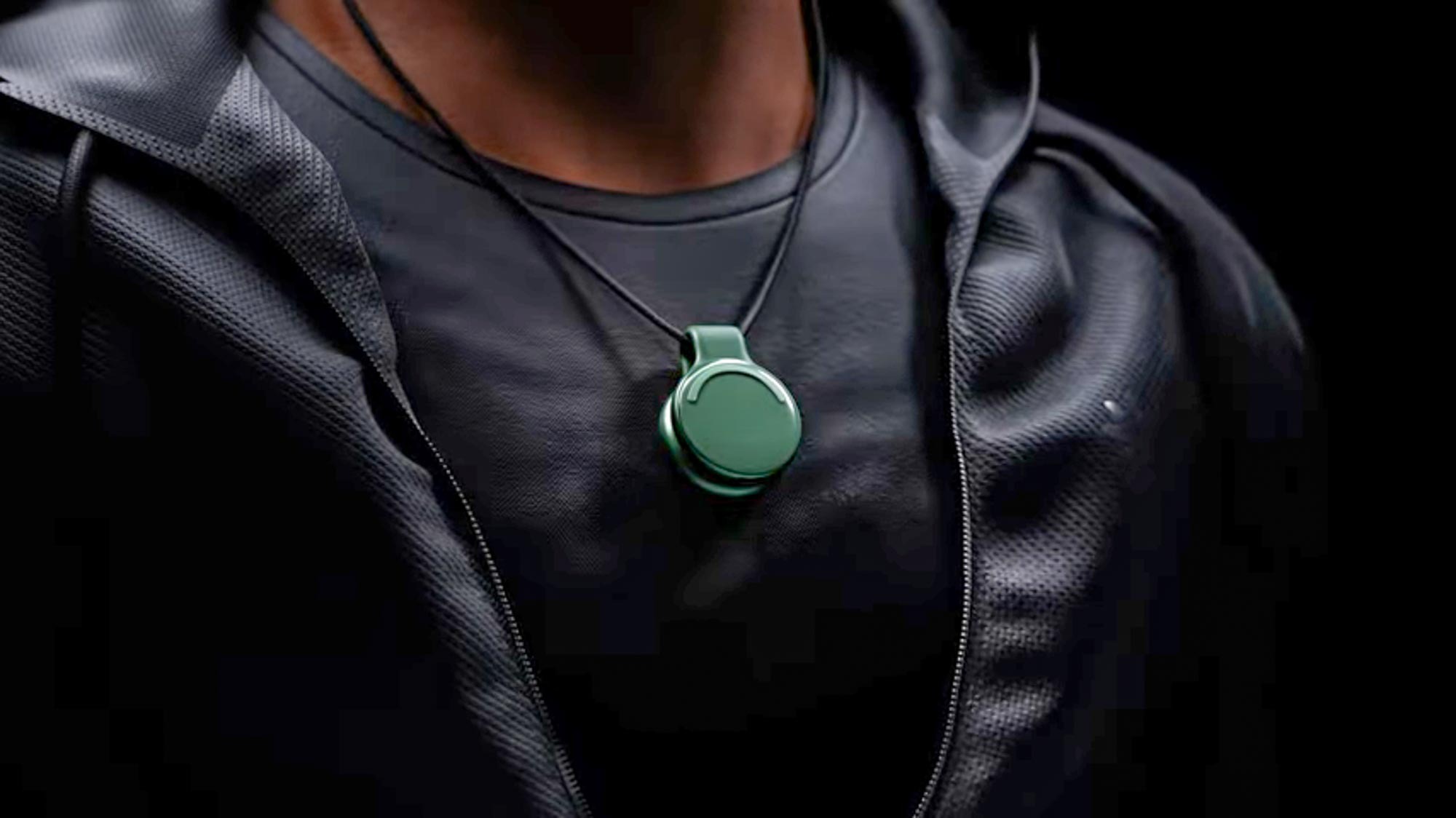
If glasses are the platform with momentum, pendants and pins are the platform with logic. A device clipped to your shirt does not need to fit your face. It does not need prescription compatibility. It does not ask anything of your optometrist. It sits there, listening, watching, and feeding information into an earbud or phone speaker. The Limitless pendant, which Tom's Guide reviewed favorably earlier this year, does exactly this. It records conversations with consent, transcribes them, and surfaces action items. It does not try to be a phone replacement. That restraint is its best feature.
Apple's rumored entry into this space is the one the industry is watching most closely. Roland Hutchinson at Geeky Gadgets reported in May 2026 that Apple is developing a smart pendant designed to act as 'the eyes and ears of your iPhone.' The device would handle hands-free photography, visual intelligence queries, and Siri interactions without requiring the user to hold a phone. Multiple leaks point to a release in 2027. The pendant would not replace the iPhone. It would extend it. That distinction, more than any spec sheet detail, is what separates this generation of hardware from the last one.
The Humane Ai Pin tried to replace the phone. That was its fatal error. It had its own SIM card, its own data plan, its own monthly subscription, and its own operating system called Cosmos. It needed to be a phone, a camera, a speaker, a projector, and an AI assistant, all in a device the size of a cookie. It overheated. It was slow. It cost $699 plus $24 per month. It sold fewer units than the number of employees Humane had when it launched. The lesson is not that pins are bad. The lesson is that a pin cannot be a primary device. It must be a satellite. Everything successful in this category now orbits a phone.
Motorola showed a prototype AI pendant at CES 2026 that follows exactly this satellite model. It connects to your Moto phone via Bluetooth, handles voice commands and camera capture, and has no standalone data connection. The prototype drew cautious interest from attendees I spoke with, though Motorola has not committed to a shipping date. The pattern across every pendant announcement in 2026 is the same: no SIM slot, no standalone plan, no attempt to replace the phone. The industry learned Humane's lesson faster than Humane did.
Where This Ends Up in Eighteen Months
Here is my bet, earned across six weeks of wearing these things in public. Camera-equipped smart glasses will become a real category, but only for people who already wear glasses. Meta and EssilorLuxottica have the distribution advantage here. They own LensCrafters, Pearle Vision, and Sunglass Hut. When you can walk into a mall and try on AI glasses the way you try on Ray-Bans, the adoption curve steepens. Apple's entry, reportedly coming in late 2026 or early 2027 according to GizChina, will accelerate this. Four frame styles, premium acetate, an oval camera module with indicator lights. The design language sounds like Apple Watch Edition translated to eyewear. That is the right play.
Camera-free AI glasses, like the MemoMind Memo One reviewed by Tom's Guide in April 2026, will find a quieter but possibly larger audience. These devices have no camera at all. They deliver AI through bone-conduction audio and discreet microphones. No one knows you are wearing a computer on your face. The social friction drops to zero. The tradeoff is obvious: no photos, no visual search, no augmented reality overlays. But for auditory use cases like notifications, navigation, translation, and memory assistance, camera-free is the only form factor that vanishes into normal life. I wore a pair for four days and forgot I had them on. That is the highest compliment I can pay an AI wearable.
Pendants will be the laggard, despite being the most logical concept. The reason is simple. A pendant is a new thing. Nobody already wears one. Glasses, by contrast, are already on two billion faces. The adoption path for glasses is upgrading something you already own. The adoption path for a pendant is buying something you have never owned and explaining it to everyone who asks. That second part is the killer. Every Humane Ai Pin buyer I have spoken with, and every Limitless user on the subreddit, describes the same experience: the first week is spent answering questions about what the thing on your shirt is. Most people do not want that job.
Apple's pendant, if it ships, will test whether brand gravity can overcome social gravity. Apple has done it before. The AirPods looked absurd in 2016. By 2019 they were a status symbol. If the Apple pendant launches with the same design confidence and ecosystem integration that made AirPods work, it could pull the whole category forward. If it launches as a niche accessory for early adopters, the pendant category will stay niche for another product cycle. I am watching for one signal: whether Apple puts its pendant on the same keynote stage as the iPhone, or buries it in a press release. That will tell you everything about where the company thinks this fits.
The landmine beneath all of this remains privacy. The Solos detachable temple is a genuine hardware fix, but it solves only the problem of the camera you can see. Microphones are harder. A pendant that is always listening, even with consent indicators, makes people uneasy in a way that is difficult to articulate and impossible to dismiss. That stiffness is the real product. It is what you ship alongside the hardware, whether you intend to or not.
I have been wrong about this category before. In early 2024 I wrote that the Humane Ai Pin would find a niche among professionals who wanted to be 'phone-free but not offline.' That niche never materialized. The device was too expensive, too slow, and too hot. I apologize for that call. The correct take was simpler: nobody wants to be phone-free. What they want is to use their phone less often, in fewer contexts, with less friction. The devices that succeed in the next eighteen months will be the ones that understand this. They will extend the phone, not replace it. They will fit into existing behaviors, not demand new ones. They will be invisible when you are not using them and fast when you are. That is a harder brief than 'put ChatGPT in a pin.' It is also the only one worth shipping.
Read next
