Nebius $32.15M Per-Engineer Inference Deal Sets Neocloud Bar
Nebius's $643M acquisition of a 20-person MIT inference-optimization spinout resets neocloud valuations as CoreWeave books $27B in weekly deals and xAI builds its own chip fab.
 siliconangle.com
In this article
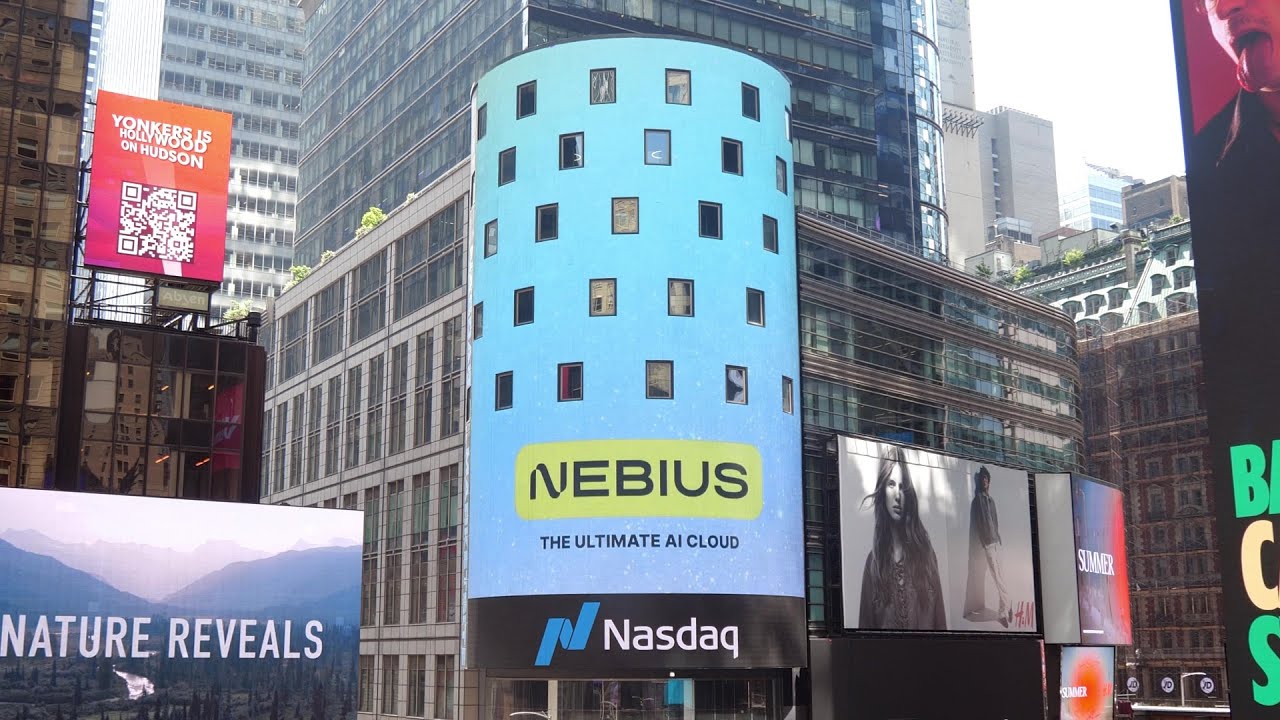
On May 1, 2026, Amsterdam-based neocloud Nebius Group agreed to acquire Eigen AI, a 20-person inference-optimisation startup spun out of MIT, for approximately $643 million in cash and stock. That works out to $32.15 million per employee, a figure that would have seemed unhinged for an infrastructure-software acquisition two years ago. But Eigen AI does not build foundation models. It does not sell GPUs. The company's entire product is a software layer that squeezes more tokens out of the same silicon, and in the neocloud market of mid-2026, that layer is now priced as the most valuable slice of the AI infrastructure stack. Nebius shares jumped 8.5 percent on the news, adding roughly $1.2 billion in market capitalisation, Blockonomi reported.
The Nebius-Eigen transaction is not an outlier. It is the logical endpoint of a market structure that has been snapping into place across 2026. Neoclouds, specialised GPU-cloud providers that rent compute to AI labs and enterprises, are no longer competing on raw flops or rack density alone. The new battlefield is inference economics: tokens per GPU per second, measured at specific batch sizes and sequence lengths, with the margin captured through software optimisation rather than hardware provisioning. The Next Web described the acquisition as proof that "inference optimisation is the competitive edge" in the neocloud race. The numbers bear this out. CoreWeave, the largest pure-play neocloud, now carries an $88 billion revenue backlog and reaffirmed its 2026 revenue guidance of $12 billion to $13 billion on its Q1 2026 earnings call, per Seeking Alpha.
The CoreWeave story illustrates why inference is where the capital is concentrating. In the span of roughly 48 hours in early April, the company signed a $21 billion expansion of its existing agreement with Meta, extending through December 2032, and a separate multiyear deal with Anthropic. Days later, trading firm Jane Street committed approximately $6 billion for CoreWeave cloud services, Reuters reported via U.S. News. That is $27 billion in new contractual commitments inside a single week. CoreWeave now claims it serves nine of the top ten AI labs, according to Forbes. Chief financial officer Nitin Agrawal told analysts the company's 2026 exit run-rate floor had been lifted to $18 billion.
What matters is not just the headline contract values but the workload mix inside them. Both the Meta and Anthropic deals are heavily weighted toward inference, not training. Training remains a big-ticket, episodic expense, a single large cluster run that may last weeks or months and then go idle. Inference is continuous: every user query, every agent invocation, every API call to Claude or Llama generates a stream of tokens that someone must serve. As AI agents proliferate, making dozens or hundreds of model calls per user request, the inference-to-training ratio tilts further toward inference. A single agent workflow might chain seven model calls to answer one email. Serve that at scale, and the GPU-seconds consumed by inference dwarf the one-time training budget within months of a model's deployment.
This is why Nebius paid $643 million for Eigen AI's 20-person team rather than for a fleet of H200 servers. Eigen's technology targets what the company calls the "token factory" layer: software that optimises inference throughput across heterogeneous GPU fleets by dynamically selecting model quantisation levels, batch sizes, and kernel launch parameters based on real-time load. The Nebius Token Factory platform, which Eigen will now anchor, promises to increase tokens-per-GPU-per-second by between 30 and 80 percent on standard NVIDIA hardware, depending on the model architecture and batch regime. At batch size 1, the worst-case scenario for utilisation but the most common for real-time chat workloads, the gains are concentrated on the low end of that range. At batch size 32 and above, where throughput-oriented serving can amortise kernel launch overhead, Eigen's approach approaches the higher end. These are the numbers that define the per-token price a neocloud can offer while still booking a margin.
The per-token price is the unit of account in this market, and the pressure on it is relentless. OnMSFT.com reported in late April that Groq's token-based pricing on its LPU architecture has begun undercutting NVIDIA-served inference on pure cost per million tokens for certain Llama-family models, though the comparison depends heavily on batch assumptions and the specific precision format used. When Groq quotes a price, it is typically at batch size 1 with a fixed sequence length, which is precisely the regime where NVIDIA hardware struggles most to amortise cost. Switch to batch size 32 with continuous batching, and the NVIDIA numbers improve dramatically. This is the assumption-set problem that makes every public per-token price comparison suspect unless the batch size, sequence length, and hardware SKU are all disclosed.
The AI industry has converged on a deceptively simple metric: cost per token. It is easy to understand, easy to compare, and easy to market. Every new system promises to drive it lower., EDN, "The truth about AI inference costs," March 31, 2026
The inference-optimisation acquisitions and the mega-deals are two sides of the same coin. CoreWeave can sign $21 billion with Meta because it has proven it can deliver inference at a per-token price that undercuts what Meta would pay to serve those same models on its own internal infrastructure, or what it would pay AWS or Google Cloud. The neocloud margin is the delta between the raw GPU-rental price and the optimised inference price, and the software layer is where that delta lives. Hardware is a commodity input: an H200 is an H200 whether it sits in a CoreWeave rack or a Microsoft Azure rack. The 30-to-80-percent throughput improvement that Eigen claims is effectively a 30-to-80-percent margin expansion on the same silicon. That is $643 million worth of arithmetic.
The neocloud competitive set is also shifting in less predictable ways. TechCrunch examined whether xAI now qualifies as a neocloud, given its 100,000-GPU Colossus cluster in Memphis and its increasingly public posture as an infrastructure provider. Russell Brandom's analysis concluded that xAI's real business may be "more about building data centers than training AI models." The xAI variant of the neocloud model is, characteristically, more vertically integrated than anyone else's: the company is building its own chips at the Terafab facility in Texas, a project that Reuters reported Intel has joined as foundry partner. SpaceX involvement raises the prospect, however distant, of data centers in orbit. But the core contention of the TechCrunch piece is simpler: xAI is monetising compute, not just consuming it, and that makes it a participant in the neocloud market whether it uses the label or not.
Applied Digital, a data-centre builder that supplies physical infrastructure to neocloud operators including CoreWeave, has seen its revenue pipeline swell in parallel. The Motley Fool called the moment a "neocloud supercycle," noting that Applied Digital's long-term road map translates directly into top-line growth as neoclouds race to build out capacity ahead of demand. The company's model is instructive: it builds the shell and the power infrastructure, while the neocloud tenant, increasingly, a single hyperscaler or AI lab on a multiyear contract, installs and operates the GPU fleet. This is compute real estate at industrial scale, and the lease terms now routinely run seven to ten years.
The Nutanix announcement at .NEXT 2026 in Chicago added another data point: the hybrid-cloud infrastructure vendor plans new agentic AI features specifically targeting neocloud providers in late 2026, Virtualization Review reported. The message is unambiguous. Neoclouds are no longer a niche, they are a named customer segment that enterprise infrastructure vendors build product roadmaps around.
The question that follows from all of this is structural: who captures the margin in a market where inference is the product, the GPU is a commodity, and the optimisation software is the differentiator? The chip layer, NVIDIA, primarily, though Groq, AMD, and now xAI's Terafab silicon complicate the picture, captures rent on the hardware. The hyperscalers, AWS, Google Cloud, Azure, capture rent on integration, data gravity, and existing enterprise relationships. The neoclouds sit between them, competing on price against the hyperscalers while depending on the same chip vendors. The software optimisation layer, the Eigen AIs of the world, is where the neoclouds can build a moat that neither NVIDIA nor AWS can easily replicate, because it is tuned to the specific workload mix, GPU fleet composition, and customer profile of a given operator.
Axe Compute, a smaller neocloud that went public via a SPAC, provided a useful benchmark in late April when it signed a $260 million, three-year contract for a 2,304-GPU NVIDIA B300 deployment, Markets Insider reported. That works out to roughly $113,000 per GPU over 36 months, or about $3,130 per GPU per month, a figure that includes power, cooling, networking, and the Axe Compute software stack. Compare that to raw on-demand GPU rental rates from hyperscalers, which typically run $2.50 to $4.50 per GPU-hour for comparable hardware depending on commitment length and region, and the neocloud premium for managed inference becomes visible: the customer pays for optimisation, not just access.
The gap between the $643 million Nebius paid and what Eigen AI had actually shipped in revenue is, on the public record, unknown. Neither Nebius nor Eigen disclosed the startup's revenue or customer count in the acquisition announcement. The price is being read entirely as a bet on forward throughput gains and on the talent density of the team. Twenty people, most with PhDs from MIT's Computer Science and Artificial Intelligence Laboratory, represent one of the deepest concentrations of inference-systems expertise outside the major labs. Whether that team can deliver a 50 percent average throughput uplift across Nebius's GPU fleet, and whether that uplift translates into a commensurate reduction in per-token cost on customer invoices, is the $643 million question.
The margin chain: chip, cloud, model, app
The inference stack splits margin four ways, and the allocation is shifting underfoot. The chip vendor, NVIDIA, captures the largest single share today, because every inference token runs on a GPU that NVIDIA sold at a gross margin north of 70 percent on its data-centre products. The cloud layer, whether neocloud or hyperscaler, captures the next slice, which is fundamentally a spread between the cost of operating the GPU fleet and the price charged to the model provider or application developer. The model provider, OpenAI, Anthropic, Meta, Google, captures margin on the delta between inference cost and the API price charged to developers. And the application layer, the chatbots, coding assistants, and agent frameworks, captures whatever is left after paying the model provider.
This is why the neoclouds are acquiring inference-optimisation companies rather than model builders. Moving up the stack into model provision would put them in competition with their own customers, the Anthropics and Metas of the world. Moving down into chip design is capital-prohibitive for all but xAI, which can lean on Tesla and SpaceX engineering resources. The available move is horizontal: own the software that makes the hardware more efficient, and capture the margin that efficiency creates without raising prices. A neocloud that can serve Llama-4 at 30 percent lower cost than a competitor can win the Meta contract without discounting, or discount and still book a healthier margin than the competitor running unoptimised inference.
The timeline for per-token price reductions to reach customer invoices is not instantaneous. When Nebius integrates Eigen's technology into Token Factory, a process that will likely take two to three quarters, based on typical acquisition-integration timelines for deep-tech software, the per-token price improvement will appear first in Nebius's own gross margin. Whether and when it flows through to lower prices on customer contracts depends on competitive dynamics. If CoreWeave, Lambda, or another neocloud achieves a similar optimisation breakthrough in the same window, prices will fall. If not, the optimisation accrues to the neocloud's bottom line. The customer only sees it when the market forces the provider's hand.
The $643 million question, at bottom, is about time. Can Nebius integrate Eigen and deploy its optimisations across a heterogeneous, growing GPU fleet before the next generation of NVIDIA hardware, Vera Rubin, due in volume in 2027, resets the baseline? Can CoreWeave sustain its deal velocity and convert an $88 billion backlog into delivered inference at margins that satisfy public-market investors? And can xAI's vertical-integration bet, chips, data centres, rockets, produce a per-token price that the market cannot ignore? The answers will show up not in press releases but in the per-token line items on enterprise invoices, one batch size and one sequence length at a time.
Watch the Q2 2026 earnings calls. CoreWeave reports in August. Nebius will be asked to quantify Eigen's throughput uplift in its next quarterly filing. And someone, a procurement manager at a frontier lab, a FinOps lead at a large enterprise, will eventually leak a real invoice showing a per-token price with the batch size and sequence length assumptions stated. That invoice will be the first honest number in this market. Everything until then is a press release.
Read next
