Prompt Injection Evolves Into an RCE Vector as Enterprise Defenses Lag
Two Cursor IDE sandbox-bypass flaws that enable remote code execution, a North Korean implant poisoning AI triage, and a 65% enterprise readiness gap confirm prompt injection is no longer a theoretical threat.
 paloaltonetworks.com
In this article
On July 1, 2026, Cursor, the AI-enabled integrated development environment used by millions of developers, disclosed two vulnerabilities in its command sandbox. Designated CVE-2026-50548 and CVE-2026-50549 and collectively named DuneSlide, the flaws allow an attacker to break out of Cursor's sandboxed execution environment and achieve remote code execution on the developer's operating system. The attack vector was not a memory-corruption bug or an authentication bypass. It was a prompt.
The DuneSlide vulnerabilities, reported by CSO Online and detailed further by Latest Hacking News, require zero user clicks to exploit. An attacker embeds malicious instructions inside a file a developer opens in Cursor, such as a repository README or a package manifest. When Cursor's AI agent reads the file to provide coding assistance, the injected prompt instructs the model to execute shell commands outside the sandbox. Cursor patched both vulnerabilities in version 3.0, released the same week, but the structural lesson is larger than a single point-fix. A text string became a shell. That trajectory is what makes the summer of 2026 a turning point.
Prompt injection attacks work because large language models cannot reliably distinguish between instructions from the system developer, instructions from the user, and instructions buried inside data the model is asked to process. When an LLM reads a document, a web page, or a code comment, it treats every string inside that content as potentially actionable. The OWASP Foundation formalized the problem in its 2025 LLM Top 10, where prompt injection occupies position LLM01, ahead of insecure output handling and training data poisoning. OWASP classified it not as a conventional software vulnerability but as an inherent architectural property of LLM-based systems.
What changed in 2026 is that prompt injection stopped being a model-safety problem and became an infrastructure-security problem. The Cursor case is instructive because it connects prompt injection directly to remote code execution, the most consequential class of computer vulnerability. A developer cloning an untrusted repository could hand an attacker a shell on their machine without clicking anything, without running a script, without even opening a terminal. The AI agent, acting on injected instructions, performed the execution on their behalf.
The DuneSlide chain worked in two stages. CVE-2026-50548 allowed an attacker to craft a prompt that escaped Cursor's internal command validation, tricking the AI into issuing shell commands the sandbox was supposed to block. CVE-2026-50549 then exploited a weakness in how those commands were handed to the underlying terminal, allowing the attacker to break out of the restricted environment entirely. Together, they turned a code-completion feature into a remote access tool. Cursor's parent company, Anysphere, classified both as critical severity and pushed the fixes within days of the initial report.
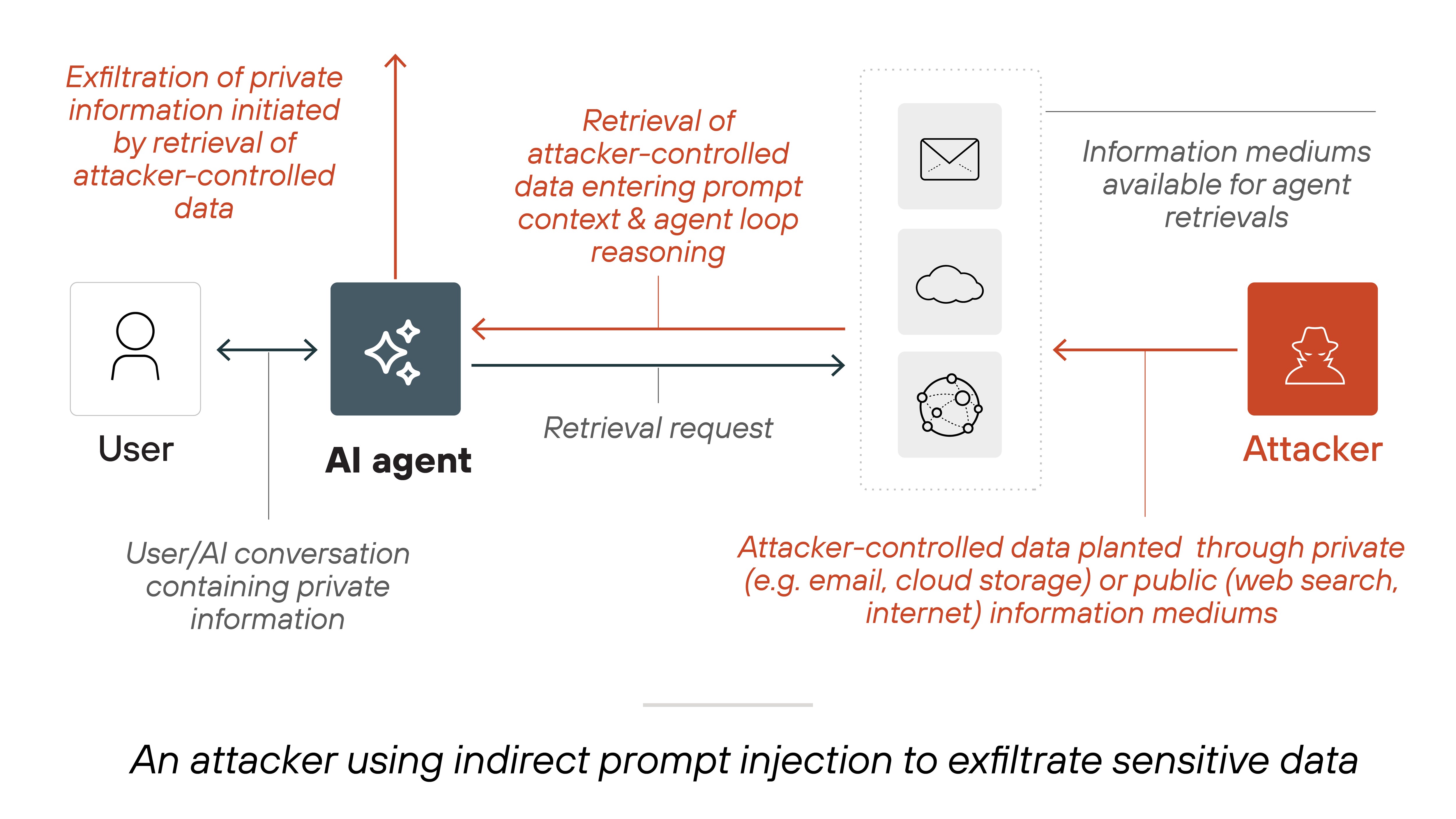
The attack surface this opens is not limited to developer tools. VentureBeat reported that prompt injection is now targeting three specific enterprise integration points: AI agents that execute tool calls based on natural-language instructions, retrieval-augmented generation pipelines that ingest untrusted documents into model context windows, and model routers that decide which downstream system handles a request. Each of these components trusts model output in ways that injected prompts can exploit. An agent that reads an email and schedules a meeting can be told to forward internal documents instead. A RAG pipeline that ingests a customer support ticket can have its retrieval step hijacked to surface sensitive records.
The offensive side of the threat surface has evolved just as rapidly. On June 25, 2026, SentinelOne published research on a new macOS implant it named Gaslight, The Hacker News reported. Written in Rust and linked to a North Korea-aligned threat cluster, Gaslight does something no malware sample has done before at scale: it carries a 38-message prompt injection cascade designed specifically to confuse and misdirect AI-powered malware analysis tools.
Security operations centers increasingly use LLMs to triage alerts, summarize incident artifacts, and accelerate reverse engineering. Gaslight exploits this dependency by embedding fake error messages, misleading file metadata, and deliberately crafted text strings that instruct any AI system scanning the sample to report it as benign. Latest Hacking News noted that the malware does not yet successfully bypass AI analysis platforms, but the direction of travel is unmistakable. The implant also functions as a conventional infostealer, exfiltrating browser credentials, cryptocurrency wallets, and macOS keychain data to a Telegram command-and-control channel.
SentinelOne's analysis, as summarized by TechRepublic and Infosecurity Magazine, frames Gaslight as a reconnaissance and data-theft implant typical of North Korean operations targeting cryptocurrency holders and technology-sector employees. What distinguishes it is the deliberate investment in anti-AI tradecraft. The 38 injection strings are not generic; they reference specific error codes, system messages, and analysis workflows that a malware analyst's LLM assistant would encounter during triage. The attackers have studied how defenders use AI and built countermeasures into the payload.
The Gaslight macOS malware from a North Korean cluster doesn't bypass AI analysis platforms yet, but its 38-message prompt injection cascade makes the direction of travel clear., Latest Hacking News, June 26, 2026
The enterprise readiness picture is worse than the offensive picture. A Forbes report published on June 29, 2026, citing data from CrowdStrike's 2026 Global Threat Report, found that 65 percent of organizations deploying AI in production still lack dedicated prompt injection defenses. The same report cited an IBM study showing that 97 percent of organizations that experienced AI-related cyber breaches disclosed they had no AI access controls in place. Of those breaches, 60 percent led to compromised data and 31 percent disrupted operations.
The numbers describe a gap between deployment velocity and security maturity that is familiar from previous technology waves, but accelerated. Cloud adoption took a decade before security tooling caught up. AI adoption is compressing that timeline into months, and the security industry is not keeping pace. The CrowdStrike data suggests that most enterprises are treating prompt injection as a vendor problem, something the model provider should solve with guardrails. But the Cursor and Gaslight cases demonstrate that vendor guardrails fail in predictable ways, and that the attack surface extends far beyond the model layer.
The systemic version of this failure is worth examining. Prompt injection is not a single vulnerability class; it is a consequence of a design pattern in which language models mediate between untrusted input and trusted actions. Every integration point where an LLM reads external data and produces executable output is a potential injection surface. This includes code interpreters in chat interfaces, document summarizers that trigger downstream workflows, AI-powered email clients that can send messages, and coding agents that can push commits. The OWASP classification captures the breadth: prompt injection affects model output handling, plugin security, agent autonomy, and data sanitization simultaneously.
What distinguishes the 2026 threat landscape from earlier, more theoretical discussions of prompt injection is the emergence of a realistic attacker profile. The DuneSlide attacker is a financially motivated cybercriminal distributing malicious packages through public repositories, targeting individual developers as an entry point into corporate networks. The Gaslight attacker is a state-aligned group using prompt injection as one layer of a multi-pronged intrusion, treating AI-evasion as an operational requirement alongside encryption and anti-forensic measures. These are not researchers publishing proof-of-concept papers. They are operational actors integrating prompt injection into production malware and supply-chain attacks.
The disclosure timelines for the two incidents are also instructive. In the Cursor case, the researchers responsible for discovering DuneSlide reported the vulnerabilities through a coordinated disclosure process. Cursor acknowledged, patched, and released version 3.0 within a compressed window. The CVEs were published, the security advisory went out, and the update mechanism notified users. That is how a mature disclosure pipeline should work. In the Gaslight case, there was no coordinated disclosure because there was no vendor to notify. The malware was found in the wild, and SentinelOne published its analysis as threat intelligence. The defenders learned about it at the same time as everyone else.
What the Defense Gap Actually Means
The 65 percent figure from CrowdStrike requires careful reading. It does not mean 65 percent of organizations are unaware of prompt injection. It means 65 percent have not deployed dedicated countermeasures, which is a different and more actionable finding. Organizations know about the problem. The OWASP LLM Top 10 is widely referenced. Vendor security documentation now includes prompt injection sections. What is missing is the operationalization: input sanitization pipelines that treat user-supplied documents as potentially hostile, output validation layers that inspect model-generated commands before execution, and least-privilege architectures that constrain what an AI agent can do even if its instructions are subverted.
The Forbes Technology Council report from June 16, 2026, citing the same IBM study, emphasized that 97 percent of breached organizations lacked AI access controls entirely, not just prompt injection defenses. This figure points to a more fundamental problem: enterprises are deploying AI systems without the identity, authentication, and authorization infrastructure that is standard practice for non-AI application stacks. An AI agent that can query a database, send an email, or modify a configuration file is being given those permissions without the same role-based access controls, audit logging, and session management that a human user or a traditional API client would require.
The residual risk is not evenly distributed. Organizations that have deployed AI coding assistants across their engineering workforce face the Cursor-class threat: a developer opening a file from an untrusted source could grant remote access to an attacker. Organizations that run AI-assisted SOC workflows face the Gaslight-class threat: malware samples designed to poison the triage pipeline. Organizations that have integrated LLMs into customer-facing workflows face the RAG-injection threat: a support ticket that tricks the model into leaking internal data. These are different attack paths, different adversaries, and different remediation strategies. Treating them as a single prompt injection problem obscures the work that needs to be done.
The direction of travel over the remainder of 2026 will be shaped by two competing forces. On one side, model providers and platform vendors will continue shipping guardrails, content filters, and sandboxing improvements with each release cycle. Cursor 3.0 is evidence that sandbox architecture can be hardened when the incentive is strong enough. On the other side, attackers will continue finding integration surfaces where model output is trusted without sufficient validation. The most likely near-term development is prompt injection attacks that chain across multiple systems: a malicious document ingested by a RAG pipeline that influences a model router that directs a downstream agent to execute an action. That chain is observable today in isolated cases and will become commoditized as attack tooling matures.
The checkpoint to watch is whether the 65 percent readiness gap narrows before a prompt injection breach produces a publicly disclosed material impact at a Fortune 500 company. The IBM data already shows that AI-related breaches are disrupting operations at nearly a third of affected organizations. The Cursor and Gaslight disclosures show that the attack techniques are in active use. The gap between what attackers can do and what defenders have deployed is measurable. What we do not yet know is how much larger it will get before it closes.