Venture’s LP Strike Ends, But Not for Emerging Managers
As venture fundraising fell 35% in 2025 and institutional money crowded into top-tier firms, emerging managers were forced to rewrite the fund-formation playbook.
 sapphireventures.com
In this article
When Restive Ventures closed its third fund last week at $45 million, the press release from GlobeNewswire hit the standard notes: early-stage fintech, AI-native financial services, a trillion-dollar market opportunity. What the release did not mention was that the firm's general partner, Cameron Peake, had spent much of the prior twelve months rebuilding her limited partner base from scratch. Traditional LPs, the endowments and pension funds that once formed the backbone of an emerging manager's cap table, had gone quiet. In their place came banks, financial institutions, and corporate balance sheets.
Restive is not an outlier. It is the new template. US venture capital fundraising fell 35% in 2025, marking the weakest stretch in at least six years, as institutional investors pulled back and concentrated commitments into a shrinking set of established firms. The numbers confirm what every GP raising a sub-$100 million fund already knows in their bones: LPs are not saying no. They are saying nothing, and silence is far more expensive. A general partner can negotiate a term. Silence means the meeting never happens, the follow-up email goes unreturned, and the fund misses its first close by six months. By the time that happens, the anchor LP who was waiting for the first close has usually moved on.
The structural reasons for the LP retreat are now well-documented. Carta's latest fund performance analysis, published in late April, showed that the venture industry remains profoundly top-heavy, with elite performers widening their lead over the rest of the field. The top-decile funds are capturing a disproportionate share of distributions, and LPs, who spent 2022 through 2024 staring at capital calls without corresponding realizations, have responded by becoming ruthlessly empirical. They are no longer buying the narrative that any given fund will find its way into the top quartile. They are demanding proof that the fund has already been there.
This has created a bifurcation in the fund-formation market that is sharper than at any point since the financial crisis. On one side, firms with brand recognition and a track record of returning capital are raising larger vehicles faster than ever. Founders Fund, which closed a $6 billion growth vehicle in early May, epitomizes the trend. The firm is concentrating its firepower into a small number of AI mega-bets, riding the thesis that the next generation of platform companies will require capital at a scale that only a handful of firms can write. Whether the strategy will generate top-quartile returns against a $6 billion base is a question LPs are apparently willing to defer, because the brand itself functions as a kind of collateral.
On the other side, emerging managers and mid-tier funds are fighting for every commitment. The Forbes Finance Council recently ran a practical framework for comparing venture fund performance to public indexes, using a16z data as the reference case. The framework's unspoken premise was the one that now haunts every GP roadshow: if the median venture fund cannot reliably beat the Nasdaq over a ten-year horizon, why should a pension fund pay two-and-twenty for the privilege of illiquidity? The question is not theoretical. It is the first slide in every LP's internal memo justifying a reduced allocation to the asset class.
The Restive solution, swapping out endowments for banks, is not merely a fundraising tactic. It represents a genuine evolution in the LP-GP relationship. Banks and financial institutions bring a different set of incentives to the table. They are less concerned with beating a public-market benchmark over a decade than with gaining visibility into the technologies that will disrupt their own revenue lines. A bank writing a $2 million check into a fintech-focused seed fund is buying an option on intelligence, not merely a financial return. That alignment is stickier, and in a market where traditional LPs are treating re-ups as optional, stickiness is the most valuable currency a GP can have.
The implications for fund formation strategy are already cascading through the industry. Josipa Majic Predin, writing in Forbes, argued that venture funds that market like startups win more deals. Her piece focused on the founder-facing side of the equation: specificity, transparency, and building in public as tools for winning competitive allocations. But the same logic applies to LP fundraising, and the emerging managers who have internalized this are running their fundraises like a Series A. They publish quarterly LP updates that read like investor letters from a public-company CEO. They share deal memos, post-investment analyses, and the occasional mea culpa on a bad pick. They treat transparency not as a compliance obligation but as a distribution channel.
This approach works because it addresses the LP's deepest anxiety about emerging managers: adverse selection. An LP evaluating a first-time fund has almost no data to work with beyond the GP's resume and a handful of reference calls. The manager who publishes a detailed investment thesis, walks through specific deals won and lost, and shows their work on portfolio construction is making a costly signal. It is costly because it exposes them to second-guessing from competitors and the press. But it is precisely that cost that makes the signal credible. The funds that cannot back up their claims with rigor will not survive the scrutiny.
The Carta data adds a layer of quantitative urgency to this qualitative shift. The analysis showed that the performance gap between top-quartile and median funds is not narrowing. It is widening, driven largely by the handful of outlier companies that generate the vast majority of venture returns. A fund that misses one of those outliers, or marks it too conservatively and loses its pro-rata in the next round, can see its IRR slip from top-quartile to median in a single decision. LPs know this, and they are now asking GPs a question that would have been considered impolite three years ago: "What is your edge in accessing the deals that actually matter?"
What the re-up math actually looks like
To understand why the LP strike has been so painful for the mid-market, it helps to look at the arithmetic of a typical institutional re-up. A university endowment with a 15% target allocation to venture capital might have commitments spread across thirty fund managers, ranging from brand-name firms to emerging managers seeded a decade ago. When the endowment's investment committee meets to approve the next vintage, it is working with a fixed pool of capital. If Sequoia and a16z are raising larger funds and the endowment wants to maintain its relationship with both, the math forces a reduction elsewhere. The first commitments to get cut are not the worst performers. They are the ones the committee has the weakest relationship with, regardless of the numbers.
This dynamic explains why fund size is now the single most predictive variable for fundraising success, ahead of track record, sector focus, or GP diversity. An LP who needs to deploy $50 million into venture in a given year can write one check to a $6 billion fund or twenty checks to $2.5 million emerging-manager vehicles. The administrative burden of the latter, plus the relationship management and quarterly reporting, makes the single-check option economically rational even before comparing expected returns. The structure of institutional capital allocation is biased toward concentration, and the bias intensifies when total allocations shrink.
Restive's pivot to bank LPs is one way around this structural bias. Another is the approach that the Forbes piece described as marketing-like-a-startup, which is less about marketing in the conventional sense than about manufacturing a relationship with LPs before they write a check. The managers who succeed at this are not sending cold emails with their pitch deck attached. They are building an audience over eighteen months through substack posts, podcast appearances, and curated LP dinners where the pitch is embedded in a conversation about market structure rather than delivered as a PowerPoint monologue. By the time the fund formally opens, the LP has already made the decision. The commitment is merely the paperwork.
Who gets squeezed when the mega-funds get bigger
The Founders Fund $6 billion raise is not just a data point. It is a signal about the future of late-stage venture pricing. When a small number of mega-funds control an increasing share of deployable capital, they set the price for the rounds that matter. A startup raising a Series D at a $4 billion valuation is not negotiating against the market. It is negotiating against three or four firms, all of whom know that the others are in the pipeline. The result is a seller's market for the best companies and a brutal dynamic for everyone else. Mid-tier funds that try to compete for those deals either get priced out or accept terms, including ratchets and participation caps, that erode their expected returns.
The knock-on effect reaches all the way down to the seed stage. A seed fund that backs a company at a $12 million post-money cap table needs that company to reach Series D before it sees a meaningful distribution. If the Series D is controlled by three mega-funds that have never heard of the seed investor, the seed investor's pro-rata rights are only as good as their relationship with the founders. Founders, in turn, are being advised by the late-stage lead to clean up the cap table. The phrase "pro-rata waiver" has become the quiet cudgel of post-2024 venture. It is the detail that fund-formation documents never mention, but that determines whether a seed fund's returns compound or evaporate.
The LPs who understand this are the ones who are still writing checks to emerging managers. They are asking better questions: not just "what did your last fund return" but "how many of your companies reached Series C with your pro-rata intact." They are looking at the fund's portfolio construction and asking whether the GP reserved enough capital for follow-ons, or whether they spread too thin across too many names. And they are increasingly asking for side letters that give them visibility into the fund's re-up strategy, a level of transparency that would have been unthinkable in the relationship-driven venture market of 2019.
The lawyers who draft these documents tell me that the side-letter requests have shifted from governance and fees to information rights and co-investment access. An LP who commits to a first-time fund wants to know, in writing, that they will see the best deals before the capital is fully deployed. They want a first look at the Series B rounds that emerge from the seed portfolio. In some cases, they are asking for a right to invest directly alongside the GP, effectively turning the fund relationship into a deal-flow subscription. This is not how LPs typically behaved a decade ago. It is the behavior of investors who have been burned by blind-pool commitments and are determined not to repeat the experience.
We saw a really significant change in the LP base. The traditional endowments and pension funds that backed Funds I and II simply weren't re-upping at the same pace. We had to build a new constituency from scratch.Cameron Peake, General Partner at Restive Ventures
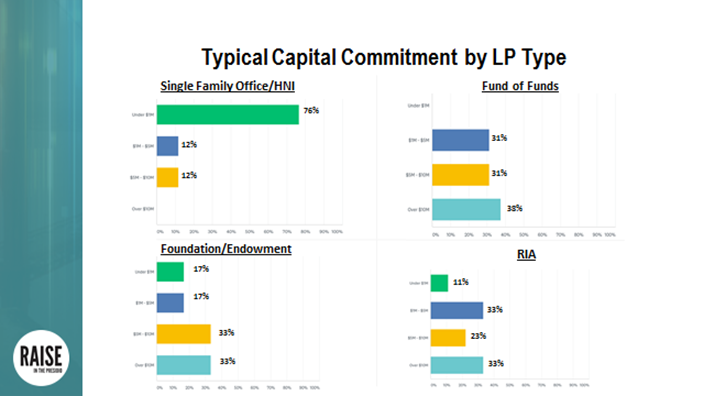
Peake's candor about the shift is notable because most GPs are reluctant to admit that their LP base has changed. The standard fund-close announcement treats every commitment as a vote of confidence in the strategy, when in reality many of those votes are being cast by a different electorate. The Restive experience suggests that the emerging-manager LP market is being rebuilt around a new set of institutions: banks, corporate venture arms, fund-of-funds that aggregate family-office capital, and the occasional sovereign wealth fund that is willing to write small exploratory checks. These LPs are more commercially oriented and less patient than the endowments they are replacing. They want distributions sooner, and they are less likely to re-up automatically.
This shift has implications for fund strategy that go beyond LP relations. A fund backed by banks and corporates has a different risk profile than one backed by endowments. The bank LP wants to see deals that are relevant to its own business, which pushes the GP toward fintech, regtech, and enterprise fintech in particular. The corporate LP wants strategic visibility, which can pull the fund into adjacent sectors that the GP might not have prioritized otherwise. The fund-of-funds LP wants a diversified return stream, which pushes for a larger portfolio with more names. Managing these competing incentives while maintaining a coherent investment thesis is the central challenge of the post-2025 fund-formation market.
What comes next depends on the IPO window. If the backlog of venture-backed companies finally begins to clear in the second half of 2026, distributions will flow back to LPs, and the re-up cycle will restart with more capital available. If the window stays shut, the concentration of LP dollars into mega-funds will accelerate, and the emerging-manager market will contract further. The smartest GPs I spoke to are not betting on the IPO window. They are structuring their funds as if this is the new normal, with smaller closes, longer fundraising timelines, and LP rosters that look more like a strategic advisory board than a traditional institutional investor list. The ones who get it right will survive. The ones who are still waiting for the endowments to call back will not.
Read next
