Agent-Native Runtimes Are Rewriting the Infrastructure Playbook
Cloudflare, Google, and Mistral are shipping stateful execution engines that treat agents as first-class workloads, not containers that happen to call an LLM, and the control plane is where the real architecture fight lives.
 siliconangle.com
When Cloudflare shipped its Agent Cloud in mid-April, the headline was the partnership with OpenAI and the GPT-5.4 integration. The architecture decision that will matter in two years was buried deeper: the company made isolate-based compute, not containers, the default runtime for enterprise AI agents. Announced on April 16, the Dynamic Workers feature runs each agent invocation inside a V8 isolate, a lightweight execution environment that cold-starts in under five milliseconds and shares no memory with its neighbors. The agent does not boot an operating system, does not pull a container image, and does not pay the scheduling tax that has been table stakes for serverless since Lambda launched in 2014. Forbes contributor Janakiram MSV reported that the move was designed to challenge containers as the default runtime for enterprise AI agents, and the technical bet is worth examining closely because it encodes an assumption that the rest of the industry is now racing to validate or reject: that agent workloads are different enough from request-response web traffic to merit their own runtime substrate.
The argument goes like this. A traditional serverless function runs for a few hundred milliseconds, reads from a database, writes a response, and exits. An agent, by contrast, might sit idle for forty seconds waiting on a tool call to a CRM, then wake up, inspect the result, decide to call a second tool, and loop. The execution model is not fire-and-forget. It is long-running, suspension-tolerant, and profoundly stateful. If the infrastructure underneath it cannot pause and resume cheaply, the operator pays for idle compute or the developer pays in complexity, wiring up external queues and checkpointing state by hand. Cloudflare's answer is to lean on the V8 isolate model it already uses for Workers, where a single process can host thousands of isolates that each carry a few megabytes of overhead and can be serialized to disk when the agent is waiting. It is a bet on density: if an agent spends 80 percent of its wall-clock time blocked, the only economic way to run millions of them is to make the blocked state nearly free.
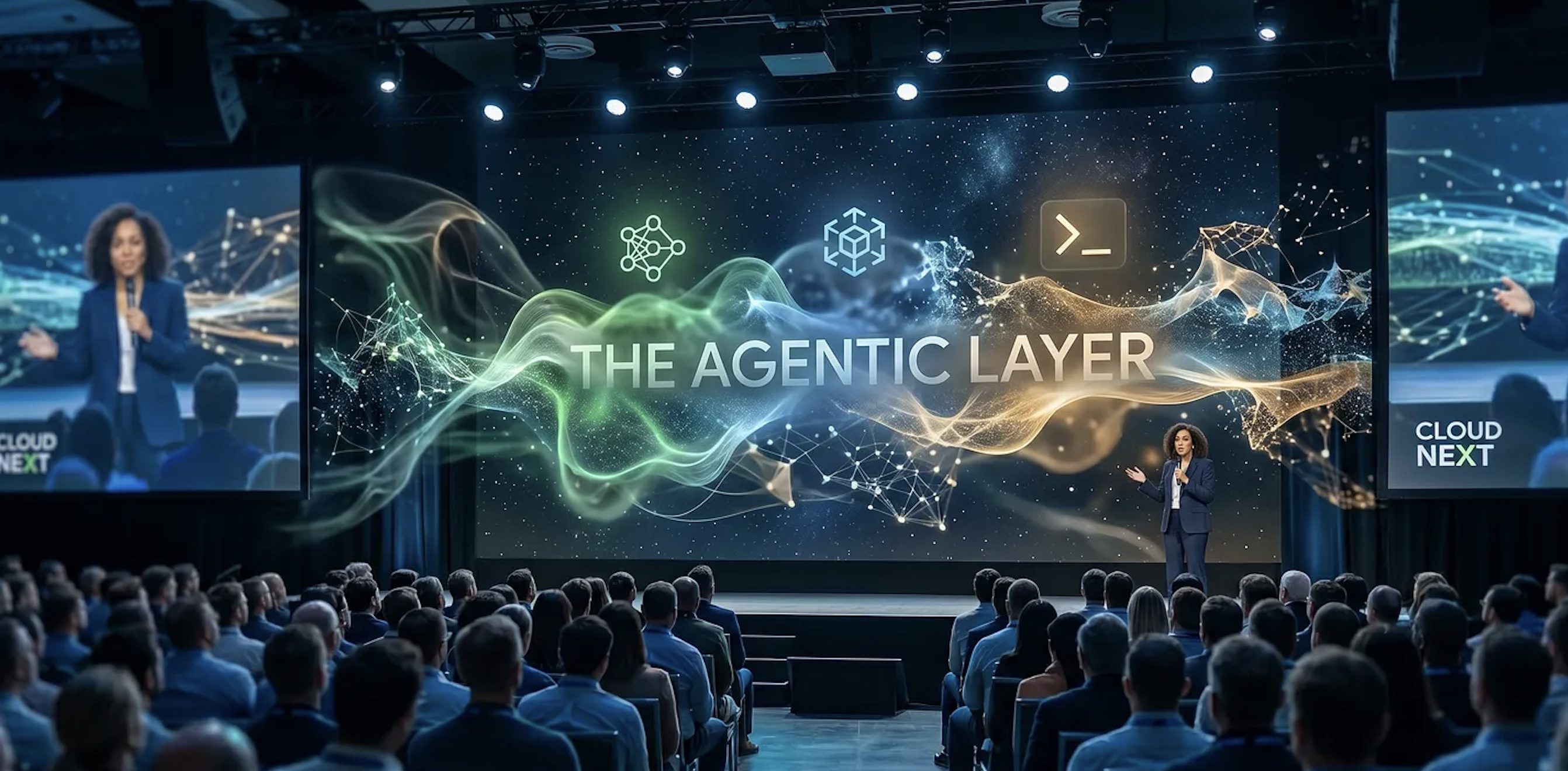
Not everyone agrees that the isolate is the right primitive. Three weeks after Cloudflare's announcement, Google used its Cloud Next 2026 conference to retire the Vertex AI brand and launch the Gemini Enterprise Agent Platform, a four-layer stack whose runtime layer looks nothing like Cloudflare's. Google's Agent Runtime is built on containers and Kubernetes, the same substrate that runs the rest of Google Cloud. The company added an Agent Development Kit, or ADK, an Agent Registry for cataloging and versioning agents across an organization, an Agent Gateway that acts as a single ingress point with authentication and rate limiting, and an Agent Identity system that gives each agent a service account with scoped IAM permissions. The message was clear: agents are not a special snowflake workload. They are just software, and software runs on the platform you already have.
This is not a small disagreement. It is the central infrastructure schism of 2026, and it replays a debate that the database community first had in the late 1980s about whether stored procedures should live inside the database process or in a separate application server. The Cloudflare camp says agents need a bespoke runtime optimized for suspension and high-density multiplexing. The Google camp says agents need integration with the existing enterprise control plane, identity, logging, network policy, compliance tooling, and you get that by running them on the same orchestration layer everything else uses. Both arguments are empirically true, and neither fully addresses the other. That is what makes the situation interesting.
Meanwhile, a third architecture entered the conversation from an unexpected direction. On April 28, Mistral AI launched Workflows in public preview, a production-grade orchestration layer built on Temporal, the open-source durable execution engine, and reported it was already processing millions of daily executions. Mistral's move is significant because it separates the concern of "what should happen next" from "where should this code run." Temporal's model, refined over years at Uber, Microsoft, and Stripe, treats each workflow as a sequence of deterministic steps that can be replayed from an event history. If the agent crashes after step four, Temporal replays steps one through four from the log instantaneously and resumes at step five. The state lives in the event history, not in the process memory, which means the runtime does not need to be suspendable at all. A container is fine. A Kubernetes pod is fine. Even a bare-metal server is fine, as long as it can append to a log.
Temporal's approach sidesteps the runtime question by pushing durability into the programming model. The developer writes what looks like synchronous code, await a tool call, branch on the result, call another tool, and the Temporal SDK instruments it so that every await point becomes a durable checkpoint in the event history. If the underlying machine catches fire, the workflow resumes on a different machine with no state loss and no custom checkpointing logic. This is not a new idea. Microsoft Research described it in a 2017 paper on the Orleans virtual actor framework, and AWS Step Functions has offered a managed version since 2016. What changed in 2026 is that LLM-powered agents made the economics of durable execution suddenly legible to a much wider audience. An agent that calls ten tools over the course of eight minutes and costs twenty cents in API fees is not a workload you want to lose because a node rolled. The cost of the LLM call makes the overhead of persistence rounding error.
The serverless ecosystem is absorbing these lessons in real time. In early May, Google Cloud Run added ephemeral storage and remote MCP server capabilities, pivoting the once-stateless platform toward the kind of stateful, long-running workloads that agents require. The Model Context Protocol, or MCP, is emerging as a standard way for agents to discover and call external tools, and giving the runtime native awareness of MCP servers means the agent does not need to manage tool discovery in application code. Vercel, for its part, faced scrutiny over delayed disclosure of a security incident, a reminder that as agent workloads move to the edge, the attack surface expands faster than the tooling to defend it.
The Control Plane Is the Hard Part
Amid the announcements at Google Cloud Next, SiliconANGLE's John Furrier argued that the real story was not the AI models but the control plane. "Everyone heading into Google Cloud Next this week is bracing for another wave of artificial intelligence announcements. More Gemini. More agents. More benchmarks. More onstage demos that look great in controlled environments," Furrier wrote. The more consequential question was whether Google would ship the governance, observability, and policy machinery needed to put agents into production. Google's answer was the four-layer Gemini Enterprise Agent Platform, whose Agent Registry, Agent Gateway, and Agent Identity components are not particularly glamorous but address precisely the problems that keep platform engineers awake: "Which version of the procurement agent is running in production right now, and what permissions does it actually have?"
This is the operational reality that separates demos from deployments. A single agent running in a Colab notebook with an API key pasted into an environment variable is easy. A thousand agents, each with different tool access, different LLM backends, different approval chains, and different SLOs, running across three clouds and an on-premises ERP system, is a control-plane problem of genuine complexity. Google's bet is that its existing IAM, logging, and networking infrastructure gives it an advantage here that Cloudflare cannot easily replicate, even if Cloudflare's runtime is technically more efficient for the workload. The counterargument, which Cloudflare would make, is that the complexity of managing agents on Kubernetes is itself a cost that the industry has been trying to escape for a decade.
At the Cloud Native Computing Foundation's KubeCon EU event in March, analyst Jason Bloomberg introduced the concept of "context density" as a way to measure how AI-native a platform actually is. The idea, as Bloomberg wrote for SiliconANGLE, is that cloud-native platforms optimize for statelessness and horizontal scaling, while AI-native platforms must optimize for the richness and persistence of context, the accumulated state of a conversation, a workflow, or a multi-step reasoning chain that an agent carries across tool calls and time. Context density is not a metric anyone currently instruments. But it captures something real about why agent workloads break assumptions baked into the last decade of infrastructure design.
What Breaks When Agents Hit Production Scale
The comfortable truth about agent infrastructure in mid-2026 is that very few organizations are running agents at a scale where the runtime substrate matters. Most production agent deployments are tens or hundreds of concurrent executions, not millions. At that scale, you can run agents on anything, a Flask app on an EC2 instance, a Cloud Run service, a Lambda function with a five-minute timeout, and the infrastructure choice is not the binding constraint. The uncomfortable question is what happens when an enterprise decides to run an agent on every customer support ticket, every procurement request, and every code review, simultaneously. That is when the difference between a runtime that can suspend and a runtime that cannot becomes the difference between a manageable cloud bill and a financial controls audit.
The data layer is where the pressure will concentrate first. Agents are voracious consumers of database connections, and the connection-pooling assumptions that work for HTTP services break down when an agent holds a transaction open across a sixty-second tool call. Postgres, even with pgbouncer, was not designed for connections that span an LLM inference round-trip. A new category of agent-native data stores is beginning to emerge, and the established players are not standing still. DigitalOcean used its Deploy 2026 conference to announce an AI-Native Cloud platform with a five-layer architecture that includes an inference engine, a model router, and managed agents, a recognition that the mid-market wants the same agent infrastructure as the hyperscalers, packaged for teams that do not employ a dedicated database reliability engineer.
The vector database wars of 2023 and 2024 offer a cautionary parallel. When vector search became the must-have feature for RAG pipelines, a wave of purpose-built vector databases raised hundreds of millions in venture funding, each arguing that general-purpose databases could not handle the ANN indexing workload. Two years later, every major database has a vector extension, pgvector for Postgres, a vector index for MySQL, an ANN index in Elasticsearch, and most of the standalone vector database companies are pivoting to broader platforms or consolidating. The agent runtime market of 2026 looks structurally similar. A dozen startups are building agent-specific execution engines, each with a different opinion about whether durability belongs in the runtime, the application framework, or the database. The hyperscalers are shipping their own versions. The outcome is not predetermined, but the pattern suggests that the runtime layer will converge while the control plane fragments along cloud boundaries.
One number from the Google Cloud Next keynote puts the scale of the bet in perspective. Sundar Pichai disclosed that Google Cloud had reached a $240 billion revenue backlog, more than double the prior year, and planned $175 billion to $185 billion in capital expenditures. That level of infrastructure investment is not for running chatbots. It is for running agents at a scale that does not yet exist, on the assumption that it will. Whether the right substrate for those agents is a V8 isolate, a Kubernetes pod, or a durable execution log is the infrastructure question of the next three years, and the answer will be written in incident postmortems, not whitepapers.
The summer of 2026 is the calm before that scale arrives. Most enterprises are still in the pilot phase, running single-digit agent workflows and learning what happens when an agent hallucinates a purchase order. The runtime debate feels academic today. But the teams that are laying down durable execution primitives now, choosing between isolates and containers, between external workflow engines and database-native state, are making architectural commitments that will either pay compound interest or demand a costly rewrite when the agents multiply. What to watch for: the first public postmortem from a company whose agent fleet ran away from them, not because the model was bad, but because the runtime had no mechanism to pause, checkpoint, and resume. That document, when it arrives, will settle more architecture arguments than any conference keynote.
Read next