Live Facial Recognition Is Now Permanent Infrastructure, Not a Pilot
Biometric surveillance architecture is being rapidly embedded from Croydon high streets to World Cup stadiums, while legal accountability lags far behind.
 BBC News
In this article
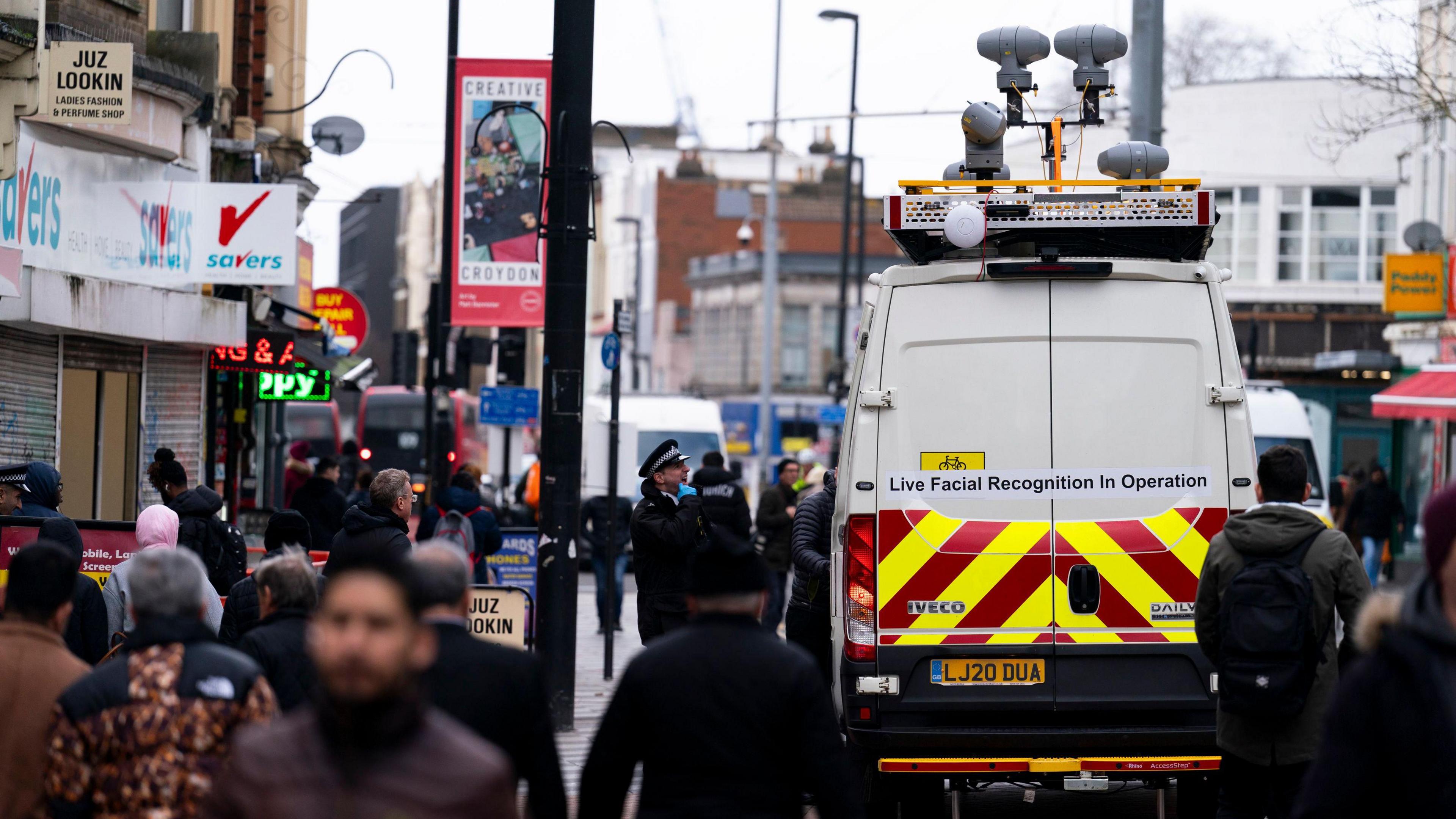
In a six-month period ending in early 2026, static live facial recognition cameras installed by the Metropolitan Police in Croydon, south London, generated 173 arrests. The charges included kidnap, rape, and serious sexual assault. One arrest involved a woman who had been wanted for 22 years. The Met reported a 10.5 percent drop in crime across the pilot zone, and by May the commissioner had declared the trial a success, pushing to expand the programme to other boroughs. The numbers are compelling, and they are meant to be. What they do not capture is the question now before the High Court: whether any of this was lawful in the first place.
In January 2026, two campaigners took the Metropolitan Police to the High Court, arguing that the force's use of live facial recognition (LFR) amounts to a disproportionate interference with the right to privacy under the European Convention on Human Rights, BBC News reported. The case, which remains under judicial review, challenges not a single deployment but the entire legal framework under which police forces across England and Wales have been rolling out LFR since the Met first operationalised it in 2020. The court has been asked to determine whether the common law policing powers that the Met cites as legal basis can really bear the weight of a technology that scans the faces of every person who walks past a camera.
The judiciary is not the only institution raising alarms. In May 2026, the Biometrics and Surveillance Camera Commissioner for England and Wales, Professor William Webster, warned publicly that police forces could face a wave of litigation. The commissioner told The Standard that LFR systems are not "fool proof" and that forces deploying them without a robust legal framework risk being sued by members of the public who are misidentified. The warning landed days before the Met announced it would use LFR operationally at a protest for the first time, scanning the faces of demonstrators at a rally in Camden under the gaze of 4,000 officers.
Misidentified members of the public could sue the police for breaching their fundamental rights., Professor William Webster, Biometrics and Surveillance Camera Commissioner for England and Wales
On an ordinary weekday in late May, Reuters correspondent Paul Sandle documented what this looks like at street level. Tourists, shoppers, and office workers on a busy London thoroughfare found themselves part of a digital identity check as a Met LFR van, its roof bristling with 4K and 8K cameras, matched their faces in real time against a database of wanted individuals. Officers at the scene told Reuters that images of anyone who did not generate a match were deleted. The claim is central to the Met's public assurance strategy, but it has proven difficult to verify independently. No independent audit of the deletion mechanism has been made public.
The Croydon pilot and the High Court challenge represent two sides of a fault line running through every jurisdiction where LFR is being deployed. On one side sits a police force armed with arrest statistics and a political mandate to use technology to fight crime. On the other sit privacy advocates, civil liberties organisations, and a growing number of regulators who argue that biometric surveillance is being normalised before its legal architecture is built. The gap between deployment and regulation is no longer a future risk. It is the present condition.
Nowhere is that gap more visible than in the security operation surrounding the 2026 FIFA World Cup. The tournament kicked off in Mexico City on 11 June, and MSN reported that stadium entry points and concourses are equipped with advanced facial recognition software and AI-powered monitoring systems, scanning faces in real time against security databases. Separately, Boston Dynamics Spot robot dogs are patrolling venues, though Reuters confirmed that these units do not carry facial recognition capability. The distinction matters: a robot dog is a mechanical patrol unit; a facial recognition camera at every gate is a biometric dragnet. Both are present. Only one captures your faceprint.
The scope of the World Cup surveillance apparatus extends far beyond facial recognition. The Next Web catalogued the full stack: thousands of AI-powered cameras across 16 stadiums in three countries, counter-drone nets, hunter drones capable of intercepting unauthorised aircraft, and 16 digital twins of every venue running operational simulations in real time. The system is technically impressive and, in its contours, genuinely novel. What is absent from the public documentation of any of these deployments is a clear, jurisdiction-by-jurisdiction explanation of what happens to the biometric data after it is collected, who holds it, and under what legal authority it may be shared.
This is the data-flow question that Saskia's reporting consistently returns to. In a live facial recognition deployment, the data pathway runs from the camera sensor to a matching algorithm, to a watchlist, to a human operator, and then to a retention or deletion mechanism. Each step is a point where a system can fail, where a misidentification can cascade, and where a legal obligation attaches. But the vendors who supply the matching engines, the cloud providers who host the watchlists, and the police forces who operate the cameras rarely disclose the full chain. The public is asked to trust the deletion promise without access to the logs that would verify it.
The commercial sector is moving at equal speed and with even less transparency. In late April 2026, Disneyland rolled out facial recognition at nearly every park entrance in Anaheim, California, the Los Angeles Times reported. Park visitors were told they could opt out, but the opt-out process was not prominently disclosed, and the default flow funnelled guests toward the biometric lane. Within weeks, a class-action lawsuit seeking $5 million was filed in federal court, NBC News reported, alleging that Disney violated privacy, competition, and consumer protection laws by collecting faceprints from adults and children without adequate notice or consent.
The Disney case illuminates a problem that extends far beyond a single theme park. When facial recognition is presented as a convenience feature, a faster lane, a frictionless entry, the framing obscures the transaction. A faceprint is not a ticket. It is a biometric identifier that, once captured and stored, cannot be reset like a password or cancelled like a credit card. The opt-out mechanisms that companies point to as evidence of consumer choice rarely survive scrutiny. A guest entering a park with children, bags, and a queue behind them is not exercising meaningful consent. They are navigating a designed environment.
Some municipalities are beginning to push back in the only way available to them: by banning the practice outright. In May 2026, the Syracuse Common Council in New York passed a local ordinance prohibiting businesses from collecting biometric data through facial recognition and similar surveillance technologies, Government Technology reported. The law was modelled on stalled state-level legislation and represented an acknowledgment that federal privacy law in the United States provides no comprehensive framework for regulating biometric surveillance. The result is a patchwork in which your faceprint is protected in Syracuse but not in Syracuse's suburbs, regulated on a Croydon high street only to the extent that a court in London is willing to intervene, and scanned at a World Cup gate under a legal regime that may not be clearly stated in any single public document.
Whose body, whose business
The question that connects the High Court in London, the World Cup gates in Mexico City, the Disneyland entrance in Anaheim, and the council chamber in Syracuse is the same one: whose body is producing the data, and whose business is buying it? In the law enforcement context, the biometric data is extracted from citizens and visitors under a claimed public-safety interest, with the watchlist provided by the state. In the commercial context, it is extracted from consumers under a claimed convenience interest, with the data flowing to private operators whose retention policies are often buried in terms of service that research shows almost no one reads. In both cases, the architecture is built before the regulation arrives, and the burden of challenging it falls on individuals and underfunded NGOs.
The European Union's AI Act, which began its phased implementation in 2025, classifies real-time biometric surveillance in publicly accessible spaces as high-risk and imposes significant restrictions on its use by law enforcement. But the Act contains national security exemptions that member states can invoke, and the United Kingdom, no longer an EU member, is not bound by it. The UK government has signalled that it views LFR as a lawful policing tool, and the Met's expansion from Croydon to Camden to, inevitably, other London boroughs suggests a policy trajectory that is unlikely to be reversed by judicial review alone. Meanwhile, the Council of Europe is preparing a new convention on artificial intelligence and human rights, but treaty processes move slowly. The technology does not.
Academic researchers have begun filling the accountability gap with data-broker audits and algorithmic testing. A 2025 study by the European Digital Rights network (EDRi) found that several commercial facial recognition systems used by European police forces exhibited significant accuracy disparities across skin tone and gender, with false positive rates for Black women that were orders of magnitude higher than for white men. When a system that misidentifies a specific demographic at disproportionate rates is deployed in a high-footfall area, the harm is not hypothetical. It is distributed. And because the watchlist matching happens in milliseconds, the person who is wrongly flagged may never know why they were stopped.
The Information Commissioner's Office in the UK has published guidance on LFR and conducted audits of several police forces, but its enforcement powers have been used sparingly. The commissioner himself has noted that the legal basis for LFR remains contested territory, and the High Court case is expected to produce a ruling that will either force a legislative response or, if the police prevail, effectively endorse the current framework by judicial precedent. Either outcome will ripple beyond the UK. Other common law jurisdictions, including Australia and Canada, are watching the London case closely, aware that their own police forces are procuring the same technology from the same vendors.
In Croydon, residents who spoke to City London News in January described a kind of ambient surveillance fatigue. They knew the cameras were there. Some welcomed them. Others avoided the high street. One campaigner, Shaun Thompson, who is among those challenging the Met in court, described the experience of living under permanent biometric surveillance as a form of civic degradation: the feeling that the state has decided you are a potential suspect and built the infrastructure to treat you as one. The reporting captured something that arrest statistics cannot articulate. The cost of normalised surveillance is measured not only in privacy violations but in the unquantifiable erosion of public trust.
The next six months will determine whether any of this gets a legislative backstop. The UK government has committed to introducing a new data protection and digital information bill, though the draft text has not yet been published. In the United States, the American Privacy Rights Act remains stalled in committee, and the White House has not indicated whether it will issue an executive order on biometric surveillance before the end of the year. In the absence of federal action, cities like Syracuse will continue to write their own rules, creating a fractured regulatory landscape that is difficult for citizens to navigate and easy for vendors to exploit. What readers can verify themselves is straightforward: the Met publishes LFR deployment locations on its website; FIFA's security contractor tender documents are partially available through the Mexican government's public procurement portal; and the High Court judgment, when it lands, will be published on the judiciary's website. The cameras are not hidden. The rules that should govern them simply do not yet exist.