Live Facial Recognition Scanned 470,000 Faces, High Court Approves
A six-month Met Police live facial recognition pilot in Croydon produced 173 arrests and a legal victory, yet the data flow that enabled it poses questions the High Court ruling left unanswered.
 Alamy
Alamy
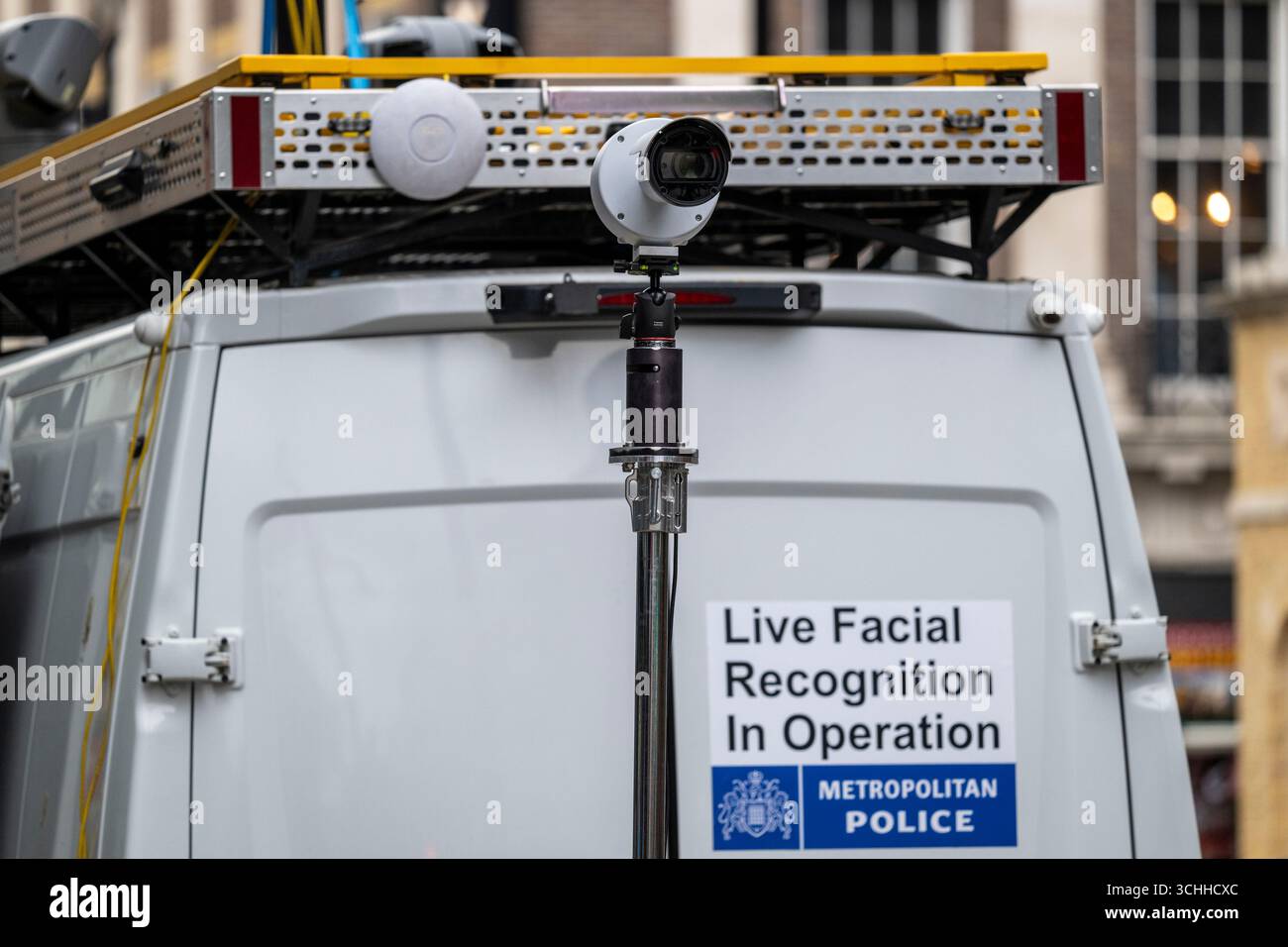
Between October 2025 and April 2026, cameras mounted on Metropolitan Police vans on Croydon High Street scanned the faces of 470,000 people. The six-month pilot of permanent static live facial recognition cameras compared each face against a predetermined watchlist of wanted individuals. When no match was found, the images were deleted. When one was found, an officer reviewed it and decided whether to intervene. The numbers, disclosed as the pilot concluded, were framed by the Met as a success: 173 arrests, a 10.5 percent drop in recorded crime in the deployment zone, and a fugitive caught after 22 years.
But the Croydon pilot landed in a year when the legal architecture around live facial recognition in Britain was being rewritten, not by parliament but by the High Court and by operational decisions that expand the technology's reach faster than the law can map its edges. On 21 April 2026, the High Court in London dismissed a judicial review brought by youth worker Shaun Thompson and Silkie Carlo, director of the campaign group Big Brother Watch, Reuters reported. The claimants argued that the Met's live facial recognition policy was unlawful, that it could be deployed arbitrarily or in a discriminatory way, and that it breached human rights law. The court disagreed, ruling that sufficient constraints were in place, Computer Weekly noted in its coverage of the ruling.
Thompson had been falsely identified by the system, Courthouse News Service reported. His face, matched incorrectly against a watchlist, turned him into a suspect for a crime he had no connection to. The case raised a question that every city deploying live facial recognition must eventually answer: is a system of mass biometric suspicion lawful simply because it sometimes works?
Among those arrested during the Croydon pilot was a woman who had evaded capture for 22 years, AOL reported on 12 May. She was wanted for an assault committed in 2004. Her arrest became the headline the Met wanted from the trial: proof that LFR catches people traditional policing could not. What went less remarked upon was the architecture required to deliver that result. The 470,000 people scanned to produce 173 arrests represent a hit rate of roughly 0.037 percent. For every matched face, approximately 2,700 people were subjected to a biometric identity check without any suspicion that they had done anything wrong.
The data flow is straightforward but rarely explained end to end. Cameras on police vans, or on static poles, capture video in real time. Each face is extracted and converted into a biometric template, a mathematical representation of facial geometry. That template is compared against a watchlist database the Met describes as predetermined and tightly controlled. If a match occurs, an officer reviews it. If no match occurs, the template and source image are deleted. The deletion pledge is the key constraint the High Court relied upon. But the watchlist itself, who is on it, on what evidentiary basis, and for how long, remains an operational decision made by the police with limited external oversight.
Less than a month after the High Court ruling, the Met deployed LFR at an event that tested the technology's boundaries differently. On 16 May, LADbible reported, live facial recognition cameras were used as an estimated 80,000 people descended on London for rival protests: Tommy Robinson's Unite the Kingdom march and a pro-Palestine Nakba Day rally. The Met confirmed the deployment was part of a £4.5 billion policing operation. It was, Reuters reported on 22 May, a test of the balance between security and liberty, played out on the capital's streets in real time.
The protests raised a question the Croydon pilot did not. In Croydon, the watchlist was populated with names of wanted individuals, people for whom arrest warrants already existed. At a political protest, the calculus shifts. The watchlist could theoretically include individuals flagged for public order offences or intelligence-based designations. The Met has said its criteria are based on serious crime and wanted persons, but the criteria are not set in statute. They are police policy, revisable without parliamentary scrutiny.
The technology is spreading beyond policing. Facewatch, a private company that provides facial recognition to retailers across the UK, appointed barrister Dean Armstrong as its Data Protection Officer in May 2026, Biometric Update reported. The same month, Facewatch received Secured by Design accreditation, a police-backed security standard. The company's model places watchlists in the hands of shop owners: a person suspected of shoplifting can be added to a database that dozens of stores use to flag them upon entry. The data flow resembles the Met's, but the oversight is thinner. A retailer, not a police force, controls the watchlist.
In the United States, the Department of Homeland Security is building a $7.5 million programme to equip Immigration and Customs Enforcement agents with smart glasses that integrate facial recognition directly into their line of sight, according to a report published on 12 May. The shift from handheld devices to heads-up displays makes the surveillance less visible to the person being scanned. An ICE agent wearing smart glasses can run a face against a database without appearing to look at a screen. The subject may never know the check occurred.
These systems share a structural feature that civil liberties organisations have spent years trying to make visible: consent is not possible. A person walking down Croydon High Street, through a protest in Westminster, or into a shop in Birmingham cannot opt out of having their face scanned. They are not asked. Silkie Carlo of Big Brother Watch, who co-brought the failed High Court challenge, argued that the technology could be deployed arbitrarily or in a discriminatory way, the Evening Standard reported. The court acknowledged the intrusiveness of LFR but found that the safeguards, watchlist controls, deletion of non-matched data, and human review of matches were sufficient to make the interference with privacy proportionate.
The ruling creates a legal pathway for every police force in England and Wales to adopt the same technology. The Met has been the most aggressive adopter, but forces in South Wales, the West Midlands, and elsewhere have run their own trials. The College of Policing is developing national guidance, but that guidance will not be binding legislation. The gap between police policy and statutory law is the space where the next decade's privacy battles will be fought.
The international picture is equally unsettled. The European Union's AI Act classifies real-time biometric surveillance in publicly accessible spaces as high-risk and imposes strict conditions on its use by law enforcement. The UK, outside the EU, is not bound by it. India, meanwhile, operates a face biometrics market that is unique in scale and architecture, Biometric Update reported on 25 May. Built on the foundation of Aadhaar, the national identity system covering more than 1.3 billion people, India's market sits at the intersection of digital public infrastructure and a diverse set of real-world deployments that conventional benchmarks fail to capture.
What connects the Croydon pilot, the Westminster protests, the Indian railway platforms, and the DHS smart glasses programme is not the technology alone. It is the architecture of unasked consent, built into public space. Each deployment adds a layer of biometric infrastructure that future governments can repurpose. Today's watchlist of wanted persons can become tomorrow's watchlist of peaceful protesters, or defaulting debtors, or people who attended a particular political meeting. The deletion pledges that courts rely upon are not inscribed in hardware. They are policy settings, changeable with a ministerial signature or a software update.
Researchers running data-broker audits have begun mapping the commercial pipelines that sit alongside state deployment. Clearview AI, which scraped billions of faces from the open web, has faced enforcement actions in multiple countries, but its core technology is licensed to police forces globally. The data broker ecosystem means a face scanned by a police camera in London might be matched against a database populated from social media profiles scraped years earlier, from jurisdictions with different privacy standards. The end-to-end data flow crosses borders, vendors, and legal regimes. Regulators in each country see only the segment inside their jurisdiction.
What the public can verify is limited, which is itself part of the problem. The Met Police publishes some statistics on LFR deployments, including arrest numbers and the number of faces scanned. It does not publish watchlist composition, the demographic breakdown of people matched, or the false positive rate disaggregated by race or gender. FOIA requests filed by civil liberties groups have produced partial answers, and those answers have sometimes raised more questions. A recent academic analysis published in The Conversation noted that facial recognition data, unlike a password or a credit card number, cannot be changed if it is stolen. A face is a lifelong identifier. Once compromised, there is no reset button.
The summer of 2026 is the inflection point. The Croydon pilot has concluded and the Met is evaluating whether to make static LFR cameras permanent across London. The High Court has given the green light. Other police forces are watching. The vendors, companies like Facewatch and the larger biometrics firms that supply the algorithms, are scaling. The question is not whether the technology works on its own terms; it does, in the sense that 173 arrests is not nothing. The question is whether a democratic society that scans half a million faces to catch one fugitive every few weeks has made a choice it fully understands. That choice is being made now, street by street, camera by camera, deployment by deployment. It will not be easy to reverse.