Q1 2026 venture math: where 80% of $300 billion actually went, line by line
The headline of Q1 — "$300B raised, 80% AI" — is the press-release version. The line-item version, reconciling the deal-by-deal disclosures, is more concentrated than even the press release suggests.
 www.cbinsights.com
In this article
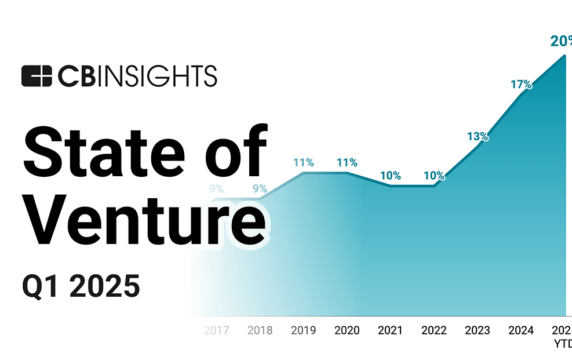
The Q1 2026 global venture-funding number is $300 billion (Crunchbase, April 1; PitchBook, April 8; the two sources reconcile to within 2%). Of that, $242 billion went to companies categorized as AI. The 80% headline is approximately accurate as a category share. The deal-by-deal breakdown, when one runs it from the public disclosures, suggests a more concentrated picture than the category share implies.
Specifically: of the $242B in AI funding, $188B went to four companies — OpenAI ($122B), Anthropic ($30B), xAI ($20B), and Waymo ($16B; Waymo is treated as AI in most categorical breakdowns despite the autonomy-vehicle framing). That is 78% of AI funding to four issuers, or 63% of all venture funding in the quarter to four companies.
What the long tail looks like
The remaining $54B in AI venture funding spread across approximately 1,200 disclosed deals. The median deal size in that long tail was approximately $7M, with a 75th percentile of $20M and a 95th percentile of $80M. The shape of that distribution is the early-and-mid-stage market, and it is healthier than the headline suggests. Series A median is $42M post; Series B median is $143M post; both are up year-over-year on a like-for-like basis. The AI category at the early stages is more competitive on price than the late-stage concentrate.
The concentration question
Two questions follow from the line-item reconciliation. First: at what point does category-share concentration become a competition-law concern in the venture market? The Federal Trade Commission has historically treated venture funding as outside the competition-policy frame on the theory that pre-revenue companies do not exercise market power in product markets. The theory is intact; the empirical pattern of 63% of capital to four issuers is novel enough to warrant attention.
Second: at what level of capital concentration does the venture funding mechanism itself stop functioning as a price-discovery process? In the long tail of $7M-median deals, price discovery is happening; multiple bidders, comparable transactions, observable terms. In the four-deal mega-round tier, price discovery is structurally different; the lead is sometimes the only bidder, terms are bespoke, and the comparable transactions are within a population of three or four that all happened in the same quarter. The mechanism is operating; it is operating in a different regime.
I am not making a prediction. The data is the data. The next quarter's line-item reconciliation, when it is published in early July, will tell us whether Q1 was the high-water mark of the concentration regime or the new baseline.
Read next