The WARN Act's 60-Day Notice Cycle Is Broken, and Workers Are Paying
Companies like Oracle and Southwest Airlines now use the WARN Act's 60-day notice requirement to structure severance packages and delay mass layoff warnings, shifting costs to workers.
 www.clevelandfed.org
In this article
On March 31, 2026, Oracle sent termination notices by email to an estimated 20,000 to 30,000 employees, the largest single layoff event in the company's history, Forbes reported. The same quarter, Oracle posted $553 million in net income. The severance offer came with a condition that caught the attention of employment lawyers and labor economists alike: sign a release of claims first, and only then receive the payout. No negotiation. No counteroffer. The company had structured the separations so that many workers did not qualify for the 60-day advance notice required under the federal Worker Adjustment and Retraining Notification Act, according to TechCrunch, because Oracle classified them under exemptions built into the 1988 law.
The WARN Act requires employers with 100 or more full-time workers to provide 60 calendar days' notice before a plant closing or a mass layoff affecting 50 or more employees at a single site. The statute, passed in an era when a layoff meant a factory gate closing and not a Slack channel going dark, was designed to give workers and their communities time to prepare. But the modern layoff rarely fits the statute's definitions cleanly. Employers structure reductions in waves timed to fall below the 50-employee threshold per site. They classify workers as remote, attached to headquarters rather than a physical location. They offer severance in lieu of notice, a practice the law explicitly permits, and present it as a benefit.
The Oracle severance structure, as TechCrunch detailed, asked departing employees to waive legal claims in exchange for a payout that many described as minimal relative to tenure. Some employees lost unvested restricted stock units worth close to $1 million, People Matters reported. A group of former workers attempted to organize and negotiate collectively for better terms. Oracle declined. The exchange captured the asymmetry that defines the modern WARN-notice cycle: the employer controls the clock, the classification, and the payout formula. The employee receives an email.
The WARN-notice data from early 2026 tells a story that is at once about contraction and about something stranger. In the Dallas-Fort Worth region, the Dallas Morning News reported, employers issued fewer layoff notices in the first quarter of 2026 than in any quarter since mid-2024. Yet job gains remained elusive. The newspaper, citing data from the Texas Workforce Commission, described a "low-hire, low-fire" economy in which companies are not cutting aggressively but are also not adding headcount with any conviction. WARN filings are public documents that state labor departments receive and publish, and they form an incomplete ledger. They capture only the layoffs large enough or visible enough to trigger the reporting obligation.
At Chicago's O'Hare International Airport, the Palm Beach Post reported, Southwest Airlines filed a WARN notice in April 2026 indicating that more than 100 employees would lose their jobs when the carrier discontinues service at O'Hare this summer. The announcement was straightforward: a business decision to consolidate operations at Midway Airport meant a hundred-plus workers in Chicago would need to find new jobs or transfer. It is the kind of event the WARN Act was written for. A single-site closure. A clear employer obligation. Sixty days' notice. The WARN filing itself is a public artifact of a private calculation: the airline determined that exiting O'Hare was worth the cost of the notice and the displacement.
At the Letterkenny Army Depot in central Pennsylvania, a different logic was at work. Penn Live reported that Bowhead Logistics Management filed a WARN notice in April 2026 after a change in the company holding a labor support contract at the depot. The workers were not being laid off by their employer in the traditional sense; the contract changed hands, and the incoming contractor's hiring decisions triggered the notification requirement. This is the WARN Act's quiet, unglamorous purpose: making visible the human consequence of procurement decisions. But the notice itself does not guarantee a job, only a warning. The workers at Letterkenny have 60 days. After that, the new contractor decides who stays.
Then there is the case of Oakland City University, which the Evansville Courier & Press reported issued a potential layoff notice to its employees and the state of Indiana, then denied it planned to conduct layoffs. The university, facing financial pressure, was attempting to sell a carbon-capture patent to shore up its balance sheet. The WARN notice, in this instance, functioned less as a warning than as a hedge: file the notice to limit legal exposure, hope the patent sale materializes, retract if it does. For employees, the signal was ambiguous in the worst way. They were notified they might be laid off, then told they would not be, contingent on a patent sale no one could verify. The WARN Act became a tool of institutional uncertainty rather than worker protection.
Severance in the American employment system occupies an odd legal position. There is no federal requirement to offer it. The WARN Act obligates notice or pay in lieu of notice, but beyond that, companies are free to set the terms. The result is a patchwork. Business Insider reported that Disney's April 2026 layoffs, the first under CEO Josh D'Amaro, offered severance based on rank and, for some employees, tenure. The structure was tiered: executives received more generous packages than individual contributors. This is standard practice. It also means that the employees least able to absorb a period without income receive the smallest cushions. The severance formula is presented as a benefit. It is more accurately described as a pricing decision.
What the employer purchases with severance is release. The standard agreement requires the departing worker to waive the right to sue for discrimination, wrongful termination, or WARN Act violations. A signature on the separation agreement closes off legal exposure. For the company, this is a bargain. For the worker, it is a transaction entered into under duress, with no paycheck on the other side of the negotiation. The Oracle case made this explicit: sign or receive nothing. The WARN Act's 60-day notice provision was meant to give workers leverage, time to organize, time to find counsel. In practice, the notice period is often bought out with a severance check, and the leverage evaporates.
The Classification Loophole
The most consequential word in the WARN Act may be "single site." The law counts layoffs by location, not by company. A tech firm with 5,000 employees spread across a headquarters and three satellite offices can cut 49 workers from each site, every quarter, and never trigger the WARN Act's notice requirement. Remote work has compounded the ambiguity. Oracle, according to TechCrunch's reporting, classified many workers in ways that placed them outside WARN Act coverage. Employees were attached to offices they had never visited, or to no office at all. The classification was not fraudulent; it exploited statutory language written before distributed workforces existed.
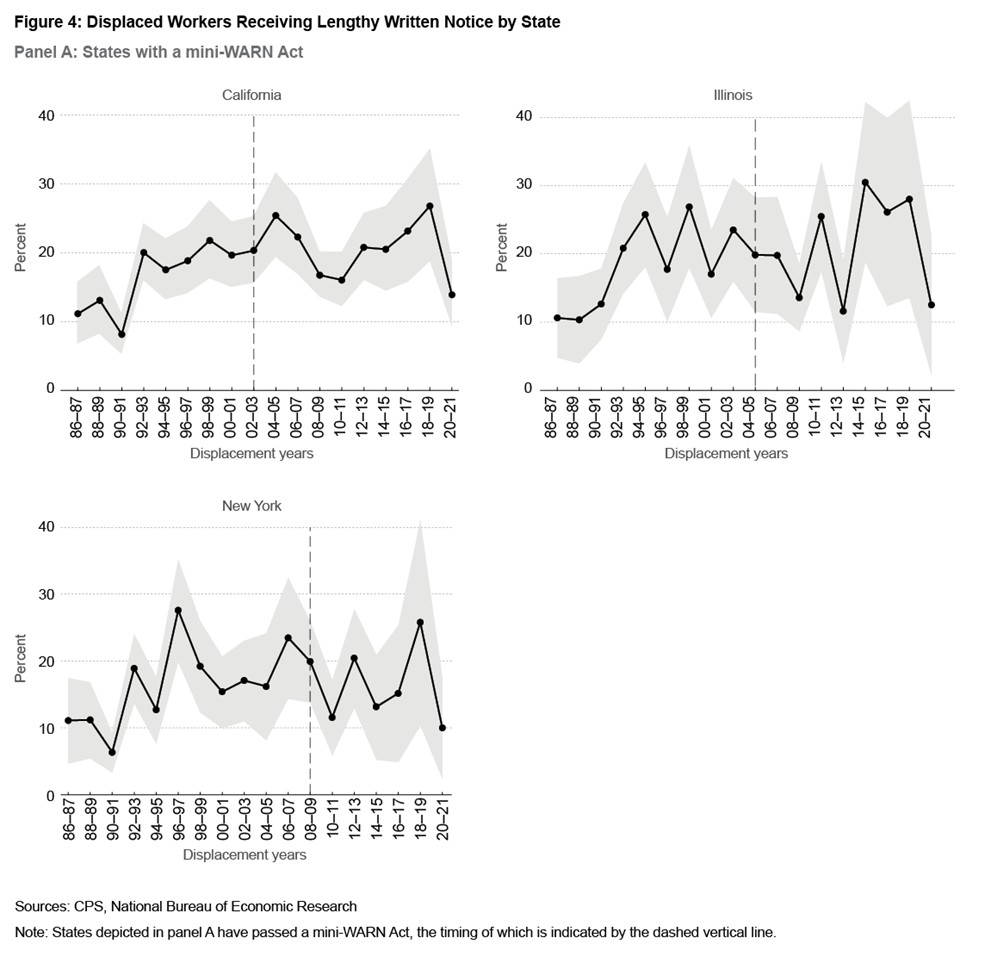
States have responded by passing their own, stricter versions. JD Supra reported in March 2026 that Ohio expanded its mini-WARN Act, lowering thresholds and broadening the definition of a covered establishment. New Hampshire's version, detailed in the NH Business Review, adds requirements for employers operating in the state. The Boston Globe maintains a public tracker of WARN filings in Massachusetts, mapping the geography of dislocation. These state-level interventions are filling a gap the federal statute leaves open. But they also create a compliance map that rewards companies for locating layoffs in states with weaker protections.
The Dallas Morning News's "low-hire, low-fire" framing captures something structural. Employers are not slashing payrolls with the abandon of 2023 and early 2024, but they are not rebuilding them either. The WARN-notice data, for all its gaps, shows a labor market in which the churn has slowed. The Tennessean's layoff tracker, aggregating state WARN filings, indicated that April 2026 was a sluggish month for employment but not a catastrophic one. The question hanging over the data is whether the slowdown in layoffs reflects genuine stability or a prelude. Companies that stop hiring first, and stop firing later, are companies that have decided to wait.
One dimension of the Oracle layoffs that received less attention than the severance negotiation is the forfeiture of unvested equity. Workers reported losing restricted stock units worth hundreds of thousands of dollars, People Matters reported, because the vesting schedule stopped on the termination date. In a conventional severance negotiation, accelerated vesting is a standard ask. But Oracle's take-it-or-leave-it structure foreclosed that conversation. The WARN Act, drafted in 1988, has nothing to say about stock grants. The compensation instrument that defines tech employment exists entirely outside the notice-and-severance framework. This is not a loophole; it is an absence of law.
The WARN-notice cycle, viewed from a distance, is a system that converts employment uncertainty into a series of public filings. Those filings are read by labor lawyers, journalists, and state workforce agencies. They are also read, belatedly, by the workers named in them. The gap between the notice and the layoff is 60 days by statute, but the gap between the decision to cut and the notice arriving in an inbox can be zero. Oracle workers learned of their termination by email on March 31. The WARN notice, where it applied, was a formality filed before or after. The law's protective logic runs on a clock that employers have learned to circumvent.
The three WARN notices from April 2026 at Letterkenny, Oakland City, and O'Hare are different in every particular. A defense contract changed hands. A small university bet on a patent. An airline consolidated gates. But what they share is a structural feature of American employment: the cost of a business decision is borne disproportionately by the people who had no role in making it. The WARN Act was supposed to redistribute that cost, or at least make it visible. Sixty days' notice, or pay in lieu. The law's remedy is temporal. It buys time. But time is not severance, and severance is not equity, and equity is not a job.
The next stress test for the WARN-notice cycle is already visible. AI-driven restructuring, the category into which Oracle's layoffs fit, does not map neatly onto plant closings. When a company eliminates 20,000 roles while simultaneously posting record revenue and hiring prompt engineers, the WARN Act's categories strain. A mass layoff of knowledge workers distributed across dozens of states and three countries is not the event the 1988 Congress had in mind. The question for labor economists, employment lawyers, and anyone who depends on a paycheck is whether the statutory framework will be updated to match the structure of modern work, or whether severance agreements will continue to serve as the private law of the American layoff. Watch the WARN filings. But also watch what happens after the 60 days run out.
Read next