AI Data Centres Go Modular as Cloud Campuses Hit Grid Limits
Armada's $230 million raise, bitcoin miners turning into AI landlords, and three federal grid emergencies all point to one thing: the next wave of AI infrastructure is modular, edge-based, and built where transmission lines can't reach.
 datacenterdynamics.com
Worldwide data centre capital expenditure climbed again in the first quarter of 2026, pushed higher by AI infrastructure buildouts and memory cost inflation, according to a Dell'Oro Group report published on 10 June. The headline number is not surprising. Capex has been climbing for two years straight. What is worth attending to is where, and in what form, the new capacity is being built. The era of the 300-megawatt hyperscale campus on a greenfield site outside a mid-cost metro is not finished. But it now shares the stage with something that looks very different: a factory-assembled, truck-delivered, satellite-connected data centre module that can be energised within days of arrival.
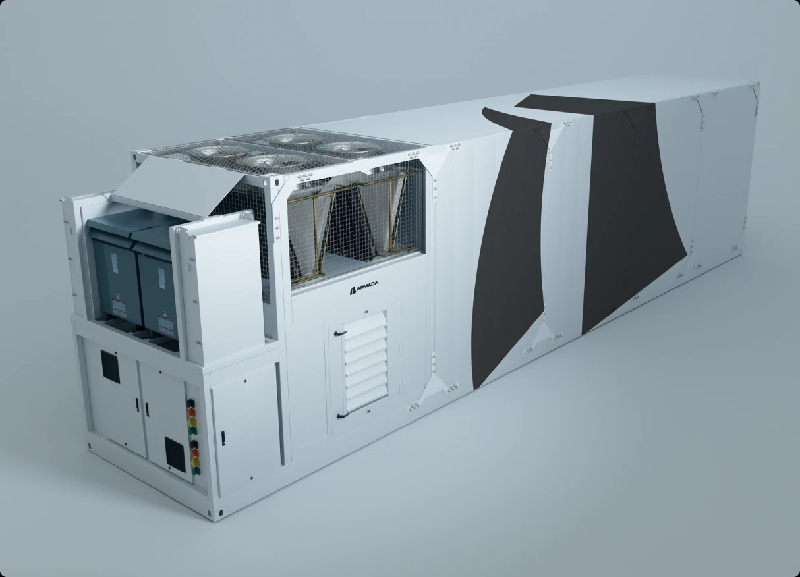
The clearest signal arrived on 19 May, when modular data centre builder Armada announced a $230 million Series B round at a $2 billion valuation. New investor BlackRock joined the round alongside a manufacturing agreement with Johnson Controls to build modular AI data centres at a factory in Arizona. Armada's current units can be deployed within days, the company told CNBC, a timeline that makes conventional data centre construction schedules look geological. The sheer scale of the raise, $230 million in a single Series B for a company that builds what are effectively containerised server rooms with satellite uplinks, says something about where institutional capital believes the bottleneck will be.
The bottleneck, increasingly, is the grid. By the first week of July 2026 the US Department of Energy had invoked a 1935 wartime statute three separate times to compel AI data centres within the PJM interconnection to switch to diesel backup generators, according to Tech Times, which reported on the escalating crisis. The North American Electric Reliability Corporation issued its highest alert after AI data centres triggered an 1,800-megawatt grid drop. These are not abstract warnings. They are operational emergencies that land on the desk of a facility manager at three in the morning, and they are reshaping assumptions about where and how compute gets sited.
The modular buildout is not a new idea. Containerised data centres have existed in various forms since the mid-2000s, when Sun Microsystems shipped Project Blackbox, a data centre in a shipping container, to early adopters. What changed in 2026 is the convergence of three forces that make modular and edge deployment economically coherent at scale. First, the AI training-to-inference ratio is shifting: as models move from the cluster to the application, latency matters, and a compute node 12 milliseconds from the user is worth more than one 120 milliseconds away. Second, transmission interconnection queues in the major US markets now stretch to four and five years; a modular unit on a site with existing power can bypass the queue entirely. Third, a new class of site is becoming available.
That new class of site is the former bitcoin mine. Across Texas, North Dakota, and rural Georgia, mining operators who built substations and switchgear for proof-of-work computation are repurposing that infrastructure for AI inference and fine-tuning workloads. Barron's reported on 6 July that several miners have become 'AI landlords,' leasing power-connected sites to hyperscalers and cloud providers who cannot afford to wait for new transmission capacity. Core Scientific is developing five new data centre sites specifically targeting long-term AI contracts, according to a report carried by MSN. Hut 8's pipeline now sits at 8,375 megawatts of potential digital infrastructure capacity, per Seeking Alpha.
The bitcoin-to-AI pivot is a story about switchgear more than silicon. A mining facility is, at its core, a building full of power distribution units, transformers, cooling loops, and a high-voltage connection to the transmission grid. The ASIC miners themselves are almost incidental to the infrastructure play. When a miner signs an AI hosting contract, what the hyperscaler is renting is not the building's past as a crypto operation but its present as a permitted, connected, and cooled site with a known interconnection agreement. The modular data centre plugs into exactly this kind of site: power-ready, zoning-complete, and waiting.
Armada's architecture makes the proposition more explicit. The company builds self-contained units with integrated satellite connectivity, meaning a module does not require a fibre buildout to begin operating. For a remote substation site in a county that lacks dark fibre, that changes the economic equation. The unit arrives on a flatbed truck, connects to the local medium-voltage line, and begins serving inference workloads within a week. The Johnson Controls manufacturing deal, in turn, is about taking that proposition from batch production to a proper assembly line. A factory in Arizona producing standardised modules at scale is a different industrial logic from the bespoke construction that dominates traditional data centre delivery.
Cooling, always the silent partner in data centre design, tilts toward modularity as well. A standard hyperscale hall uses chilled water or pumped refrigerant loops that are designed, laid out, and commissioned as part of the building's mechanical systems. A modular unit, by contrast, arrives with its cooling plant pre-integrated and factory-tested. Vendors such as CoolIT, Submer, and Iceotope have been shipping direct-to-chip and immersion cooling modules that fit within a containerised footprint for several years. The difference in 2026 is that the thermal design point has shifted: Nvidia's Vera Rubin platform and its successors push rack power densities past 100 kilowatts, at which point air cooling is no longer viable for dense GPU clusters. A pre-integrated liquid-cooled module ceases to be a niche option and becomes the default for new edge deployments.
The economic logic of edge deployment was laid out in a Forbes article published on 30 June. The argument, stripped of consultancy language, runs like this: centralised cloud regions waste money on data transit, idle cooling capacity, and overprovisioned power infrastructure that sits unused during off-peak hours. Small, networked nodes placed proximate to demand reduce all three forms of waste. The piece, which appeared under the 'Forbes Technology Council' banner, called edge scaling 'the AI Age growth model.' Whether or not one accepts the branding, the underlying point is sound. A kilowatt-hour of electricity spent moving data across a continent is a kilowatt-hour not spent on compute, and the ratio gets worse as model sizes grow.
The grid emergency reports from PJM make the edge argument more urgent. When the Department of Energy orders data centres onto diesel generators, the cost of that power jumps by a factor of three to five, depending on fuel contracts and emissions compliance costs. A modular edge node on a less congested part of the grid, or on a site with on-site generation, avoids those emergency orders entirely. It is not a coincidence that FERC, the top US energy regulator, ordered grid operators in June to consider new protocols for quickly connecting very large energy users, Reuters reported. The regulator is trying to solve the queue problem from the supply side. Modular deployment solves it from the demand side, by shrinking the unit of capacity that needs to be connected.
There is a tension here that the industry has not fully resolved. Modular data centres promise speed. Edge data centres promise proximity. But the two promises pull in different directions on the question of power. A modular unit that can be deployed anywhere still needs a power source. If the point of edge deployment is to place compute close to users, the power source must be close to users as well. In practice, that often means colocating modular units on existing commercial or industrial sites in metropolitan areas, where the grid is already strained. A module on a car park in Northern Virginia may be geographically close to the users, but it is also inside the same PJM congestion zone that triggered three federal emergencies this year.
The resolution, if one is coming, lies in the satellite connectivity that distinguishes Armada's offering from a generic containerised data centre. If a module does not need fibre, it does not need to be in a metro at all. It can be sited at a rural substation where the local distribution network has spare capacity, and the satellite link handles the data backhaul. The latency penalty of satellite versus terrestrial fibre narrows with each generation of low-earth-orbit constellation, and for inference workloads that are tolerant of 50 to 80 milliseconds of round-trip delay, the trade-off works. Training runs that require tightly coupled GPU clusters will stay in the hyperscale campuses. Inference, fine-tuning, and retrieval-augmented generation will fan out.
The Dell'Oro Group's capex figure captures the aggregate trend but obscures the compositional shift. Hyperscalers are still spending, and spending heavily, on large-footprint facilities. But the growth rate in modular and edge deployments is outpacing the growth rate in traditional builds, starting from a smaller base. The Arizona factory that Armada is building with Johnson Controls is not a pilot line. It is intended for volume production, and volume production implies a pipeline of orders that extends beyond the current quarter. When a manufacturing company like Johnson Controls, whose core business is building automation and HVAC systems for commercial real estate, invests in a data centre factory, the investment reflects a calculation that data centres are becoming a building-systems problem rather than a pure real-estate problem.
The WEF Energy Transition Index 2026, covered by Forbes on 30 June, showed readiness falling for the first time in a decade. The timing is instructive. Just as AI infrastructure demand is accelerating, the grid's capacity to absorb new large loads is deteriorating relative to expectations. The response from the data centre industry has been to disaggregate the load, spreading smaller units across more interconnection points rather than concentrating them in a handful of gigawatt-scale campuses. That strategy has a physical expression: the modular unit on the back of a truck, heading for a substation in a county that has not seen a new industrial customer in twenty years.
The Data Center Insights 2026 virtual conference, scheduled for 15 and 16 July and produced by Data Center Frontier and EndeavorB2B, lists cooling, power distribution, and fibre among its headline topics. The agenda reflects what the industry is actually discussing in conference rooms and procurement meetings: not whether modular buildouts will happen, but how to standardise the power and cooling interfaces so that a module manufactured in Arizona can connect to a substation in Georgia without a six-month commissioning process.
Standardisation is the quiet prerequisite for scale. At present, every hyperscaler has a slightly different specification for the power connection, the cooling interface, the fire-suppression system, and the physical security posture of a modular unit. Armada, for its part, is building to its own specification and selling to customers who accept it. But the broader market will not achieve the cost curves of factory production until a module built by one manufacturer can be connected by any electrical contractor to any utility's medium-voltage service. That kind of standardisation took the solar industry a decade. The data centre industry, facing a grid that is running out of time, may have to compress that decade into two or three years.
The bitcoin miners turned AI landlords understand this timeline intuitively. They have lived through the boom-and-bust cycles of a commodity compute market and know that speed of deployment is the only durable competitive advantage. A mining site can be rewired for AI hosting in months if the modular units are available. If they are not, the site sits idle while a general contractor builds a conventional data hall. Core Scientific's five new development sites and Hut 8's 8,375-megawatt pipeline are bets on the availability of modular capacity. If Armada's Arizona factory delivers on its production targets, those bets will pay. If it does not, the sites will wait.
The grid emergencies in PJM are not going to abate in the second half of 2026. Summer peak load is still ahead, and the transmission projects that FERC's June orders aimed to accelerate will take years to complete. In the interim, the data centre industry's capacity expansion will rely on whatever can be connected quickly to whatever power is available. The modular unit, the edge node, and the repurposed mining site are not the whole answer, but they are the answer that can be delivered in 2026. The factory in Arizona is scheduled to begin production before the year ends. Watch for the first shipment.
Read next