Grid Interconnection Delays Hit 2029, Substations Now the Bottleneck
Transformer lead times hitting five years, local zoning moratoriums, and a NERC Level 3 Alert signal that the AI buildout's power problem is a substation bottleneck no chip can solve.
 elginpowersolutions.com
In this article
On 4 July 2026, the North American Electric Reliability Corporation issued a Level 3 Alert, its highest-urgency warning, after documenting something the grid was not designed to handle. An AI training campus in the eastern interconnection shed 1,800 megawatts of load in under a second when its uninterruptible power supply systems tripped during a normally cleared fault, TechTimes reported. The event did not cause a blackout, but NERC's alarm was unambiguous: a single customer-initiated load reduction of that magnitude, happening faster than any generator could ramp to compensate, represents a category of reliability threat the regulator had not previously codified. The Level 3 Alert sets an August 3 deadline for corrective action plans from every registered entity on the bulk power system.
The 1,800 MW figure is arresting enough on its own. It is roughly the output of two large nuclear reactors. But what makes it a grid-interconnect story rather than merely an operations one is where that load sat before it vanished. It sat behind a substation that had been energised only 14 months earlier, the product of an interconnection process that took four years from initial application to commercial operation, and that was considered fast by the standards of the queue it entered. The queue into which it was filed, in 2021, contained roughly 140 GW of pending generation and load interconnection requests across the PJM Interconnection footprint. By mid-2026, PJM's queue had swollen past 300 GW, more than half of it driven by data centre load, and the grid operator was projecting a 6 GW capacity shortfall by 2027, according to Reuters.
The interconnection queue is the funnel through which every new large load must pass before it can draw power from the bulk transmission system. It is a study process, run by the regional grid operator, that models what a new load will do to voltage stability, thermal limits, and fault currents on every line within the affected study area. It is not fast. A typical queue position in PJM now takes three to five years to reach an interconnection agreement, and that is before anyone orders a transformer. The transformer is where the timeline really comes apart.
Large power transformers, the kind that step transmission voltage down to distribution levels at a data centre substation, now carry lead times of three to five years from order to delivery, Forbes reported in late June. The bottleneck is not a single component but a supply chain that was sized for a world in which the entire United States ordered roughly 800 large power transformers per year. Data centre developers alone are now placing orders at twice that rate. There are fewer than a dozen manufacturers worldwide capable of producing the largest units, and the specialised electrical steel they require comes from a single mill in Japan and another in South Korea. No amount of capital expenditure can accelerate a grain-oriented silicon steel annealing line. The physics of the process sets the pace.
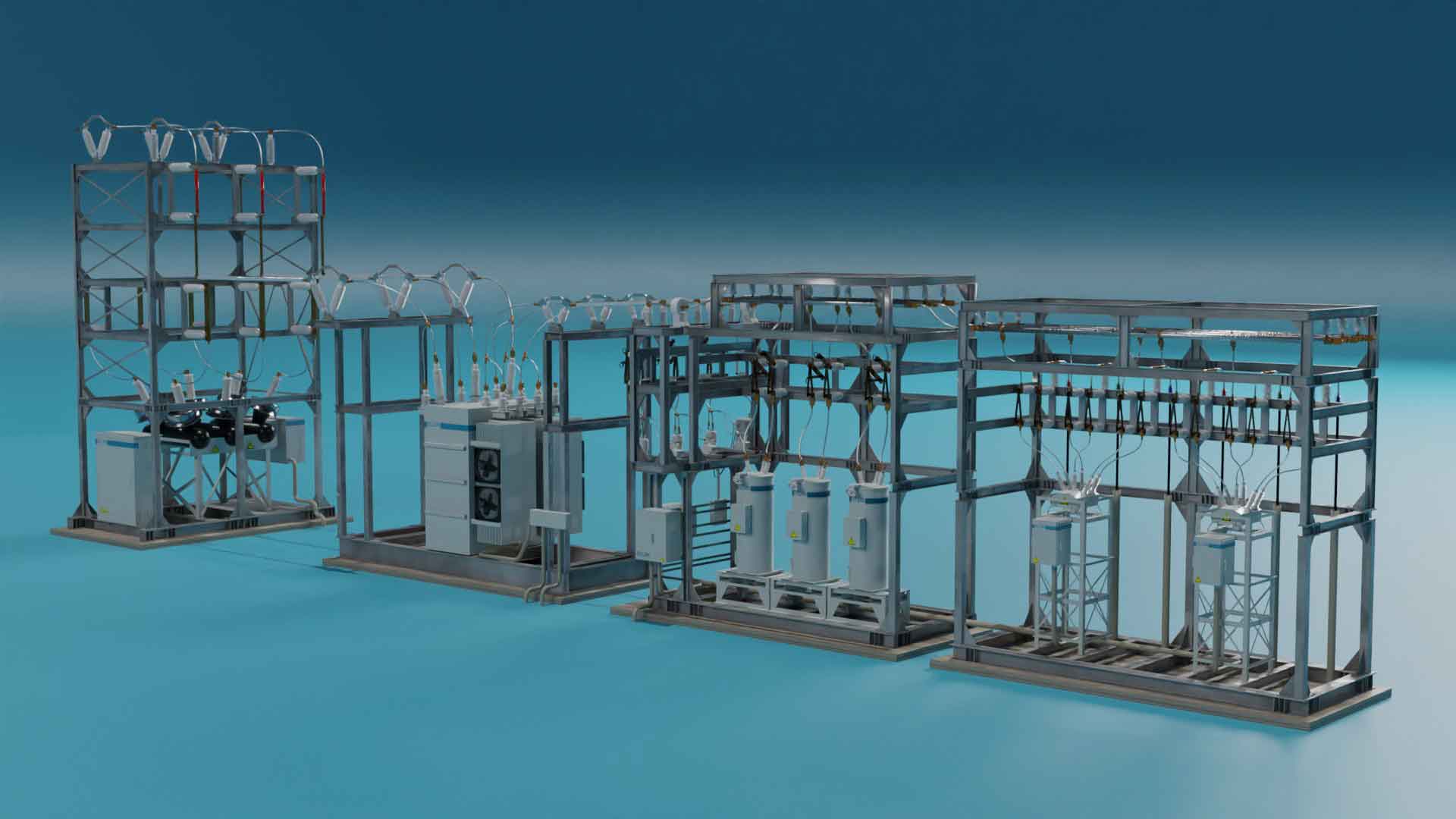
This is where modular substations enter the frame. POWER Magazine reported at the start of July that factory-built substations, assembled on skids and shipped to site as pre-commissioned units, are emerging as the most practical tool for closing the gap between construction completion and grid connection. A conventional field-built substation requires civil works, foundation pours, separate procurement of transformers, switchgear, protection and control panels, and months of on-site commissioning. A modular substation arrives on a truck with everything wired, tested, and ready to accept a transmission feed. The schedule compression is real: a field-built substation can consume 18 to 30 months from ground-breaking to energisation; a modular unit, assuming the interconnection agreement is already in hand, can be operational in six to nine months.
The distinction matters because it shifts the critical path. Without modular substations, the critical path runs through the civil contractor's schedule, the transformer factory's backlog, and the relay technician's availability. With a modular unit, those activities happen in parallel inside a factory while the site is being graded. The schedule risk moves to the interconnection queue itself, to the studies that determine whether the local 230 kV bus can absorb another 300 MW of load without collapsing voltage during a contingency. That is a software and process problem, not a manufacturing one, but it has proven no easier to solve.
In June, the Federal Energy Regulatory Commission directed PJM to revise its tariff to expedite data centre interconnection, JD Supra reported, issuing a show-cause order that required PJM and its transmission owners to explain why the existing process could not be accelerated. Days later, FERC approved PJM's expedited interconnection track, a temporary mechanism that allows certain generation and load projects to bypass the standard queue in exchange for funding their own network upgrades upfront. Then, on 30 June, PJM members voted to advance a broader plan to source more electricity for rising data centre demand, as Reuters detailed. The votes and orders are piling up; the energisation dates are not moving nearly as fast.
And then there is the substation that nobody can build at all because the county commissioners will not let them. On 4 June, Queen Anne's County, Maryland, became the sixth jurisdiction in that state to impose a moratorium on data centre development, as CBS News Baltimore reported. The 12-month pause blocks the approval and processing of applications while the county studies impacts on infrastructure, land use, utilities, and environmental resources. Baltimore County, Carroll County, Harford County, Howard County, and Baltimore City have each passed or are advancing their own restrictions. The moratoriums are not identical: Howard County's S.M.A.R.T. Siting Act creates a task force; Harford County is moving toward a permanent ban. But they share a premise, which is that local zoning codes written for warehouses and light industry are not adequate to govern facilities that draw 300,000 gallons of water per day and enough electricity to power 50,000 homes.
While interest in data center development has increased, our existing local zoning regulations were not specifically designed to address the potential impacts associated with these contemporary data center facilities., Phil Dumenil, Queen Anne's County Commissioner, in a statement reported by CBS News Baltimore
The Maryland counties are not outliers. Governing reported on 10 July that since early 2024, more than 1,200 public actions, ranging from zoning board hearings to county commission votes, have been logged across the United States in opposition to data centre projects. The pattern is consistent: a developer secures land, files an interconnection request with the grid operator, begins site work on a speculative timeline, and then hits a zoning board that was never consulted in the queue process. The zoning board does not care about the queue position. It cares about noise, water, viewsheds, and whether the local high school's vocational programme will produce enough electricians to staff a 200 MW facility. The interconnection queue and the zoning calendar operate on different clocks, and they are synchronised nowhere.
The political economy of substation siting adds another layer. A transmission substation that serves a data centre campus is not a general-purpose piece of infrastructure; it is a dedicated facility, often built and paid for by the developer, but connected to a shared transmission system. When that substation requires a network upgrade, a new 345 kV line, a reconductored transmission corridor, or a second auto-transformer at the point of interconnection, the cost is socialised across all ratepayers in the utility's service territory under most existing tariff structures. The data centre developer pays for the substation. Ratepayers pay for the upstream upgrades. That allocation is increasingly contested, and it is the subject of at least four active proceedings before state public utility commissions as of mid-2026.
The Forbes analysis by Robert J. Szczerba, published 25 June, captured the dynamic succinctly: the AI industry has been counting GPUs, but the real constraint is power transformers, devices the size of a single-car garage that weigh 200 tonnes and take half a decade to procure. A transformer is not a software problem. It cannot be scaled horizontally by adding more instances in a Kubernetes cluster. It is a wound-copper-and-laminated-steel assembly that requires a factory acceptance test, a heavy-haul transport permit, and a crane crew that may be booked two years in advance. Half of all large power transformers installed in the United States are imported, and the domestic manufacturing base is not expanding quickly enough to close the gap.
Modular substations help with the downstream side of the problem. A factory-integrated unit from a vendor such as Eaton, Hitachi Energy, or Siemens can compress the on-site schedule dramatically, but it does not compress the transformer lead time. The transformer is the long-lead item inside the modular package, and the factory that builds the modular substation is competing for that transformer against every utility, every industrial customer, and every other data centre developer on the same allocation list. The modular approach shifts the integration risk from the field to the factory, which is a genuine improvement. It does not create new transformer production capacity. That capacity is growing, but slowly, and the demand curve is nearly vertical.
What the August 3 deadline actually tests
NERC's Level 3 Alert sets a deadline that falls less than two weeks from today. The alert requires every registered entity to submit a corrective action plan addressing the specific vulnerability the 1,800 MW event exposed: large data centre campuses whose UPS systems can drop offline faster than automatic generation control can respond. The plans must be filed with NERC by 3 August 2026. What the deadline will actually measure is not the technical creativity of utility engineers. It will measure whether the regulatory apparatus that governs interconnection, reliability standards, and transmission planning can move at a speed that bears any relationship to the speed at which AI training campuses are being built.
The mismatch is structural. An interconnection queue study takes years because it must model every contingency on every affected transmission element under multiple load scenarios. A zoning board hearing takes months because it must accommodate public comment, environmental review, and the political calendar of elected commissioners. A transformer takes years because it must be wound, dried, tested, shipped, and commissioned. Meanwhile, a hyperscaler can pour a concrete slab, erect a steel frame, and install server racks in nine months. The data centre industry has mastered the art of compressing construction schedules. It has not yet mastered grid interconnection timelines, substation politics, or the physics of grain-oriented silicon steel, and there is no indication that any of those three things is prepared to bend.
PJM members voted in late June to advance a demand-management framework. FERC has approved an expedited interconnection track. Maryland counties are writing zoning codes for a land use that did not exist when their comprehensive plans were adopted. Modular substation factories are adding shifts. None of these is sufficient on its own. The question that will be answered across the next 18 months is whether their combined effect can compress the timeline from interconnection request to energised substation from its current five-to-seven-year range to something that the AI industry's capital expenditure plans can actually tolerate. The August 3 corrective action plans will provide the first public indication of whether the grid's institutional machinery can match the urgency its own regulator has now assigned to the problem.
Read next
