Modular Data Centers Go Mainstream as Armada Raises $230M
The San Francisco startup is building an Arizona factory with Johnson Controls to produce portable AI infrastructure, as Dell'Oro data shows capex shifting to prefabricated and edge deployments.
 cnbc.com
In this article
ARMADA INC., a San Francisco company that builds portable data centres in shipping-container-style enclosures, closed a $230 million Series B round in May at a $2 billion valuation and announced it would construct a dedicated manufacturing facility in Arizona with new investor Johnson Controls. The factory, branded Galleon Forge One, is the clearest signal yet that modular infrastructure has moved from niche procurement into the capital-expenditure mainstream. The round was co-led by Overmatch, BlackRock, and 8090 Industries, and it was oversubscribed, CNBC reported. The raise follows a $131 million strategic round in July 2025 that included Microsoft's venture fund, M12.
These are not server racks on a flatbed. Armada's Galleon modules ship as self-contained, weatherised units with integrated cooling, power distribution, fire suppression, and satellite backhaul, designed to be deployed at mine sites, oil fields, military forward operating bases, or the car park behind a rural hospital. Each module arrives with its own management plane. The company is not alone in this category, but it is becoming the best-capitalised. Customer bookings grew sixfold from Fiscal Year 2025 to Fiscal Year 2026, and the first quarter of its Fiscal Year 2027 posted a 21-fold increase in bookings growth year on year, according to the company's funding announcement as covered by CRN.
The modular data centre market is being pulled forward by two forces that do not always align. The first is AI inference moving to the edge: large language models deployed in factories, on drilling platforms, and inside logistics hubs where latency to a hyperscale region is unacceptable. The second is the sheer difficulty of building traditional brick-and-mortar data centres quickly enough. In April, Ars Technica reported that nearly 50 percent of data centre projects in the United States were delayed, with tariffs on Chinese electrical equipment and transformer shortages among the principal bottlenecks. If you cannot get a 200-megawatt campus through permitting and interconnection queues in under three years, a 2-megawatt module that can be ordered, built, and commissioned in six months starts to look less like a stopgap and more like the primary strategy.
The Dell'Oro Group confirmed that data centre capital expenditure climbed again in the first quarter of 2026, driven by AI infrastructure buildouts and memory cost inflation, according to a report released on 10 June. Dell'Oro's data, widely cited by hyperscale procurement teams, captures spending on servers, storage, networking, and physical infrastructure. The firm does not break out modular deployments as a separate line item, but the vendors it tracks are increasingly reporting that prefabricated and containerised orders represent a growing share of their pipeline. A site-selection consultant familiar with the figures would note that the lead time for a traditional build has stretched past 36 months in Northern Virginia and beyond 48 months in Dublin; a Galleon module can be delivered in 26 weeks.
The Arizona factory matters because it transforms Armada from an integrator into a manufacturer. Johnson Controls brings industrial automation expertise and a supply chain that spans chillers, building management systems, and fire suppression. The joint venture effectively verticalises the production of a product that until recently was assembled by hand in leased warehouse space. Dan Wright, Armada's co-founder and chief executive, has described the partnership on Fox Business as a way to drive per-unit costs down while simultaneously increasing throughput. The cost curve is everything in this market: a single Galleon module capable of supporting an inference cluster must compete not against a hyperscale campus but against the cost of leasing colocation space and pulling dark fibre to a remote location.
Edge computing has been the next big thing for so long that the phrase has lost most of its meaning. But the Qualcomm announcements at Computex 2026 suggest the silicon is finally catching up to the rhetoric. Qualcomm unveiled its Dragonfly brand for data centre products, covering server CPUs, AI accelerators, and networking silicon, and named Meta as a CPU customer, Quartz reported via Yahoo Finance. The chipmaker described 2026 as 'the year of agents' and framed its edge diversification as the company's next chapter. Dragonfly chips are designed to run inference workloads at lower power envelopes than the Nvidia H200 or B200, which makes them plausible candidates for deployment inside modular units where power density is the binding constraint.
Our primary focus is always going to be helping customers get the maximum ROI they can from those investments., Niall Woodward, co-founder and CTO of DoiT International's Select division, speaking to CRN
Woodward was discussing the neocloud market, which Synergy Research Group pegged at $9 billion in the fourth quarter of 2025, a 223 percent increase year over year, according to CRN. The neocloud providers, GPU-as-a-service companies that rent compute by the hour, are natural buyers of modular infrastructure because they need to scale capacity faster than they can negotiate power-purchase agreements. Synergy forecasts the neocloud market will reach $400 billion by 2031. The numbers strain credulity, but the trajectory is consistent with IDC's estimate that global spending on public cloud services will surpass $1 trillion in 2026, growing more than 21 percent, with United States spending alone reaching $647 billion.
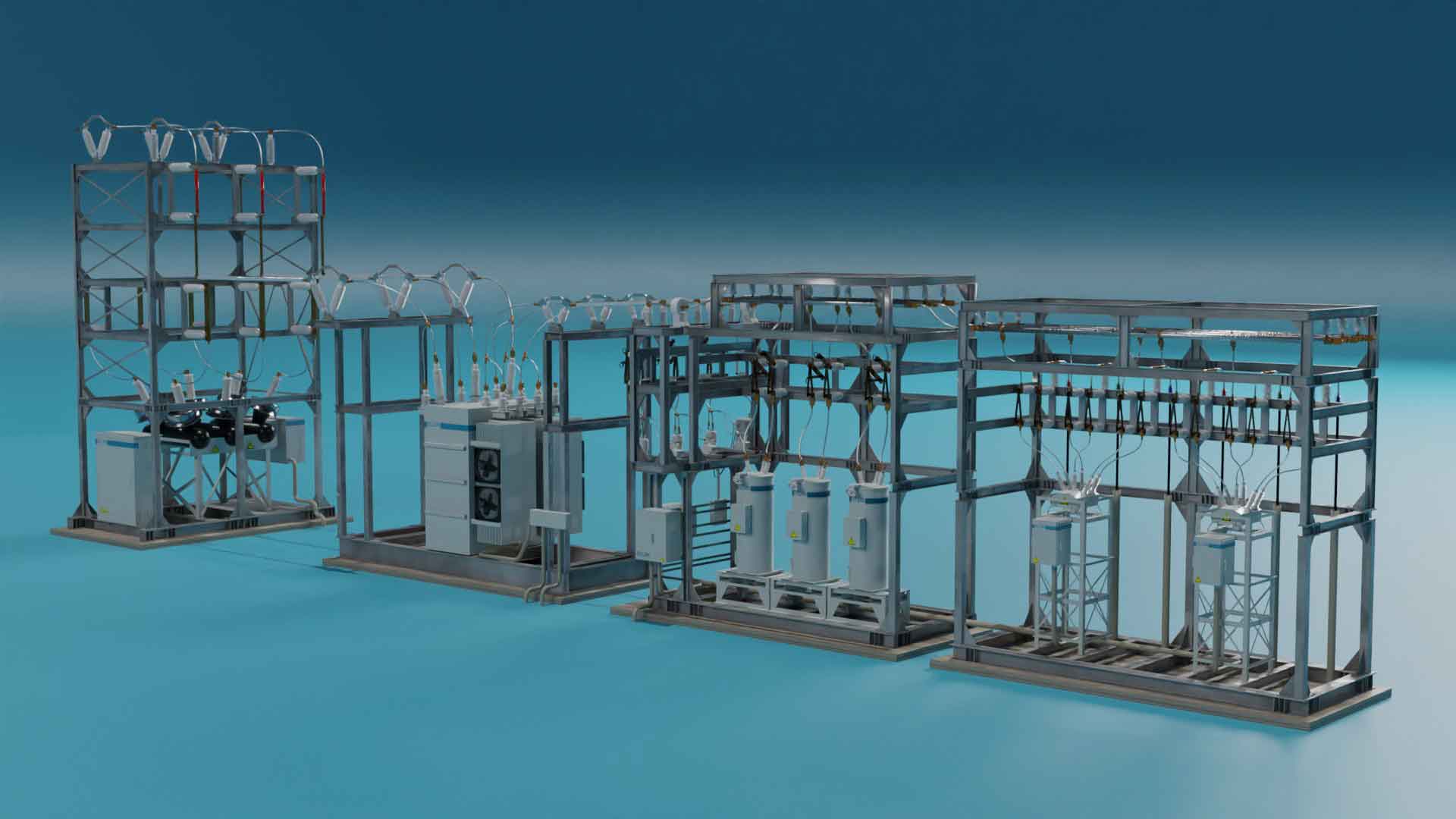
The physical question that modular data centres raise is straightforward and uncomfortable: who pays for the substation? A Galleon module can be dropped onto a gravel pad beside a factory, but it still needs a grid connection, and the local distribution network was not sized for a 2-megawatt continuous load. In many rural counties where Armada's customers operate, the substation transformer is the single most expensive component of the deployment, often costing more than the module itself and requiring a 24-month lead time. The contracted load, meaning the capacity the utility has agreed to deliver, is frequently lower than the connected load, meaning what the equipment could actually draw. Understanding the difference between those two figures is the difference between a project that pencils out and one that never gets past the interconnection study.
Rob Enderle, a technology analyst writing in TechNewsWorld earlier this month, argued that modular data centres could reduce community resistance to AI infrastructure by lowering the resource footprint and making facilities less visually intrusive. It is a reasonable thesis. Town councils in Virginia, Ohio, and Ireland have spent the past two years imposing moratoriums on data centre construction, citing noise, water consumption, and the aesthetic blight of windowless concrete boxes. A prefabricated unit screened by landscaping, drawing air-cooled rather than evaporative cooling, is an easier sell at a planning hearing. Whether it is an easier sell at the public utilities commission, where the question is always who pays for the grid upgrade, remains unresolved.
The competitive landscape is fragmenting in ways that suggest the category is real rather than speculative. Armada opened its first Galleon Experience Center in April at the Reston, Virginia headquarters of Carahsoft, the government IT reseller ranked No. 6 on the 2026 Solution Provider 500, CRN reported. The centre is designed to demonstrate self-sufficient modular infrastructure to federal agencies, educational institutions, and healthcare systems. Separately, Panthalassa, a startup backed by maritime and energy investors, is developing floating data centres cooled by seawater, Forbes reported in mid-June. And Starcloud, a company that appeared on CRN's hottest startups list, is pursuing data centres in orbit.
The ocean-based and space-based approaches share a common logic with modular land-based deployment: the traditional data centre campus is too slow and too constrained by local opposition to absorb the growth that AI demand is generating. The difference is that floating and orbital data centres require regulatory regimes that do not yet exist, while modular land-based units fit inside existing electrical codes, building codes, and utility interconnection procedures. The permitting pathway is not easy, but it is known. For a procurement manager at a hyperscaler or a neocloud provider evaluating deployment options, a known permitting pathway with a 26-week lead time compares favourably to an experimental one with no timeline at all.
Cooling is the other dimension where modular units have an architectural advantage. A traditional 50-megawatt data hall requires a centralised chiller plant, miles of piping, and a dedicated water supply. A modular unit can be factory-fitted with direct-to-chip liquid cooling from vendors such as CoolIT or Submer, tested under load before it leaves the factory floor, and commissioned on site within days. The thermal management problem shrinks from a civil engineering project to a product specification. This is not a trivial distinction when the chip roadmap calls for 1,500-watt processors within the next two generations.
What the building is actually for
It is worth pausing on the question that a substation engineer would ask: what is the building actually doing, and is it built for anything else? The answer with modular deployments is that they are overwhelmingly single-purpose. A Galleon module at a copper mine in Chile is running predictive-maintenance models on sensor data from the ore crushers. It is not also serving web pages, hosting virtual desktops, or running a Redis cache for a mobile gaming company. This single-tenancy model simplifies cooling design and power provisioning, but it also means the module is economically stranded if the use case disappears. The hyperscale campus model, for all its inefficiencies, at least aggregates demand across thousands of tenants and workloads.
The Data Center Insights 2026 conference, a virtual event scheduled for 15 and 16 July and produced by Data Center Frontier and EndeavorB2B, will devote sessions to cooling, power distribution, and fibre strategies for AI infrastructure, according to the organisers. The agenda reflects an industry that is no longer debating whether modular and edge deployment models matter but rather how to engineer them for reliability at scale. The challenges are not theoretical. In the first half of 2026 alone, multiple hyperscale projects in the United States have been paused or redesigned because the local substation could not accommodate the revised load.
The grid question will resolve, slowly. The US Department of Energy has accelerated its transformer loan programme, and several Independent System Operators have reformed their interconnection queue procedures to prioritise projects that can demonstrate a credible path to commercial operation. But none of these reforms will deliver a transformer in less than 18 months. For the next two years, the economics will continue to favour solutions that can be built inside a factory, shipped on a lorry, and connected to whatever distribution feeder happens to be available. Johnson Controls expects the Galleon Forge One facility to begin production in the first half of 2027. The first modules off that line will tell us whether the modular data centre is a permanent asset class or a bridge technology that disappears the moment substation lead times return to normal. The answer will show up not in a funding round but in a county recorder's office, filed as a permanent easement.
Read next