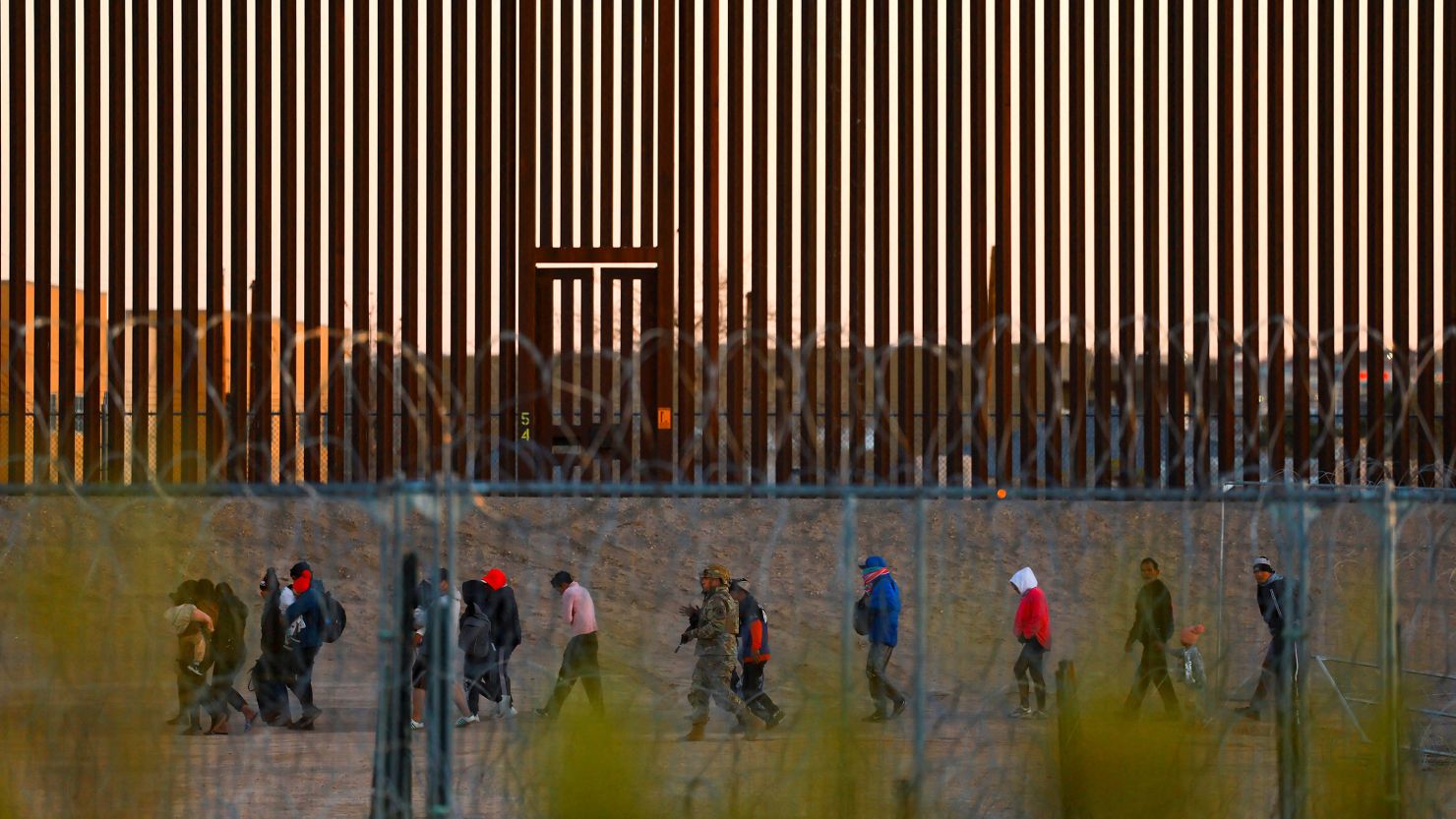
Court Blocks Asylum Ban, But Surveillance Infrastructure Remains
The D.C. Circuit struck down Trump's asylum ban, but the biometric and algorithmic surveillance architecture built over two administrations continues to expand with little oversight.
 cbsnews.com
In this article
On April 24, 2026, a divided three-judge panel of the U.S. Court of Appeals for the D.C. Circuit blocked President Donald Trump's executive order suspending asylum access at the southern border, ruling that the Immigration and Nationality Act "does not allow the Executive to suspend Plaintiffs' right to apply for asylum" or "curtail mandatory procedures" for adjudicating protection claims. The opinion, authored by Judge J. Michelle Childs and joined by Judge Cornelia Pillard, held that the president's proclamation declaring an "invasion" and his administration's accompanying Department of Homeland Security guidance were unlawful in their attempt to bypass the statutory framework Congress established. Judge Justin Walker, a Trump appointee, concurred in part but dissented from the majority's conclusion that the president could not deny all asylum applications outright.
The ruling, reported by CBS News and carried by outlets including The Boston Globe, is the most significant judicial check yet on the Trump administration's effort to functionally erase the asylum system. But the decision addresses only one layer of the apparatus that now governs who is permitted to request protection at the border. Beneath the legal battles over presidential authority sits a sprawling, multi-agency technology stack that collects, stores, and processes biometric and personal data from millions of migrants, and its procurement and expansion continue regardless of which way the courts rule on any given proclamation.
The DHS guidance that the D.C. Circuit struck down did more than suspend asylum. It instructed asylum officers not to ask migrants specific questions about whether they had a credible fear of persecution or torture, directing instead that individuals crossing between ports of entry could be summarily removed under new processes called "direct repatriation" or "expedited removal" without any asylum screening whatsoever. Lee Gelernt, an attorney for the ACLU, which challenged the policy, said the decision "will potentially save the lives of thousands of people fleeing grave danger who were denied even a hearing under the Trump administration's horrific asylum ban." The Trump administration may now ask the full D.C. Circuit to review the decision or appeal to the Supreme Court.
We conclude that the INA's text, structure, and history make clear that in supplying power to suspend entry by Presidential proclamation, Congress did not intend to grant the Executive the expansive removal authority it asserts., Judge J. Michelle Childs, U.S. Court of Appeals for the D.C. Circuit, majority opinion
What the legal debate over the asylum ban obscures is how thoroughly the process of seeking asylum has already been technologized, in ways that both the Biden and Trump administrations advanced. The CBP One mobile application, launched under Biden in 2023 as a scheduling tool for asylum appointments at ports of entry, required migrants to upload facial biometrics, geolocation data, and personal identification documents before they ever set foot on U.S. soil. By the time Trump took office in January 2025, the app had processed over 900,000 individuals through a parole program that granted temporary legal status while their claims were adjudicated. Within weeks of his inauguration, Trump terminated that program.
On April 1, 2026, a federal judge in Boston ruled that the Trump administration violated the law when it stripped immigration status from the nearly 900,000 migrants who had entered through the CBP One parole pathway, as NPR reported. That decision ordered DHS to restore protections and deportation relief. The two rulings, issued three weeks apart, form a pair of judicial rebukes to policies that depend on the same underlying data infrastructure: the digital identities, biometric profiles, and application histories that migrants were required to submit as a condition of even requesting entry.
The data generated by the CBP One app does not disappear when a policy is reversed. Each upload, each facial scan, each GPS ping, feeds into a constellation of DHS databases that have been consolidating rapidly. In February 2026, Wired reported that Homeland Security is seeking to combine its separate face and fingerprint identification systems into a single biometric search platform, a move that the agency is pursuing after it dismantled centralized privacy reviews and key limitations on how facial recognition data could be used across sub-agencies. The consolidated platform would allow CBP, ICE, and USCIS to query the same biometric corpus, collapsing the jurisdictional walls that once separated an asylum applicant's file from an immigration enforcement target's file.
This is the data flow that no court ruling on the asylum ban has addressed. A person fleeing persecution arrives at the U.S.-Mexico border. They provide their face, their fingerprints, their phone number, their family contacts, their travel history, to an app or to an officer holding a biometric tablet. That data enters the Automated Biometric Identification System, or its successor platform, where it can be matched against criminal databases, intelligence holdings, and the records of every other person who has ever crossed. The credible fear interview, if one is even conducted, is recorded, transcribed, and stored. The decision, whether made by a human officer or informed by a risk-scoring algorithm, becomes a permanent entry. The architecture is built for enforcement, not for protection.
The expanding scope of data collection at the border was made explicit in December 2025, when U.S. Customs and Border Protection proposed new screening requirements that would compel foreign travelers to submit selfies through a mobile-only application and provide five years of social media history, as USA Today reported. The proposal, framed as a security modernization, did not distinguish between travelers arriving on visas and those presenting themselves for asylum. The data collection architecture is the same, and the absence of differentiated treatment is precisely the point: in a unified biometric system, everyone is a potential subject of enforcement.
Civil liberties organizations have been mapping this architecture for years. The European Digital Rights network and Access Now have documented the export of U.S. border surveillance technology to the European Union's own migration management systems. The Electronic Frontier Foundation has filed repeated Freedom of Information Act requests seeking details on the vendors, contracts, and algorithmic assessments embedded in DHS screening tools. Much of what is known about the technology stack comes from these FOIA responses and from procurement databases, not from any affirmative transparency by the agencies that deploy the tools.
An analysis published by UntoldMag in November 2025 and republished by Global Voices in April 2026 argued that AI-driven border enforcement amounts to a form of digital colonialism, in which "Black and brown migrants are forced to surrender biometric data to systems designed to exclude them, while the companies that build those systems profit from government contracts funded by the same enforcement apparatus." The authors, Tsion Gurmu, Hinako Sugiyama, and Sobechukwu Uwajeh, framed the issue not as a question of whether border technology is accurate or inaccurate, but as a structural matter of whose bodies generate the training data and whose interests the systems serve.
That framing points to a question the D.C. Circuit's ruling does not answer: what does consent mean in a system where a person cannot meaningfully refuse to provide their data and still access the legal process to which courts have now affirmed they are entitled? The asylum statute that Judge Childs' opinion defends requires an individualized determination of credible fear. But the technology mediating that determination has been built on a presumption of mass data extraction, where the price of a hearing is total informational surrender.
The vendors behind this infrastructure are largely the same defense and intelligence contractors that built the post-9/11 surveillance state. Palantir Technologies, which holds extensive contracts with ICE and CBP, provides the data integration platform that links biometric records, travel histories, and investigative case files. Clearview AI, whose facial recognition database was built by scraping billions of images from social media without consent, has been tested by DHS components despite repeated legal challenges in multiple countries. The procurement pipeline for border technology is long, multi-year, and largely insulated from the policy oscillations that dominate headlines.
What makes the current moment distinct is the velocity of the consolidation. The Wired report on the unified biometric platform is not an isolated development. It follows a pattern that Sara Geoghegan, a senior counsel at the Electronic Privacy Information Center, has described in congressional testimony as the "function-creep" problem: data collected for one purpose, under one legal framework, migrates to other purposes and other agencies without new authorizing legislation or meaningful public debate. A selfie submitted for an asylum appointment becomes a faceprint that can be run against a surveillance camera feed years later.
The regulatory gap is not a gap at all. It is the design. The United States has no comprehensive federal privacy law. The Privacy Act of 1974 governs federal agency records but contains exemptions broad enough to exclude entire DHS database systems. The Federal Trade Commission has no jurisdiction over government surveillance. The Privacy and Civil Liberties Oversight Board, a watchdog created after 9/11, has a staff of roughly two dozen and an advisory mandate. Oversight of border technology is distributed across so many committees, offices, and inspector general audits that responsibility attaches to no one.
The D.C. Circuit's ruling restores a legal right to seek asylum. It does not restore privacy, nor does it constrain the data infrastructure that has been layered atop the asylum system. A person who is now permitted to request a credible fear interview will still submit biometrics, still have their social media scrutinized, still enter a database whose downstream uses they cannot anticipate or contest. The right to apply has been reaffirmed. The conditions under which one applies remain a black box.
What to watch
The Trump administration has the option to petition the full D.C. Circuit for an en banc rehearing or to appeal directly to the Supreme Court. Either path would extend the legal uncertainty through the remainder of 2026. The Supreme Court's conservative majority has shown deference to executive immigration authority in past cases, but the statutory question here is narrow: whether the INA permits the president to create new summary removal procedures and suspend asylum access by proclamation. The D.C. Circuit's answer was clear that it does not.
Separately, the CBP One parole termination ruling from the District of Massachusetts will proceed through its own appeals process, with the Biden-era parole program's fate tied to whether DHS can demonstrate that it followed the Administrative Procedure Act when it revoked status for nearly 900,000 people. Meanwhile, the procurement cycle for border surveillance technology will continue. The DHS unified biometric platform RFP is active. The CBP social media screening proposal is under public comment review. None of these processes will pause for the courts. The asylum-decision stack is being built faster than the law can rule on what is done with it.
For readers who want to trace the data flows themselves: the DHS privacy office publishes Privacy Impact Assessments for each major IT system at dhs.gov/privacy. The CBP One app's most recent PIA, dated October 2024, is publicly available. The Unified Biometric System PIA has not yet been published. FOIA requests to CBP's FOIA office can be submitted through the DHS online portal. The ACLU's Immigrants' Rights Project maintains a litigation tracker at aclu.org that follows every case in the current asylum docket. The public record exists for anyone willing to read it. What remains absent is a regulator willing to act on what it reveals.
Read next