Fixed facial recognition cameras yield first arrest amid UK rollout
A woman wanted for two decades was arrested after London's permanent cameras scanned her face, just days after the UK High Court dismissed a challenge to the Met's live facial recognition programme and the government announced national expansion.
 bbc.co.uk
In this article
On an ordinary day in Croydon, south London, a woman who had been wanted by police for two decades walked past a camera fixed to street furniture. The camera scanned her face, converted the geometry of her features into a biometric template, and compared it against a watchlist of suspects. Within moments, the system flagged a match. Officers made an arrest. The pilot of permanent, fixed-position live facial recognition (LFR) cameras had produced what the Metropolitan Police called an "incredible" result, LBC reported on 12 May.
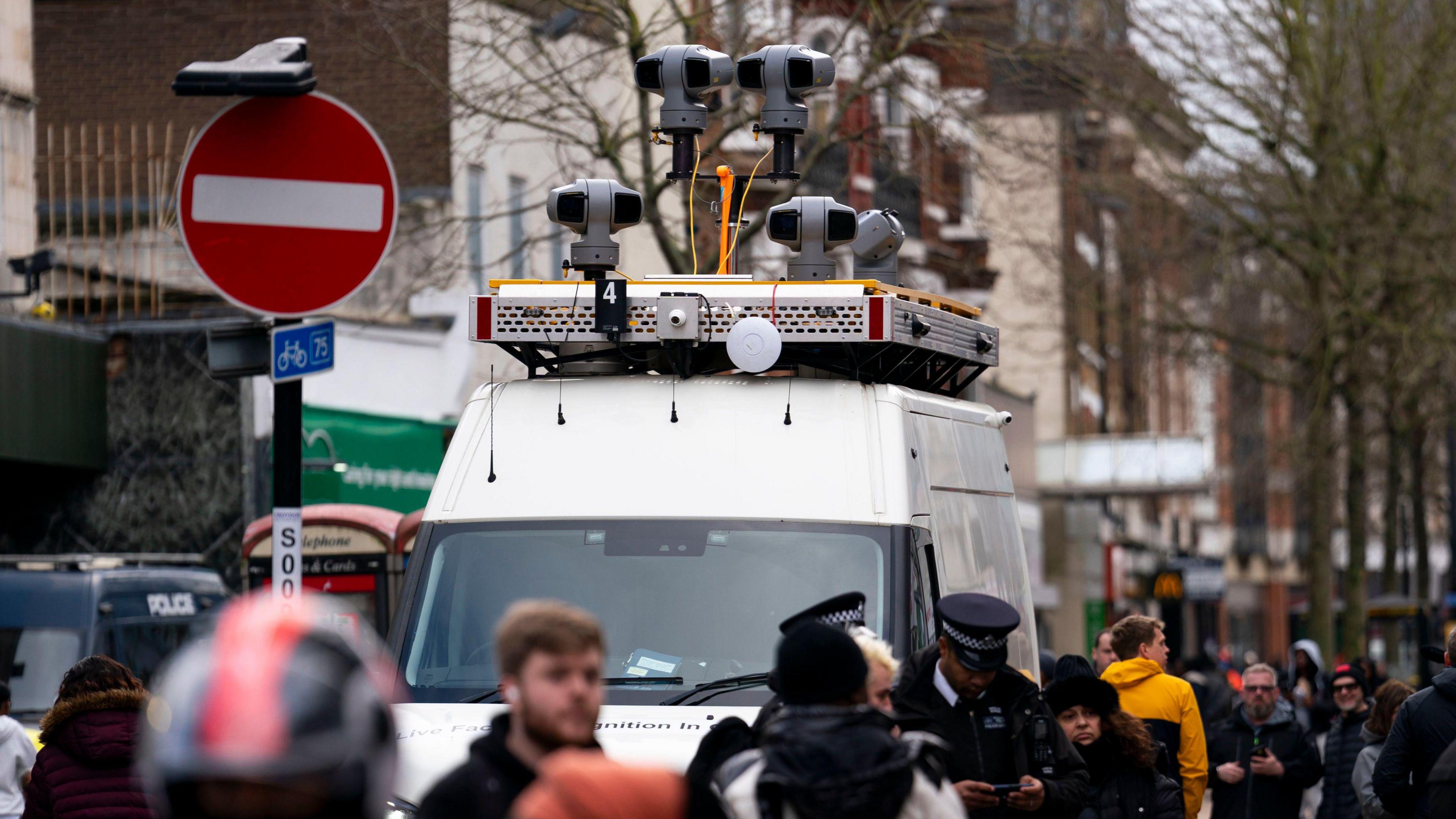
The arrest, reported by Fraser Knight for LBC, is the most visible outcome yet of a technology infrastructure that has been assembling itself across London for years. Until now, the Met's LFR operations used vans parked at high-footfall sites: Oxford Circus, shopping districts, public events. Cameras mounted on the van roof captured faces, compared them in real time to a database of wanted individuals, and, if there was no match, deleted the images. The new fixed cameras change the geometry of that system. They do not drive away at the end of the day. They sit on street furniture, municipal lampposts, and public buildings, creating a permanent biometric collection surface across the city.
The Croydon arrest landed in a policy vacuum that had been reshaped only three weeks earlier. On 21 April 2026, the High Court in London dismissed a legal challenge to the Metropolitan Police's use of live facial recognition technology, the BBC reported. The claim had been brought by youth worker Shaun Thompson and Silkie Carlo, director of the campaign group Big Brother Watch, who argued that the Met's deployments amounted to mass biometric surveillance that was neither lawful nor proportionate.
Thompson had standing that was difficult for the court to ignore. In 2023, he was stopped and questioned by police after an LFR system wrongly identified him as someone on a watchlist, Courthouse News Service reported. A false positive had turned a youth worker into a suspect, and the experience became the factual spine of the legal challenge. The High Court, however, ruled that the Met's existing policy framework was sufficient. The judges found that the force's use of the technology did not breach human rights law, and that the watchlist-based system contained adequate safeguards.
The ruling was not merely a legal defeat for the claimants. It was a green light. Within hours of the judgment, the UK government signalled that it welcomed the outcome and intended to support the rollout of facial recognition systems across the country, Sky News reported. A technology that had been framed as a temporary, geographically bounded policing tool was being reclassified, in real time, as national surveillance infrastructure.
Big Brother Watch previously described the 'mass biometric surveillance' of people going about their daily lives as 'disturbing.', Big Brother Watch, as quoted in <a href="https://www.msn.com/en-gb/news/world/two-people-fail-in-bid-to-stop-live-facial-recognition-cameras-in-london/ar-AA21pibs">Metro</a>
To understand what that infrastructure actually does, it helps to follow the data. The Met's LFR system, whether van-mounted or fixed, operates on a watchlist model. A list of individuals wanted by police, suspects in criminal investigations, missing persons, individuals subject to court warrants, is loaded into the system. Each camera continuously captures video of the public space it surveys. Faces are detected, isolated, and converted into biometric templates: mathematical representations of the distances between facial landmarks. Those templates are compared against the watchlist in near-real time. If the system finds no match, the template and the source image are deleted, according to the Met's published policy. If a match is declared, a human officer reviews the alert before any action is taken.
The architecture sounds tidy on paper. In practice, the step that nobody is regulating is the match threshold itself. Every facial recognition system operates on a confidence score. Set the threshold too high and the system will miss genuine matches. Set it too low and it will generate false positives, flagging innocent people as persons of interest, as happened to Thompson. The Met has not published the confidence thresholds it uses, nor has any independent auditor been given access to the watchlist composition, the demographic distribution of the gallery, or the false-positive rates broken down by age, gender, and ethnicity. Researchers have repeatedly shown that facial recognition systems perform less accurately on darker-skinned faces and on women, and the absence of published, disaggregated performance data is the gap through which entire civil-liberties arguments fall.
The question of whose body produces the data, and whose business buys it, extends far beyond policing. On 28 April, Disneyland Resort in Anaheim, California, expanded its facial recognition system to nearly every entry gate at both Disneyland Park and Disney California Adventure, the Los Angeles Times reported via the Spokesman-Review. Disney frames the system as a convenience feature: guests who opt in can enter the park without presenting a ticket or ID, because the gate camera recognises their face. The company says participation is voluntary, that the biometric data is converted to a numerical token, and that the images are deleted after the visit.
The word "voluntary" is doing heavy lifting here. A family arriving at Disneyland encounters a choice: stand in a slower queue and present physical documents, or walk through the faster lane by submitting to a face scan. The infrastructure is designed to make the biometric path the path of least resistance. And once a face template enters Disney's system, the downstream data-sharing question becomes paramount. The World Socialist Web Site reported that the expansion has raised concerns about data sharing with authorities, noting that private-sector biometric databases are increasingly accessible to law enforcement through subpoenas, warrants, and informal arrangements that fall outside public oversight.
The Disney deployment and the London LFR expansion share a structural feature that civil-liberties advocates consider the central regulatory failure: neither system requires meaningful, informed consent. In London, a person walking down Oxford Street or through Croydon town centre cannot opt out of being scanned. The camera captures every face that passes its field of view. The Met's position is that consent is not required because the images of unmatched individuals are deleted. But the deletion occurs only after the biometric template has been generated and compared. The scanning itself is non-consensual. The data processing happens before any deletion decision is made.
The same week the High Court issued its ruling, a city council in Oklahoma took a quieter step in the same direction. The Lawton City Council approved a policy governing police use of facial recognition technology, Biometric Update reported, moving the city closer to deploying Clearview AI, the controversial company that has scraped billions of face images from the public web to build a search engine for faces. Clearview's database is fundamentally different from the Met's watchlist model. Rather than comparing faces against a curated list of known suspects, Clearview allows law enforcement to search an unknown face against a gargantuan, privately assembled database of images harvested from social media, news sites, and any publicly accessible webpage.
The data flow in a Clearview deployment inverts the traditional policing model. In the Met's LFR system, a watchlist comes to the camera. With Clearview, a single face image, perhaps from a surveillance camera, a bystander's phone video, or a doorbell camera, goes to the database, and the database returns all publicly available images of that person, along with the URLs where they were found. The subject of the search never knows it happened. There is no deletion guarantee, because Clearview does not control the source images; it indexes what already exists online. The company has faced enforcement actions from data protection authorities in multiple countries, but it continues to sign contracts with police departments across the United States.
Lawton's policy approval represents the municipalisation of a technology that, five years ago, was treated as radioactive by most city governments. The shift is not accidental. It reflects a deliberate strategy by facial recognition vendors to normalise the technology from the ground up: secure a small-city contract, run a pilot, produce a success story, and use it to open the next, larger door. The strategy works because policing policy in the United States is radically decentralised. There is no federal law governing police use of facial recognition. There is no federal requirement to publish accuracy data, audit match thresholds, or conduct community impact assessments before deployment.
The architecture of non-consent
What connects the Croydon fixed camera, the Disneyland entry gate, and the Lawton police department's Clearview contract is a shared theory of consent that is, on examination, no consent at all. In each case, the individual whose face is being scanned is presented with a system that has already been installed. The decision to deploy the cameras, select the vendor, configure the software, and set the match threshold was made by a small group of people, police executives, corporate security directors, city procurement officers, none of whom are accountable to the people being scanned. The moment of data capture is the end of a long chain of decisions, not the beginning of one.
Civil-liberties organisations across Europe and the United States have spent years trying to insert accountability into this chain. NOYB, the European privacy group founded by Max Schrems, has filed complaints against facial recognition deployments under the GDPR, arguing that the indiscriminate collection of biometric data from public spaces violates the principle of data minimisation. The European Digital Rights network (EDRi) has pushed for a full ban on real-time biometric surveillance in public spaces in the EU's AI Act negotiations. Access Now has documented facial recognition deployments in over 75 countries and found that the overwhelming majority lack any legislative authorisation. The pattern, these groups argue, is not a series of isolated deployments but a coordinated push by the surveillance industry to establish the technology before the law can catch up.
The UK is now a test case for what happens when the law does catch up, and the result is authorisation rather than restriction. The High Court's ruling did not find that LFR was privacy-protective; it found that the Met's policy framework was not so deficient as to be unlawful. The distinction matters because it leaves the door open to incremental expansion. The fixed cameras in Croydon will become fixed cameras in Birmingham, Manchester, and Glasgow. The watchlists will grow. The match thresholds will be tuned for operational efficiency rather than civil-liberties protection, and the tuning will happen behind closed doors.
In the United States, the Lawton deployment points toward a future in which Clearview-style searching becomes a routine policing tool in cities that never held a public hearing on the technology. The policy approved by the Lawton City Council, Biometric Update noted, was a prerequisite for deployment, but the deployment decision itself has not yet been made. The council approved the rules of the road before deciding whether to drive on it. Santa Fe, New Mexico, is reportedly further behind, still developing its own policy framework. The staggered pace means that, in the absence of a federal standard, the United States is running dozens of simultaneous, uncoordinated experiments in biometric policing, with no central repository of outcomes, error rates, or harm assessments.
The Disneyland deployment, meanwhile, extends the biometric surface area of private-sector surveillance into spaces designed for children. A generation of visitors will grow up with face scanning as a routine part of entering a theme park, a stadium, or a shopping centre. The normalisation effect is not a side effect of the technology; for the vendors selling it, normalisation is the business model. Once a population accepts biometric scanning at the amusement park, it becomes harder to argue that the same scanning is unacceptable on the high street. The distinction between public and private surveillance blurs not because the law changes, but because the lived experience of being scanned becomes ambient.
Researchers at the University of Cambridge's Minderoo Centre for Technology and Democracy have been running data-broker audits that trace exactly how biometric data moves from collection points, a police camera, a retail scanner, a stadium entry gate, into commercial databases and back into law-enforcement tools. The audits have found that data-sharing agreements between private operators and public agencies are rarely disclosed, even when the same facial recognition vendor supplies both sectors. The vendor ecosystem is remarkably concentrated: a small number of companies provide the core algorithms, and an equally small number of system integrators customise them for different clients. The concentration means that a privacy failure in one deployment is often a privacy failure in many, but the contractual silences around data-sharing make it impossible for an outside researcher, let alone a member of the public, to trace the full path of a single face template.
The UK government has not published a timeline for the national rollout of LFR, nor has it committed to a parliamentary vote on the expansion. The policy shift is being driven through police procurement frameworks and Home Office guidance documents, not primary legislation. For readers who want to verify the scope of deployments in their own area, the Metropolitan Police publishes deployment locations and dates on its website, though the data is retrospective and does not include fixed-camera sites. The UK Biometrics and Surveillance Camera Commissioner, an oversight role created by the Protection of Freedoms Act 2012, publishes annual reports, but the office has no enforcement powers and cannot compel police forces to disclose accuracy data. The commissioner's next report is expected before the summer recess.
The woman arrested in Croydon had been wanted for twenty years. That is a genuine policing outcome, and it is the outcome the Met will foreground as the fixed-camera network expands. What the arrest does not tell us is how many people were scanned to find her, how many false matches were reviewed and discarded, or whether the system performs equally across the full demographic range of the south London population it now watches permanently. Those numbers are not published. Until they are, the public is being asked to trust an infrastructure it cannot audit, operated at a scale it cannot measure, on the basis of success stories selected by the operator itself.
Read next