Smartphone Innovation Stalls as Industry Scrambles for a Next Chapter
Smartphones and tablets have become durable appliances replaced only when they break, leaving modular concepts, AI assistants, and new laptop hybrids as desperate attempts to reignite consumer interest.
 androidauthority.com
In this article
A CNET survey published in May 2026 asked 2,500 smartphone owners what would make them upgrade. The answer, stripped of all qualifiers, was: not much. Foldable screens ranked near the bottom of the list. AI integrations barely registered. The top reason for buying a new phone, by a wide margin, was a battery that no longer held a charge. Not camera specs. Not a thinner chassis. Not on-device intelligence. The battery died. So they walked into a store.
This is not a product category in crisis. This is a product category in retirement. The smartphone has reached the point where its users experience it the way they experience a refrigerator or a washing machine: a durable appliance that gets replaced when it breaks, not when a new model ships. The firms that make these devices know this. What they have not figured out is what to do about it. And so the industry, collectively, has decided to pretend that something interesting is happening.
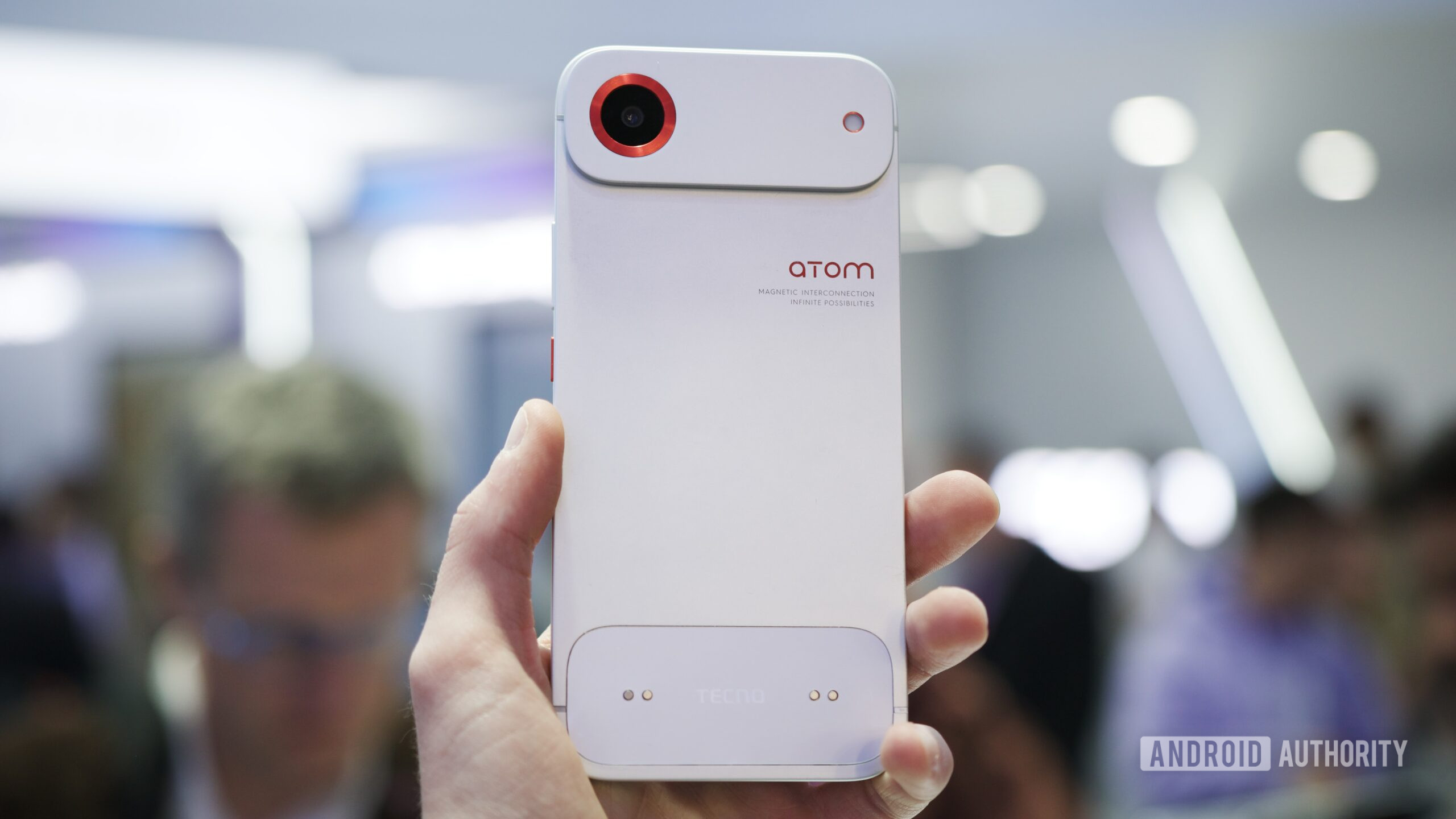
At Mobile World Congress in Barcelona in February 2026, Tecno showed a modular concept phone that, for a few news cycles, restored the sensation that phones could still surprise. The device starts as a 4mm-thin slab and uses magnetic connectors to snap on accessories: a battery pack that triples endurance, a periscope zoom lens, a secondary display. Android Police called it one of the standout devices of the show. Android Authority ran a hands-on declaring the concept "better than the iPhone Air in two ways." The excitement was genuine. The problem is that concept phones at trade shows have a perfect track record: they are remembered, they are praised, and they are never shipped.
Modular phones are not a new idea. Google's Project Ara generated similar enthusiasm in 2014 before being cancelled two years later. Motorola's Moto Z line shipped with magnetic modular accessories called Moto Mods; the line died quietly in 2019. LG tried it with the G5 in 2016. Fairphone continues to sell a repairable, modular-by-design handset in Europe, and its market share rounds to zero. The pattern is too consistent to ignore. Consumers say they want modularity in surveys. They do not buy it at retail. Tecno's concept is clever engineering that answers a question nobody outside a Barcelona convention centre is actually asking.
The question the industry keeps answering, instead of the one consumers are asking, is "what else can we stuff into the package?" At the Android Show in May 2026, Google announced Gemini Intelligence, a rebranding and expansion of its on-device AI that now permeates Chrome, widgets, and a new laptop category called Googlebook. Digital Trends catalogued the announcements: Gemini will now generate custom widgets on command, complete web bookings inside Chrome, and anticipate user needs across Android 17 devices. The demo reel was polished. The features, taken individually, are technically impressive. Taken together, they represent the same strategy the industry has pursued since 2022: load the phone with capabilities so computationally demanding that last year's silicon feels inadequate.
But the CNET survey data tells a different story. When phone owners were asked what they actually use their devices for, the list was mundane: messaging, photography, web browsing, maps, streaming. Tasks a mid-range phone from 2023 handles without stuttering. The chasm between what manufacturers ship and what people do has never been wider. A phone that can draft emails with on-device generative AI is a phone solving a problem its owner does not believe they have.
ZeDNET, in its Best of MWC 2026 roundup, highlighted the Lenovo ThinkBook Flip, the Xiaomi 17 Ultra, and Honor's MagicBook Pro as the standout hardware. The editors noted that the Xiaomi 17 Ultra "feels like a camera that happens to make phone calls." This is, by now, the standard pitch for any phone above $1,000. It is not a communication device. It is not a pocket computer. It is a camera with a SIM card. The problem is that the camera on a 2025 flagship is already good enough for Instagram, for family photos, for the occasional concert video. The diminishing returns are now so steep they are essentially a cliff. A 200-megapixel sensor in a phone is not an upgrade. It is a rounding error.
The secondary consequence is economic. The refurbished smartphone market is accelerating as new-device prices climb past thresholds that consumers silently refuse to cross. The Financial Express reported in May 2026 that the refurbished phone segment is on track for its strongest growth year yet, driven almost entirely by iPhones. A two-year-old iPhone 16 Pro Max does everything a buyer needs. It costs 40 percent less. The math is not complicated.
Tablets reached this same destination earlier and with less ceremony. The iPad was introduced in 2010. Sixteen years later, the form factor is unchanged: a flat glass rectangle with a screen between 10 and 13 inches. Apple adds a faster chip each year. Samsung adds a better S Pen. The software gets modest multitasking improvements. But the fundamental question, "what is a tablet for?" has never been answered because the market answered it by accident: a tablet is a content consumption device that occasionally fills in for a laptop when a laptop is too much trouble. That is a real role. It is also a role a $350 device filled perfectly in 2021.
The numbers bear this out. Tablet sales have been flat to declining since the pandemic bump of 2020-2021. Apple remains the dominant player not because the iPad Pro is revolutionary but because the base iPad is fine. The upgrade cycle for tablets now exceeds five years. A device purchased in 2021 still runs the latest operating system, still streams video without issue, still handles email. The industry can ship a new iPad with an M6 chip and 16GB of RAM, and the consumer who owns a 2021 iPad Air will not care, because apps will not materially change in ways that require that silicon for another four years.
The Yahoo Tech feature "10 tech items that are no longer worth your money in 2026" catalogued a parallel phenomenon: the list of standalone gadgets that phones and tablets have rendered redundant. Standalone GPS units. Point-and-shoot cameras. Basic e-readers. MP3 players. The phone ate them all. The tablet ate the rest. And now the phone and the tablet have eaten themselves: there is nothing left to absorb, no adjacent category waiting to be vacuumed into the glass rectangle. The rectangle is full.
Googlebook and the Search for a Third Thing
Google's answer to saturation in phones and tablets, unveiled at the Android Show and Google I/O 2026, is a new laptop operating system that merges Android and ChromeOS into a single platform branded Googlebook. Digital Trends called it Google's attempt to build "the MacBook for Android buyers." The pitch is Gemini Intelligence running natively on a clamshell, with a Magic Pointer that turns the cursor into an AI-powered assistant, and seamless handoff between phone, tablet, and laptop. It is the ecosystem play Apple perfected a decade ago, repackaged for 2026 with an AI bow on top.
The problem is not the idea. The problem is that the idea solves a fragmentation issue most Android users have already learned to live with, and does so with unproven silicon, no confirmed pricing, and an operating system that must convince developers to target yet another platform. Google has launched and abandoned enough hardware initiatives that the default posture among reviewers and consumers alike is wait-and-see. Chromebooks succeeded because they were cheap and simple. Googlebook is neither. It is an AI laptop for people who might want an AI laptop, and there is no evidence yet that this group is larger than a few million early adopters.
ZaDNET's Best of MWC coverage noted that Lenovo and Xiaomi dominated the show floor with laptops and phones that were, above all else, iterative. "The most impressive thing about MWC 2026," the editors wrote, "was how little anyone tried to reinvent the wheel." This was meant as a compliment. Read differently, it is an indictment. An industry trade show where nobody tries to reinvent the wheel is an industry that has stopped believing in reinvention.
The fear that stalks every product briefing in 2026, whether anyone in the room says it aloud or not, is that the smartphone has become the personal computer. Not in the triumphant sense Steve Jobs meant when he introduced the iPhone. In the grim, mature-market sense: the personal computer market stopped growing in 2011. People replace PCs when they break. They replace phones when the battery dies. The two curves are converging, and nobody in Shenzhen or Cupertino or Mountain View has a slide deck that explains how to bend them back upward.
Eighteen Months Out
The question that separates a good hardware review from a useful one is not "what does this device do?" but "where will this device be in eighteen months?" For the Galaxy S26 Ultra, the answer is predictable: in someone's pocket, doing the same things the S24 Ultra did, with marginally better battery life. For the Tecno modular concept, the answer is not in anyone's pocket at all. It will occupy a display case at Tecno's Shenzhen headquarters, a footnote in a YouTube retrospective about phones that could have changed everything. For the Googlebook, the answer depends on whether Google commits for five years or loses interest after two. History suggests the latter. For the tablet, the answer is the most damning of all: it will be on a nightstand, streaming Netflix, and nobody will have thought about replacing it.
The smartphone and the tablet are not broken. They are complete. That is the insight the industry refuses to accept because accepting it means acknowledging that the cycle of annual upgrades, spec bumps, and trade-show reveals serves the companies, not the customers. The next genuinely interesting thing in consumer hardware will not be a better phone or a thinner tablet. It will be whatever comes after them. And the companies best positioned to build that thing are the same companies doing everything they can to avoid admitting the current thing is done.
Read next
