WARN Notices in 2026 Show Layoff Reality Hidden by Corporate AI Spin
Halfway through 2026, the federally mandated WARN notices reveal a stark divide between corporate AI layoff narratives and the actual severance and restructuring data companies file, exposing a labor market story that press releases consistently ignore.
 thecincinnatiexchange.com
Just over 5,000 working Tennesseans had been caught in layoffs or facility closures by the midpoint of 2026, according to WARN notices filed with the state and compiled by WSMV in Nashville. The latest notices came from a restaurant in East Tennessee and two companies in Middle Tennessee, not the kind of firms that make national headlines, but precisely the kind whose filings, aggregated across fifty states, compose the most reliable real-time picture of the American labor market anyone has.
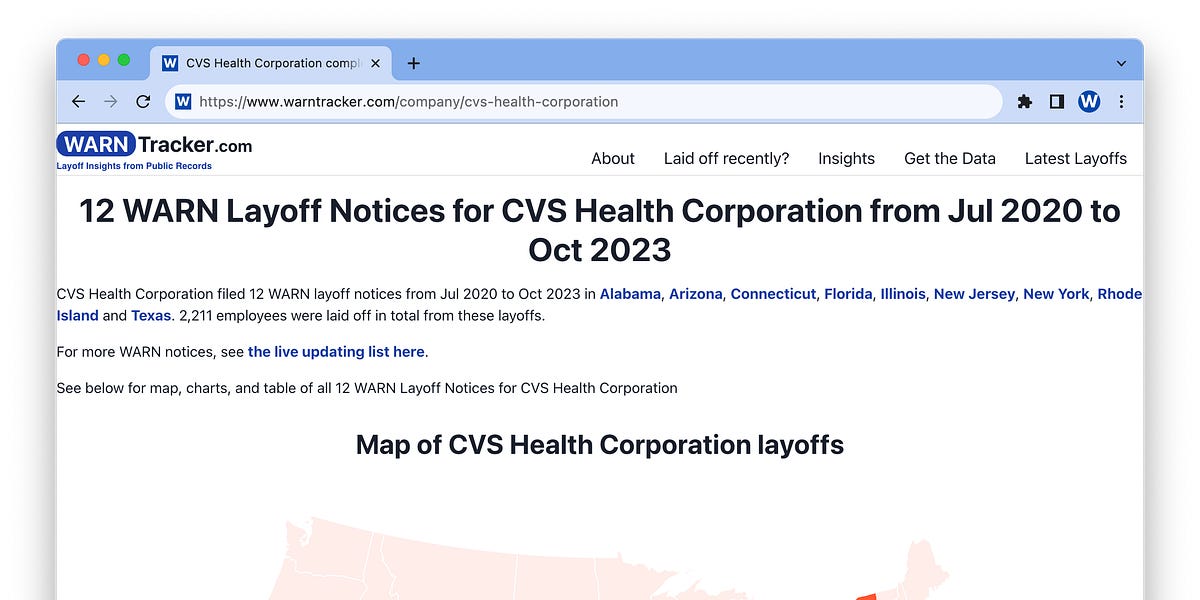
The Worker Adjustment and Retraining Notification Act turns thirty-eight this year. It requires employers with a hundred or more full-time workers to give sixty days' notice before a mass layoff or plant closing. What the law produces is a public ledger: a running tally of which companies are cutting how many workers, where, and on what timeline. The data is fragmentary, delayed, and maddeningly uneven across states, but it is also the only federally mandated disclosure that forces employers to put a number and a date on a decision they would otherwise announce in a blog post with an aspirational subject line.
Halfway through 2026, that ledger is telling a story that diverges from the dominant narrative in two important ways. First, the volume is accelerating. Tech Times reported that 247 layoff events displaced 183,966 workers across the tech, finance, and healthcare sectors as of mid-June, an average of 1,115 jobs lost every working day, nearly double the rate of 564 per day observed across comparable data. In Shelby County, Tennessee, Fox13 Memphis found that layoffs announced in the first half of 2026 had quadrupled compared with the same period in 2025. Second, and more telling, the official paperwork rarely says what the press releases say.
The most revealing dispatch on this subject ran late last month under a headline that gets directly at the discrepancy: "Everyone blames AI for retail layoffs: The WARN notices tell a different story." The piece, syndicated on MSN, examined the filings piling up across 2026 and found that the official record rarely names artificial intelligence as the cause. The stated reasons are more prosaic: facility closures, consolidation, restructuring, contract losses. The AI attribution, when it appears, shows up in the earnings call, the CEO memo, and the tech press, not in the document the company signs and submits to the state.
This gap matters beyond questions of corporate candor. The WARN notice is a legal instrument. What a company writes in the "reason for layoff" field is reviewed by state labor agencies and can be introduced in litigation. The AI narrative, by contrast, is a positioning instrument. It signals to shareholders that the company is forward-looking and capital-efficient. It signals to remaining employees that the cuts were inevitable, driven by technological forces beyond management's control. And it signals to policymakers that displacement is happening for the right kind of structural reasons, automation, not overhiring or strategic error.
The structural mechanics of how companies actually execute large-scale separations are even less visible than the reasons they give. The WARN Act's sixty-day clock is, in practice, a severance negotiation conducted in reverse. Employers who want to reduce headcount immediately can do so by paying workers for the notice period in lieu of time worked, the legal term is "pay in lieu of notice," and it effectively converts a statutory protection into a line item on a separation agreement. The company writes a check, the worker signs a release, and the sixty-day buffer collapses to a Friday afternoon.
Oracle's 2026 layoff cycle, which Forbes reported reached 30,000 workers, is the most extreme recent case study in how this mechanism scales. According to Tech Times, the company folded the sixty days of legally required WARN notice into the severance package itself, workers who had not signed separation agreements by early June were warned they would forfeit severance. The arrangement creates a hard tradeoff: accept the company's terms within a narrow window or lose the financial cushion entirely. The WARN clock, designed to give workers time to prepare, is repurposed as a pressure mechanism for the employer's preferred release terms.
The Oracle example also surfaces a secondary cost that WARN filings do not capture: unvested equity. Multiple reports indicated that laid-off Oracle workers lost restricted stock units that had not yet vested, a standard consequence of separation that nonetheless compounds the effective financial loss well beyond the severance multiple a WARN notice might imply. For a senior engineer hired three years ago with a four-year grant, a layoff can mean walking away from a quarter of the equity package that was part of the original compensation bargain. The WARN ledger registers the headcount reduction. It does not register the unvested equity forfeited alongside it.
The severance landscape across large tech employers has settled into a narrow band. Business Insider reported in May that Meta's 2026 layoffs, expected to eliminate around 8,000 roles, provided sixteen weeks of base pay plus two additional weeks for every year of service. That is roughly in line with what other large-cap tech firms have offered in recent cycles, generous by the standards of the broader economy, where the WARN Act's sixty days of pay often functions as the de facto severance ceiling, but well short of what workers at these companies would have earned had they remained employed through a full vesting cycle.
What makes the Meta severance structure notable is not its generosity but its consistency. Across multiple rounds of layoffs since late 2022, the formula has barely changed. It has become a standard product: sixteen weeks of base pay, an additional week or two per year of tenure, six months of COBRA coverage, and career services that most recipients report using exactly once. The predictability is itself a signal. A company that repeats the same severance formula across three or four cycles is not responding to changing conditions. It has built a recurring operational process.
Walmart's June 2026 WARN filing adds another layer to the picture. The company disclosed 306 job cuts at its technology campus in Sunnyvale, California, a campus that had opened barely a year earlier, in April 2025, to considerable fanfare about Walmart's "next-generation workplace." The juxtaposition of a ribbon-cutting and a WARN notice twelve months apart is the kind of detail that only shows up when you compare real estate announcements against state filings. The East Bay Times reported that multiple companies, including Uber, had slashed Bay Area tech positions in the same period, signaling what the paper called "fresh waves of layoffs for the region's technology sector."
The Walmart case also illustrates how the WARN system interacts with state-level variation. California's WARN Act, unlike the federal version, applies to employers with seventy-five or more employees and covers layoffs of fifty or more workers at a single site. The lower threshold means more California layoffs produce public filings than in states without mini-WARN laws. Nebraska, meanwhile, enacted its own mini-WARN statute in May 2026, requiring ninety days' advance notice for business closings and mass layoffs, a fifty percent increase over the federal sixty-day standard. The patchwork of state laws means that identical corporate restructuring decisions produce different paper trails, different notice periods, and different severance economics depending on which building the affected workers happened to occupy.
This jurisdictional variation is not a minor footnote. It creates a structural incentive for employers to concentrate layoffs in states with weaker notice requirements whenever they have discretion over which sites close first. A company with facilities in Tennessee and California facing the same headcount reduction target will, all else equal, find it cheaper and faster to cut in Tennessee. The WARN filings themselves do not reveal this calculus, but the geography of the notices, aggregated across years, makes the pattern legible.
The layoff notices piling up across 2026 rarely name AI as the culprit. The stated reasons are facility closures, consolidation, restructuring, and contract losses, the same reasons that appeared in WARN filings ten and twenty years ago., MSN Money, analyzing WARN filings across retail and office sectors, June 2026
The legal machinery around the WARN Act continues to grind in ways that clarify what employers actually owe. In late June 2026, the U.S. District Court for the District of Delaware affirmed the disallowance of federal WARN Act claims against Yellow Corporation, signaling judicial skepticism toward arguments that a "liquidating fiduciary" can be held liable for notice violations after a company has already collapsed. The ruling is narrow but consequential: it means that workers at the end of a failed company's life cycle may find their WARN claims subordinated to other creditors, transforming a statutory right into a contingent, and potentially worthless, paper claim.
The Yellow Corporation ruling, the Oracle release-or-forfeit structure, the Walmart Sunnyvale reversal, and the Nebraska ninety-day standard are not disconnected developments. They are points on a single curve. The WARN Act was designed in 1988 to give workers and communities time to adjust to mass layoffs. Thirty-eight years later, the system has evolved into something closer to a severance pricing mechanism, one that employers navigate with increasing sophistication, and one whose public filings provide a more honest accounting than anything the companies volunteer.
The gap between the AI narrative and the WARN record is the most legible version of this dishonesty, but it is not the most consequential. The deeper story is about who pays for the adjustment period that the law was designed to guarantee. When an employer converts the sixty-day notice period into a severance check, the worker gets cash but loses time, time to find another job while still employed, time to negotiate from a position of having a job rather than having lost one, time to arrange healthcare transitions without a gap. The severance check compensates for the loss of income. It does not compensate for the loss of leverage, which is harder to price and appears nowhere in a WARN filing.
What to watch in the second half of 2026: the Nebraska mini-WARN law takes effect in mid-July, adding a ninety-day requirement to a state whose largest employers include several insurance and financial-services firms with substantial back-office workforces. If those employers begin filing WARN notices with ninety-day lead times instead of sixty, it will surface a natural experiment, do longer notice periods change the severance calculus, or do employers simply write larger checks and keep the timeline tight? The answer will say more about the real economics of the WARN-notice cycle than another year of aggregated layoff counts ever could.
Read next