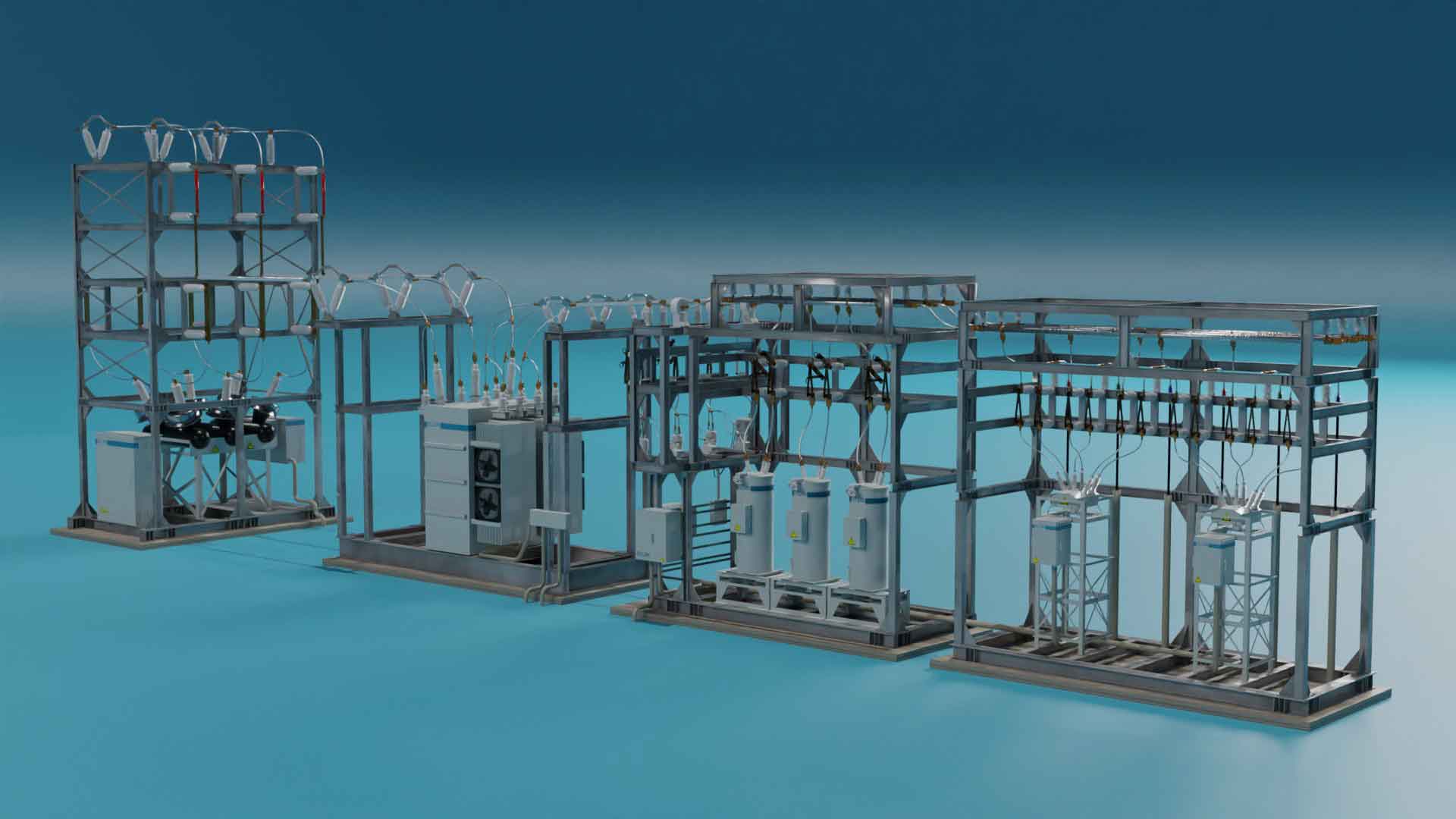
Modular Data Centers Reshape the Edge One Factory-Built Skid at a Time
Hyperscale campuses still grab headlines, but the real edge computing buildout in 2026 is factory-based, as modular data halls roll off production lines and ship directly to urban substations, car parks, and rooftops.
 modular.org
In this article
In Chantilly, Virginia, 26 miles west of the White House, a low-slung industrial unit changed hands on the final day of March 2026. The acquirer was Compu Dynamics Modular, known to the trade as CDM. The target was R&D Specialties, a modest firm with a particular and suddenly precious skill: fabricating the steel frames, mounting rails, and integrated busway assemblies that turn a standard shipping-container footprint into a fully operational data centre module. The price was not disclosed. The significance was. A single production line in that Virginia facility can now turn out a 500-kilowatt module, fully commissioned and factory-tested, in six weeks.
Six weeks. That number, or something near it, is what has rewired the economics of compute delivery in 2026. It means a colocation provider can sign a lease, pour a pad, and accept live customer racks inside a calendar quarter. It means a wireless carrier can add inference capacity at a tower site between spectrum auctions. It means a municipality can stand up a small-footprint datacentre in the car park behind the planning office before the next budget cycle closes. The modular data centre, dismissed for a decade as a niche product for mining camps and military forward-operating bases, has become the delivery mechanism the AI infrastructure boom could not do without.
The numbers behind the shift are large enough to make the point unaided. Gartner estimated in January that worldwide spending on AI infrastructure alone will reach $1.37 trillion in 2026, accounting for over 54 percent of total AI expenditure and rising 43 percent over 2025 levels, with a further 28 percent increase projected for 2027. Joseph F. Kovar, writing in CRN's AI 100 list in April, noted that the infrastructure category now encompasses everything from individual CPUs and GPUs to massive rack-scale systems, and that the spending is pulling an entire supplier ecosystem forward with it. But the aggregate figure conceals a structural shift: an increasing share of those dollars is paying for capacity that was not dug into the ground on a greenfield site. It was bolted together indoors, under a roof, with quality-control inspectors walking the line.
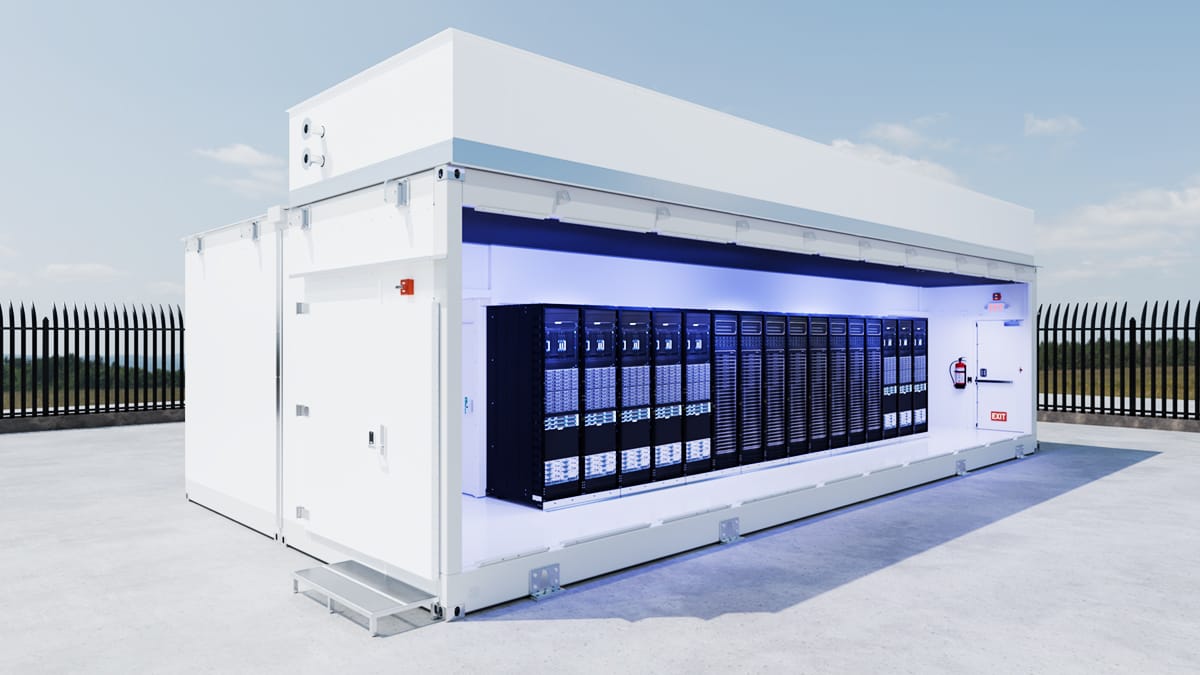
To understand why that matters, it helps to understand what a modular data centre actually is. The term covers a spectrum from fully containerised units, essentially server rooms inside ISO shipping containers with integrated cooling and power distribution, to prefabricated skids that are assembled on site into larger data halls. What unites them is that the mechanical, electrical, and plumbing work happens in a factory, not in a muddy construction site in Loudoun County or outside Council Bluffs. The distinction between contracted load and connected load becomes critical here: a factory-built module arrives with its power distribution already commissioned to a specified contracted load, meaning the utility interconnection timeline shrinks from eighteen months to something closer to twelve weeks. For an industry where time-to-energisation now routinely determines competitive position, that gap is everything.
CDM's acquisition of R&D Specialties, announced via Globe Newswire on 31 March, was explicitly framed around AI infrastructure demand. The release noted that R&D Specialties brought proprietary welding techniques, in-house powder coating, and certified UL 891 switchboard fabrication, capabilities that allow CDM to control its supply chain from raw steel through commissioned module without subcontracting the electrical backbone. That vertical integration matters when lead times for medium-voltage switchgear from traditional suppliers have stretched past 80 weeks. By owning the busway fabrication, CDM can deliver a fully integrated power train inside the module on its own schedule. It is, in effect, a bet that speed of assembly now beats scale of campus.
CDM is not alone in reading the market this way. Comfort Systems USA, the Houston-based mechanical and electrical contractor, reported first-quarter 2026 revenue of $2 billion, a 56.5 percent year-on-year increase, driven almost entirely by data centre construction and prefabrication. The company has been expanding its modular assembly facilities in the American South, running three shifts in some locations to keep pace with hyperscaler orders for prefabricated mechanical skids. A single Comfort Systems plant in Sherman, Texas now produces more cooling distribution modules in a month than the entire state procured in 2019. The firm's executives have described modular not as a different product line but as a different method of project delivery, one that moves the critical path from the jobsite to the factory floor.
The manufacturing logic is compelling on its own terms. A climate-controlled factory eliminates weather delays. Welding robots produce repeatable joint quality. Electrical testing can be completed before the module leaves the loading dock, rather than after a general contractor has enclosed the building. But the real force pulling modular toward the centre of the industry is not about building faster; it is about building closer to the point of consumption. That is where the modular story converges with the edge computing story, and where the geography of the thing becomes inescapable.
The edge has needed modular longer than modular has needed the edge. Inference workloads that must run within single-digit-millisecond latency of a user, whether for autonomous vehicle telemetry, real-time video analytics, or industrial machine vision, cannot traverse 80 kilometres of fibre to a regional hyperscale campus and back. They require compute within the metro area, often within the neighbourhood, sometimes within the building. But no one pours a $600 million concrete shell for a 2-megawatt inference cluster in a light-industrial zone in Queens. The unit economics do not work. A factory-built module delivered on a flatbed truck, however, does.
The economics of inference at the edge received an additional shove in March 2026, when Pasadena-based PrismML emerged from stealth with what it described as the world's first commercially viable 1-bit large language model. Led by Caltech mathematician Babak Hassibi, the team demonstrated that high-fidelity AI models could be radically compressed without the accuracy penalties that plagued earlier quantisation attempts. Forbes reported that the model could run inference on hardware drawing under 200 watts. A server consuming 200 watts does not need a dedicated substation. It does not need a chilled-water plant. It needs a weatherproof enclosure, a network uplink, and a power feed that any commercial electrician can pull from a building's main switchboard. That changes where compute can live.
Nowhere is the tension between where compute wants to go and where it is allowed to go more acute than in New York. A panel convened by Construction Dive in March 2026 made the point bluntly: a single constraint may decide whether New York successfully captures the next wave of datacentre investment. That constraint is power. The city's grid is dense but old, and the available capacity at the distribution level is fragmented across thousands of secondary network nodes, each with its own transformer rating, fault-current limits, and queued interconnection requests. A 10-megawatt hyperscale hall in Midtown Manhattan is not going to happen. A 500-kilowatt modular unit tucked into the basement of a telecoms hotel in Hudson Square might, provided Con Edison can deliver a clean 480-volt service.
The power question is not unique to New York. In Dutchess County, 90 minutes north of the city, a developer that had initially planned warehouses on a parcel near the town of Wappinger is now considering a 1,000-megawatt data centre instead, as The Journal News reported in early May. The proposed load drew immediate scrutiny from state senator Liz Krueger, who told the press the project would draw approximately double the energy usage of all households in New York combined, a claim PolitiFact rated as mostly false but indicative of the political temperature. The episode revealed a fault line that runs through every major datacentre market in 2026: large-scale builds attract opposition. Small-scale builds, below the threshold of public notice, do not.
That is the opening through which modular and edge buildouts are now moving. A 2-megawatt modular installation on a substation-adjacent industrial lot does not require a county-wide environmental impact statement. It does not make the evening news. It arrives on six trucks, gets craned onto pre-poured pads, and begins drawing power before the next planning commission meeting. CNBC reported in late April that public support for large-scale datacentre buildouts is declining across the United States, and that a new class of equipment designed to operate inside individual homes and small commercial properties is entering the market. The report described units the size of a domestic boiler, liquid-cooled and nearly silent, capable of running always-on inference workloads at the household scale.
What the factory actually builds
The term modular can obscure as much as it reveals. A factory-built data centre is not simply a container with servers in it. It is an integrated assembly that compresses what would ordinarily be six or seven subcontractor scopes into a single bill of materials: structural steel, fire suppression, power distribution, cooling distribution, network patching, and building management system integration. The cooling architecture deserves particular attention because it is often the deciding factor in whether a site can accept a module at all. Traditional chilled-water plants require cooling towers, make-up water lines, and chemical treatment systems, infrastructure that is impractical at a rooftop or car-park site. Direct-to-chip liquid cooling and immersion cooling, supplied by vendors such as CoolIT, Submer, and Iceotope, have changed the calculus. A module equipped with a sealed liquid-cooling loop can reject heat through a dry cooler the size of a parking space. That eliminates the water requirement and, not incidentally, eliminates the water-use permit.
We are past the point where modular meant compromised. Today it means pre-commissioned, factory-tested, and delivered to a higher reliability spec than most site-built halls achieve in their first year of operation., Senior facilities engineer at a North American hyperscaler, speaking on background
The shift has not gone unnoticed by the large original equipment manufacturers. Super Micro Computer, which projects revenues of at least $33 billion for fiscal 2026, has been expanding its modular data centre offerings alongside its traditional server business. The company's rack-scale integration facility in San Jose now produces fully populated racks that ship with cooling loops pre-filled and power distribution units pre-commissioned, a configuration that crosses the line from modular component to modular data centre. Barchart reported via Yahoo Finance in late April that the modular data centre space is quickly becoming one of the most consequential battlegrounds for server vendors, because the customer who buys a pre-integrated module is unlikely to unbundle the purchase across multiple suppliers.
The supply chain implications ripple outward. A traditional datacentre build involves a developer, a general contractor, an electrical subcontractor, a mechanical subcontractor, a commissioning agent, and a facility operations team, each with its own contract, schedule, and incentive structure. A modular build collapses those roles. The module manufacturer becomes the single point of responsibility for everything inside the steel envelope. That appeals to hyperscalers who are managing dozens of simultaneous projects and want fewer interfaces to govern. It also appeals to smaller buyers, enterprises, universities, municipal broadband authorities, who lack the in-house engineering teams to manage a conventional build but can evaluate a factory-tested module against a straightforward specification sheet.
There is a subtler consequence as well, one that transmission planners at the independent system operators have begun to notice. When load can be added in 2-megawatt increments rather than 100-megawatt increments, it can be matched more precisely to available grid capacity at the distribution level. A substation with 8 megawatts of headroom can accept four modules. It cannot accept a hyperscale campus. The result is that modular buildouts are utilising grid capacity that would otherwise sit idle, raising the aggregate load factor of existing infrastructure rather than triggering new transmission buildout. Whether that is a feature or a loophole depends on whom you ask at the public utility commission. But the electrons do not care.
The cooling question loops back into the geography question. In Reykjavík, where this reporter is based, the modular conversation takes on a different timbre. Iceland's grid runs on hydropower and geothermal, its ambient air temperature rarely exceeds 15 degrees Celsius, and its fibre connections to Northern Europe and North America are among the lowest-latency transatlantic routes available. Modular data centres have been deployed here for cryptocurrency mining for a decade. What is new is that the same factory-built enclosures are now being specified for inference workloads that serve European and East Coast American users from a midpoint that happens to have free air cooling nine months of the year. The module does not need to know it is sitting on a lava field. It needs a power feed, a network link, and a dry cooler that will run at near-zero fan speed for most of its operational life.
What to watch for
The modular buildout wave has not yet peaked, and two indicators will signal when it is approaching the top. The first is the lead time on factory-built modules themselves. If CDM, Comfort Systems, and their competitors begin quoting delivery windows longer than 20 weeks, the speed advantage that justifies the modular premium will have eroded. The second is the queue for distribution-level interconnections at urban substations. Con Edison in New York, ComEd in Chicago, and PG&E in Northern California all publish interconnection queue data on a rolling basis. When the queue depth at the 480-volt and 12-kilovolt level begins to resemble the queue at the transmission level, the edge buildout will have hit the same grid-constraint wall that the hyperscale buildout hit three years earlier.
There is a third indicator, less quantitative but equally telling: the zoning board agenda. In Fairfax County, Virginia, not far from CDM's Chantilly facility, the planning commission has begun receiving applications for data centre modules on parcels zoned light industrial, parcels that would never have been considered for a conventional build. Approval times on those applications are running under 90 days. When that number starts to stretch, or when neighbourhood associations begin adding modular data centres to their lists of grievances alongside cell towers and self-storage units, the phase of quiet expansion will be over. For now, the trucks are still rolling. The next checkpoint is the third quarter of 2026, when the interconnection queues from the spring buildout wave will produce their first clear signal about whether the grid can absorb the load as fast as the factories can produce it.
Read next