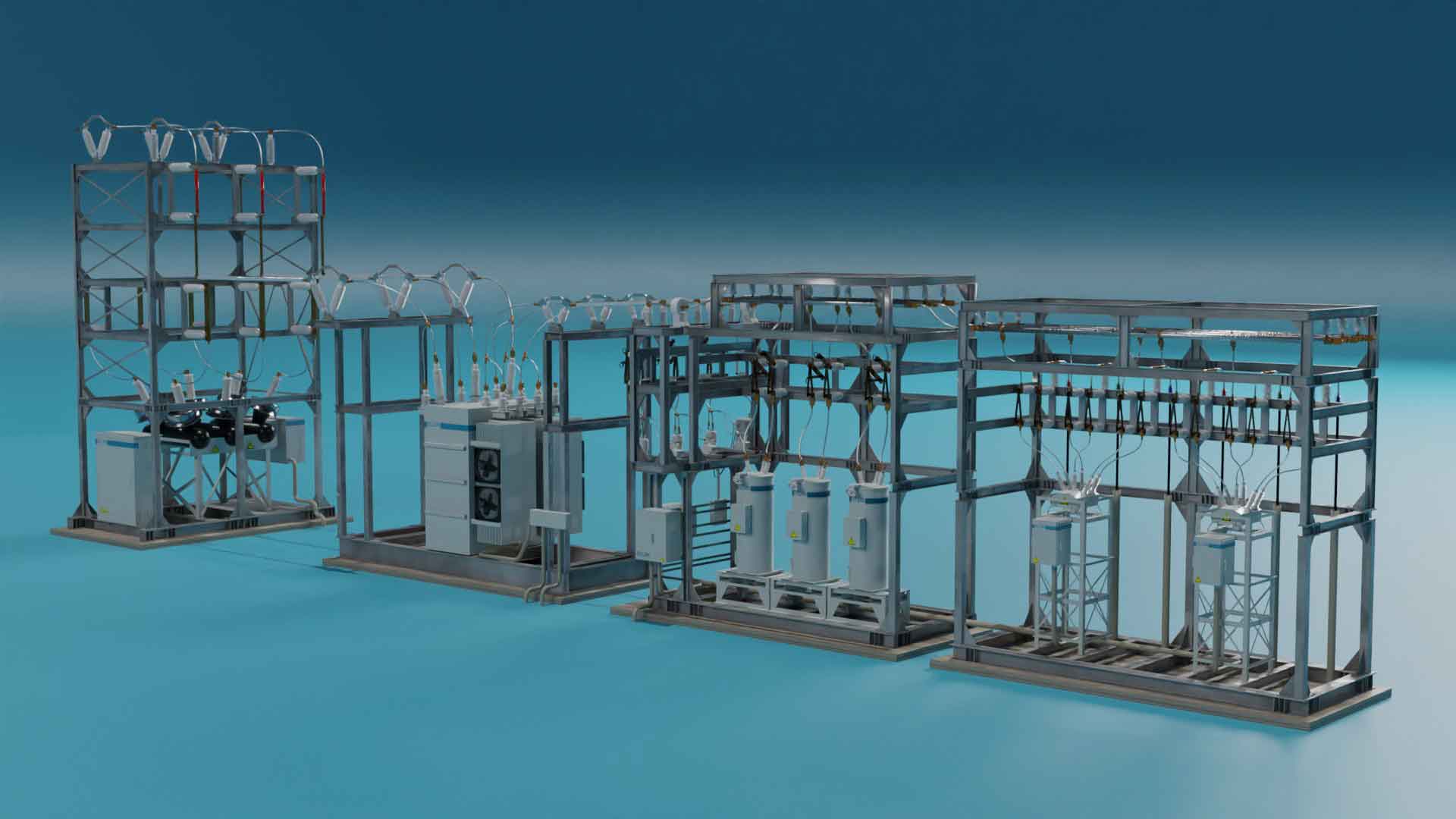
Modular data centre buildout transforms into factory production
As Armada's $230 million Arizona factory and Comfort Systems' record prefabrication backlog signal, modular data centre construction is no longer experimental, instead reshaping AI's physical footprint from edge pods to fibre backbones.
 cnbc.com
On 19 May 2026, a three-year-old startup named Armada closed a $230 million funding round that valued the company at $2 billion. The lead investor was BlackRock. The disclosed use of proceeds was not another tranche of GPUs or a software platform. It was a factory. Armada, reported CNBC, will build a manufacturing plant in Arizona with new investor Johnson Controls, a facility it has named Galleon Forge One. The factory is intended to produce portable, modular data centres at a pace that site-by-site construction cannot match.
The announcement landed in the middle of a quarter that had already made one thing unmistakable: modular and edge data centre buildouts are no longer a niche. They are a procurement category. SiliconANGLE reported that Armada's portable units combine satellite internet software with self-contained compute enclosures designed to operate far from any hyperscale campus. The Arizona factory is meant to turn those units from a bespoke engineering exercise into a manufactured product line.
Armada is the visible tip of a shift that runs much deeper through the physical supply chain of compute. In March, mechanical and electrical contractor Comfort Systems USA disclosed plans to expand its prefabrication and modular capacity by 30 percent during 2026, Simply Wall St reported via Yahoo Finance. The company, which installs heating, ventilation, air conditioning, plumbing, and electrical systems for commercial and industrial buildings, had already seen its backlog swell as hyperscale and colocation customers accelerated orders. By late April, when Comfort Systems reported first-quarter results, Seeking Alpha noted that the company had again topped estimates and that the backlog was still climbing.
The numbers attached to Comfort Systems tell the story in hard figures. Zacks Equity Research projected the company's sales would grow 31 percent in 2026, according to a report carried by MSN. That is not the growth rate of a contractor riding a routine construction cycle. It is what happens when an entire category of physical infrastructure needs to be produced faster than the traditional general-contractor model allows. Prefabrication, which moves electrical switchgear assembly, pipe welding, and duct fabrication from a muddy job site into a controlled factory floor, is the mechanism through which speed compresses.
The distinction worth understanding here, and one that transmission planners at ISOs have been making with increasing urgency, is between contracted load and connected load. A data centre project can secure a power reservation from a utility, announce a groundbreaking, and still be years away from drawing actual megawatts. Factory-built modular units compress the gap. A prefabricated electrical room or a containerised cooling plant arrives on-site with internal connections already tested, reducing the window between delivery and energisation from months to weeks. The local substation tells the real story, and what substation engineers across northern Virginia, Phoenix, and West Texas are seeing is a queue of projects that intend to connect faster than the historical record suggests is possible.
The factory model also changes who can participate. Armada's Galleon Forge One is being built in partnership with Johnson Controls, a company whose core competency is building automation and HVAC, not semiconductor fabrication. The supply chain is reorganising around firms that know how to manufacture physical enclosures, manage thermal loads, and ship completed assemblies on a flatbed lorry. Comfort Systems is expanding modular capacity in its own fabrication shops. Super Micro Computer, long known as a server original design manufacturer, has been expanding its data centre offerings into the modular space, as Barchart reported via Yahoo Finance, describing the modular data centre segment as quickly becoming one of the most competitive in the industry.
The Edge Arrives in a Texas Strip Mall
If the factory story is about producing modular capacity, the edge story is about where that capacity gets deployed. On 12 May 2026, Duos Edge AI opened what it described as Corpus Christi's first AI-ready edge data centre on Tancahua Street, the Corpus Christi Caller-Times reported. The facility was designed, the paper noted, to provide reliable connections for businesses, schools, and hospitals to run their online applications and data tools without latency. Two days later, on 14 May, Duos Edge AI held an open house at a second edge data centre in Victoria, Texas, according to a GlobeNewswire release carried by Markets Insider.
These are not hyperscale campuses. Victoria, Texas, has a population of roughly 65,000. The edge data centre there is not designed to train a foundation model. It exists to run inference workloads close to the end user, to cache content, and to process data that cannot economically or legally traverse a long-haul fibre route back to a regional cloud availability zone. The Corpus Christi facility, the Caller-Times reported, operates with what the company described as zero water use for cooling. In a part of Texas that has experienced recurring drought, that specification is not a marketing detail. It determines whether a municipal permit gets issued.
Duos Edge AI, a subsidiary of Florida-based Duos Technologies Group, has been placing these units in a pattern that traces a specific geography: downtown Amarillo, Lubbock, Corpus Christi, Victoria. Each site is chosen for proximity to a population centre that a hyperscale cloud provider would not build a dedicated availability zone to serve but that nonetheless houses hospitals, municipal offices, and industrial facilities generating data that needs local processing. The company proposed a 20-year lease on Potter County property in Amarillo, USA Today reported in mid-2025, aiming to improve broadband reliability and attract technology companies to the area.
The Fibre Beneath the Factories
The modular and edge buildout is not only a concrete and steel story. It is a fibre story. Clearfield, which manufactures fibre connectivity products, reported in its fiscal second-quarter 2026 earnings that demand was stabilising after a period of inventory corrections and funding uncertainty, with data centre prospects beginning to build materially. MarketBeat reported via Yahoo Finance that executives pointed to early signs of a recovery in orders. The specific products in demand were not the high-count fibre cables used in long-haul backbone networks but the modular, pre-connectorised assemblies that allow a fibre connection to be terminated in minutes rather than hours at an edge site.
At the Fiber Connect 2026 conference in early June, Data Center Frontier reported, Clearfield executives explained why the AI infrastructure buildout is pulling fibre closer to the edge. The logic is straightforward: a modular data centre in Victoria, Texas, or a portable Armada unit deployed at a remote industrial site is only as useful as the backhaul that connects it. Without dense, low-latency fibre, an edge node is an island. The optical transport and IP routing layer is where the upstream demand registers. In late April, Nokia received an analyst upgrade driven specifically by stronger optical and IP routing demand tied to data centre buildouts for AI workloads, The Motley Fool reported.
The capital now flowing into the modular and edge data centre space is large enough to reshape the supplier landscape. Armada's $230 million raise, at a $2 billion valuation, brought BlackRock onto the cap table alongside Johnson Controls. That combination, an asset management giant and an industrial controls company, signals how the investment community is classifying modular infrastructure: not as a real estate play and not as a software bet, but as a physical manufacturing opportunity with recurring service revenue attached. The Arizona factory, Galleon Forge One, is the concrete expression of that thesis.
The question hanging over all of this activity is whether the grid can keep pace. A modular data centre can be fabricated in a factory in six weeks, shipped on a lorry in three days, and commissioned in another two. The substation upgrade that needs to serve it, by contrast, can take eighteen months or longer depending on the ISO queue and the utility's interconnection study backlog. The difference between the speed of factory production and the speed of grid interconnection is the most important constraint the modular buildout faces, and it is not one that any startup's funding round can resolve.
What to watch for is straightforward. Armada has disclosed the factory but has not yet disclosed a production start date. Comfort Systems reports second-quarter earnings in late July; whether the modular backlog continues to accelerate will be the number to track. Duos Edge AI is opening edge data centres at a cadence of roughly one per quarter across Texas, and its expansion beyond the state border will signal whether the edge deployment model travels to regions with different utility regimes and different fibre density. The modular buildout has graduated from a concept to a supply chain. The supply chain is now being asked to deliver at factory speed. 2027 will show whether it can.
Read next