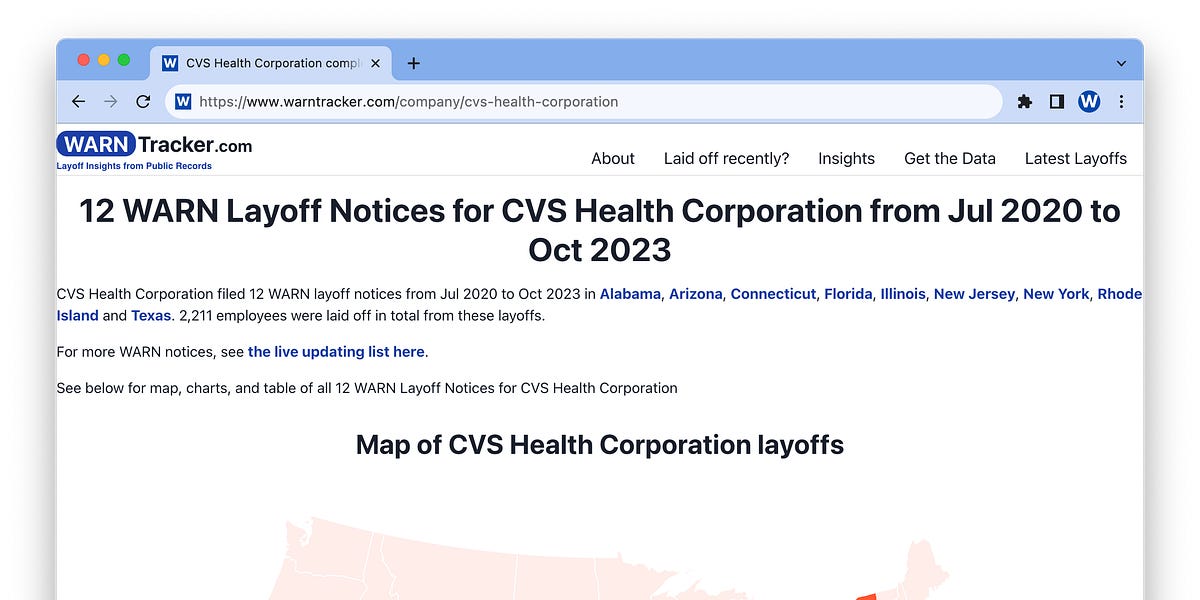
WARN-Notice Severance Ledger Exposes How Companies Value Workers
Nearly 73,200 U.S. workers appeared in state WARN databases in Q1 2026, and the severance formulas attached to those filings reveal how companies really value their departing workers, more than any earnings call could.
 ocwr.gov
Oracle filed its WARN notices with the state of California on a Tuesday morning in late March, and by Wednesday the severance formula was circulating among the company's U.S. engineers: four weeks of base salary, plus one additional week for every year of service, capped at twenty-six weeks total. That formula, confirmed by Ashley Stewart at Business Insider, is not unusual. It is slightly below the tech-industry median for a company of Oracle's scale and slightly above what workers in Mississippi or Ohio were receiving from the manufacturers and logistics firms that populated their states' first-quarter WARN filings. But the Oracle number is not interesting because it is generous or stingy. It is interesting because it is legible. A severance formula tells you, with arithmetic precision, exactly how many weeks of salary a company believes a year of your labor was worth.
The Worker Adjustment and Retraining Notification Act, passed in 1988, was designed to give workers and communities sixty days' notice before a mass layoff or plant closing. It has since become something else: a ledger, updated quarterly and filed with fifty state agencies, that records not just who is cutting jobs but how each employer prices the act of letting go. In the first three months of 2026 alone, Moneycontrol tallied 73,200 job cuts across the tech and media sectors, with Snap, Disney, Meta, and Oracle all filing within weeks of each other. Add the manufacturing, logistics, and airline reductions tracked through separate state WARN databases and the number climbs well past 80,000. The notices are public records that almost nobody reads in aggregate, but read that way they become the closest thing the U.S. has to a real-time severance survey.
The geography of filings in the first quarter tells a quieter story than the headline numbers suggest. Neil Strebig reported in the Commercial Appeal that nearly five hundred jobs were cut across three employers in DeSoto and Marshall counties in North Mississippi, a corridor that sits just below the Tennessee state line and relies heavily on distribution-center employment. Ohio's Department of Job and Family Services recorded thirteen WARN notices in March alone affecting 1,510 workers, according to The Cincinnati Enquirer, with auto-parts supplier First Brands and a Kroger distribution operator among the largest filers. These are not tech layoffs. They are the WARN Act working exactly as designed, flagging structural contractions in industries where severance packages are often negotiated by collective bargaining agreements rather than set by HR policy.
What makes the first quarter of 2026 structurally distinct is that layoffs are happening inside a labor market that has stopped hiring but has not started hemorrhaging. Trevor Bach, writing in The Dallas Morning News, described the Dallas-Fort Worth metro as having entered a "low-hire, low-fire" equilibrium: North Texas employers issued fewer WARN filings in the first quarter of 2026 than in any quarter since the summer of 2024, but net job gains were virtually flat. The Federal Reserve's Dallas branch registered hiring freezes across professional services, tech, and finance while layoff rates stayed below their long-term averages. Workers are not being pushed out en masse, but they are not being pulled in either. The WARN database, normally a lagging indicator, is now functioning as a leading one: when filings are low but so are hires, the economy is not stabilizing. It is holding its breath.
The severance packages themselves are where the class stratification of the 2026 layoff cycle becomes most visible. James Faris reported for Business Insider that Disney's April layoffs, the first under new CEO Josh D'Amaro, applied a tiered severance structure based explicitly on rank: senior vice presidents received a different multiple than directors, who received a different multiple than individual contributors. The company eliminated about one thousand positions, concentrated in the marketing division and at ESPN. Disney did not disclose the exact multipliers, but former employees told Business Insider that tenure-based formulas were applied only within certain bands, meaning a twenty-year veteran at the manager level and a twenty-year veteran at the VP level did not receive the same per-year value. That is unusual in white-collar reductions, and it signals something about how Disney's new leadership thinks about the cost of seniority.
Oracle's formula, by contrast, was flat across all U.S. employees regardless of level: four weeks of base salary plus one week per year of service, capped at twenty-six weeks. That structure is cleaner and more predictable, and it exposes exactly how much the company values tenure at the margin. At Oracle's median U.S. engineering salary of roughly $175,000, a five-year employee would receive approximately $30,000 in severance before benefits continuation. A twenty-two-year employee would hit the cap at roughly $87,500. Those figures are not large relative to the total compensation packages Oracle's senior engineers command, which routinely exceed $300,000 when equity is included. But Oracle, like many large tech employers, does not include unvested equity in its severance calculation, a quiet decision that can cost long-tenured employees hundreds of thousands of dollars in forgone stock grants.
The WARN Act requires sixty days' notice for covered mass layoffs, but it does not require a severance package at all. The packages exist because companies have learned that severance is cheaper than litigation., Adam Hamel, employment attorney, in NH Business Review, April 10, 2026
That observation, drawn from a practitioner's guide to New Hampshire's WARN requirements published by NH Business Review, cuts to the core of why severance structures exist in the first place. The federal WARN Act, and its various state-level counterparts including New Hampshire's own mini-WARN statute, mandates notice periods. It does not mandate pay. The pay exists because mass layoffs generate mass litigation risk, and a signed severance agreement typically includes a release of claims under the Age Discrimination in Employment Act, Title VII, and state labor codes. A company offering four weeks of base salary plus one per year is not being generous. It is pricing the cost of a class-action waiver, and it has concluded that twenty-six weeks of pay is cheaper than a multiyear litigation cycle.
The Southwest Airlines filing at O'Hare International Airport illustrates a different dynamic entirely. Hannah Hudnall reported for USA Today that 107 employees would be affected when the carrier discontinues service at O'Hare this summer. Those workers, covered by union contracts, do not receive severance set by a corporate HR formula. Their packages are governed by collective bargaining agreements negotiated between the airline and the unions representing ground crew, mechanics, and flight attendants. The WARN notice in this case serves its original statutory purpose, a sixty-day clock for workers and the city of Chicago to respond, but the severance terms were determined at a bargaining table years before the route decision was made. For unionized workers, the WARN-notice cycle is less a severance lottery and more a contractual right.
The non-union severance landscape has been shifting in ways that WARN filings only partially capture. Snap Inc. filed a notice in Washington state showing 95 affected employees across its Bellevue, Seattle, and Vancouver offices in mid-April, part of a broader restructuring that Todd Bishop at GeekWire reported would eliminate about a thousand jobs companywide. Snap's public rationale, disclosed in an investor update, was that more than 65 percent of new code was being generated by AI. This is becoming the standard framing: the layoff is not a cost-cutting measure but an efficiency dividend. The WARN notice, however, records only the job loss, not the productivity gain. There is no column in the form for "replaced by automation."
Amazon filed WARN notices affecting thousands of workers across four states at the beginning of May, according to records reviewed by Newsweek. The notices spanned fulfillment centers and corporate offices, a pattern that has become familiar during the company's post-pandemic recalibration. Amazon's standard U.S. severance package, confirmed in earlier reporting cycles, provides two weeks of pay for every year of tenure with a minimum of four weeks, plus continued health coverage. At the company's median corporate salary, that translates to roughly the same per-year value as Oracle's formula, but with a lower floor. A two-year Amazon employee receives four weeks. A two-year Oracle employee receives six. These small differences compound across a layoff wave of tens of thousands of workers, and they illustrate why comparing severance formulas is not an academic exercise. It is a wage question, deferred to the moment of exit.
The calendar pattern of the first quarter deserves attention because it reveals something about how companies time their workforce reductions. March and April are peak months for WARN filings, a rhythm driven by the end of the fiscal year for many large employers and the completion of annual performance-review cycles. Companies that missed earnings targets in the fourth quarter often announce restructuring in January or February, triggering WARN notices that land in the state databases by March. This means the Q1 data represents decisions made before anyone knows what the second quarter will bring. It is backward-looking by design, and treating it as a forecast is a mistake that analysts make every year.
What the aggregate WARN data cannot show, but severance formulas implicitly reveal, is the cost asymmetry between the employer and the employee. A severance package of twenty-six weeks represents half a year of base salary. For the company, that is a one-time charge, often excluded from adjusted earnings in the quarter it is recognized. For the employee, it is a bridge to the next job in a market where, as the Dallas Fed data suggests, hiring has slowed to a crawl. The WARN Act gives a worker sixty days of notice. A severance package might give another twenty-six weeks of pay. After that, the worker is on their own. There is no statutory requirement to track how many of them find new employment, or at what salary, or how long it takes. The WARN ledger records only the departure, never the landing.
Mississippi's first-quarter report offers a case study in what happens when the severance bridge is shorter than the job search. The three employers that cut nearly five hundred positions in DeSoto and Marshall counties were operating in distribution and light manufacturing, industries where severance is often one week per year of service with a cap of eight to twelve weeks. A ten-year warehouse worker in Olive Branch might walk away with ten weeks of pay, roughly $8,000 before taxes. The nearest metro area with significantly higher-paying logistics work is Memphis, where competition for those jobs means the search can stretch past the severance runway. The WARN notice, in this context, is not just a regulatory filing. It is a countdown clock that starts ticking sixty days before the last paycheck clears.
The structural question the first-quarter filings pose is not whether layoffs will continue. They will. The question is whether the severance formulas embedded in those filings are adequate for a labor market that has entered what the Dallas Fed calls a low-hire equilibrium. If the average job search for a displaced tech worker now takes four months, a severance package of twelve to sixteen weeks covers the gap. If it takes six months, it does not. The WARN Act was written for an economy where sixty days of notice was supposed to be enough time for a worker to retrain or relocate. In 2026, the retraining pipelines that the act envisioned barely exist, and relocation is not a solution when the hiring slowdown is national. The WARN ledger tells us who is being cut, when, and at what price. It does not tell us what happens on day sixty-one. That part of the cycle remains undocumented, and it is where the real economics of a layoff are lived.
Read next