Humanoid Robots Arrive, but Plugging Them In Is the First Problem
In 2026, consumer humanoid robots that walk and backflip cost less than a used Corolla, but the gap between glossy demos and Tuesday morning reality leaves owners scrambling for a place to plug them in.
 bloomberg.com
In this article
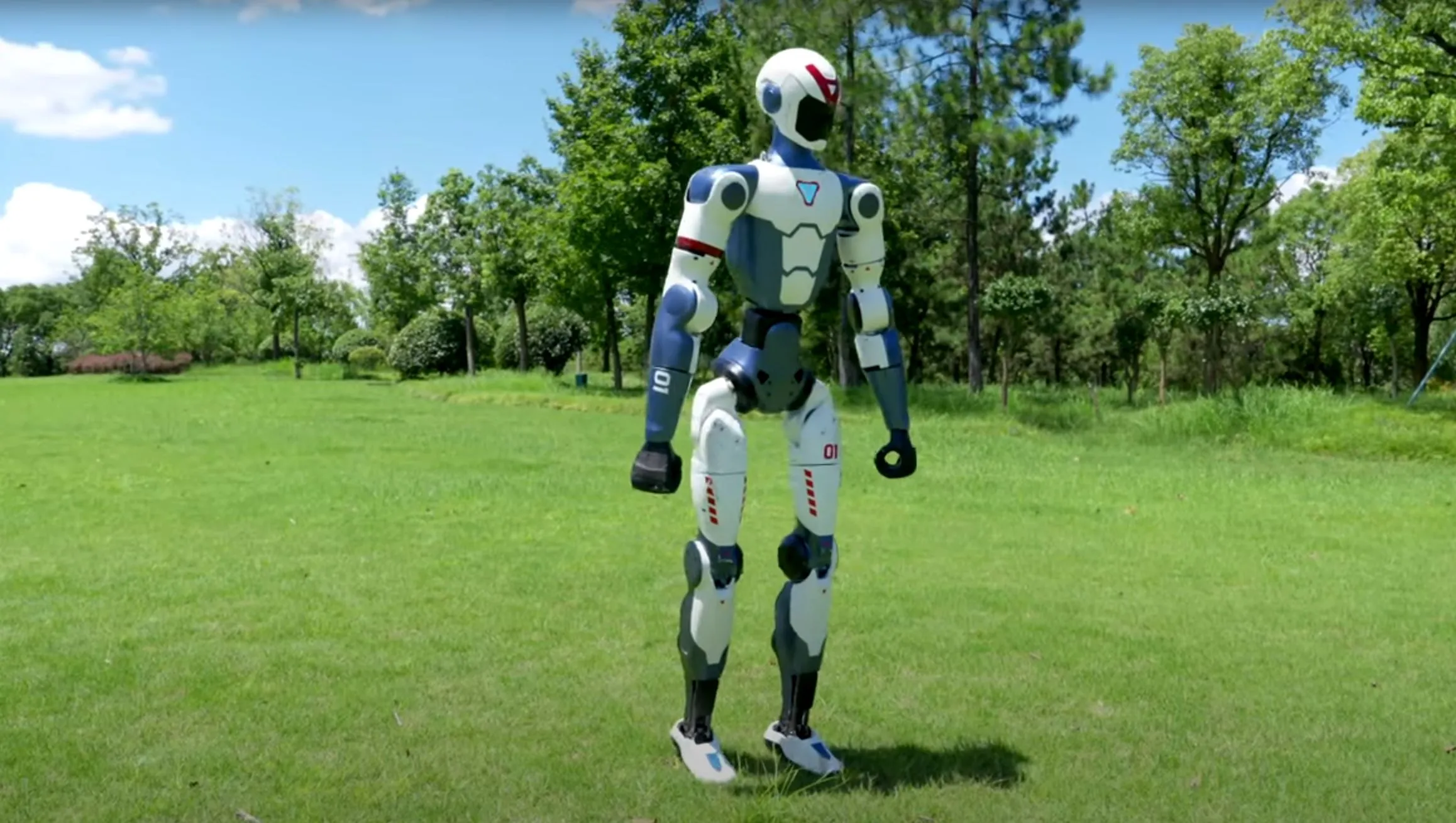
The box that arrived at Mateo's apartment in San Jose weighed 47 kilograms and required a freight elevator. He had ordered the Unitree R1 on AliExpress in April, the way you'd order a standing desk or an air fryer, and six weeks later it was propped against his kitchen island in a nest of foam packing. His girlfriend stood in the doorway, arms folded. 'It's shorter than I expected,' she said. The R1 is 132 centimeters tall. It does not look like a person. It looks like a person-shaped appliance, which is what it is, and the first thing Mateo discovered was that the charging dock needed a dedicated 20-amp circuit his 1970s apartment did not have.
This is the moment consumer humanoid robotics entered in the spring of 2026. Not with a stage demo or a founder manifesto, but with an AliExpress listing and a circuit breaker. In the span of six weeks, three distinct companies pushed three distinct visions of the home humanoid into actual commerce. OpenAI-backed 1X opened a 58,000-square-foot vertically integrated factory in Hayward, California, on April 30, targeting 10,000 NEO units in year one and 100,000 by the end of 2027, as first reported by Ana-Maria Stanciuc at The Next Web. Unitree Robotics of China listed its R1 humanoid on AliExpress for global preorder at $5,900, a move Sonia Ramírez at Vozpópuli called 'the humanoid robot no one expected to see listed like ordinary tech.' And Menlo Research released the Asimov v1, an open-source humanoid kit for builders who would rather assemble their own. The demos are over. The shipping labels are real.
But between the factory ribbon-cuttings and the front door, there is a gap. The gap is not about whether the hardware works in ideal conditions. Every company shipping a humanoid in 2026 can show you footage of a robot walking, picking up an object, righting itself after a shove. The gap is about everything the demo room does not contain: a narrow hallway, a cat that regards the robot as a threat, a Wi-Fi dead zone behind the refrigerator, a partner who did not consent to a $20,000 roommate with microphones. This is the beat I cover. I do not ask whether the engineers built the thing. I assume they did. I ask what happens when it meets a Tuesday.
Three tiers of home humanoid have materialized, and the price stratification is telling. At the top, there is 1X's NEO: $20,000, available for preorder through the company's website in three colors, including a tan finish designed to read as 'warm' rather than 'laboratory.' The NEO is a soft-shelled bipedal robot with fabric-covered actuators, a design choice that eWeek's reporting in late April framed explicitly as an effort to reduce the 'creepy' factor. It is intended to fold laundry, carry groceries, and navigate a multi-room home. 1X says the Hayward factory employs over 200 people and has already deployed NEO units on its own assembly lines, a closed-loop spectacle that generated exactly the headlines the company wanted.
In the middle tier sits Unitree's R1, starting at $4,290 for a fixed-base dual-arm configuration and climbing to $5,900 for the full bipedal 'sport-ready' model with acrobatic capabilities. That is less than a high-end MacBook Pro and a monitor, or about the price of a used 2021 Toyota Corolla. The R1 ships through AliExpress to North America, Europe, Japan, and Singapore, with the first consumer units expected to arrive by June 30. Unitree's pitch is not domestic utility. It is mechanical spectacle: a robot that can run, jump, and recover from a kick, sold through the same logistics infrastructure that delivers phone cases and LED strip lights.
Then there is the Asimov v1 from Menlo Research, covered in detail by Tom Cuylaerts at i-SCOOP in early May. The Asimov is an open-source hardware platform with a DIY kit option, full simulation models, and a sensor suite designed to be tinkered with. It is not a consumer product in the conventional sense. It is a declaration that the building blocks of a humanoid robot are no longer exotic. If you can assemble a 3D printer from a kit, you can, in theory, build an Asimov. That changes who gets to ask questions about what these machines should do.
The Tesla-shaped hole in the room
Every conversation about humanoid robots in 2026 must contend with Tesla's Optimus, which is the most famous humanoid robot that does not ship. Elon Musk teased the Optimus V3 in late April during Tesla's Q1 earnings call, alongside a warning that the company plans to spend $25 billion on AI and robotics infrastructure this year. A Tesla executive in China told journalists in April that the Shanghai Gigafactory holds the 'golden key' to mass-producing Optimus, language that reflects the company's tendency to announce industrial strategy as prophecy. An Optimus unit greeted runners outside the Tesla showroom on Boylston Street during the Boston Marathon on April 20. It posed for photos. It did not fold any laundry. Two weeks later, 1X was shipping actual robots from an actual factory in Hayward.
Tesla's approach is a useful foil for the market because it is pure demo economics. The company can afford to tease indefinitely because Optimus is not a revenue line; it is an argument about Tesla's future valuation. 1X, Unitree, and Menlo Research do not have that luxury. They are selling hardware, which means they need customers, which means they need the product to work in a home that was not designed by the people who built the robot. That is a harder problem than walking across a stage, and the industry's uneven progress on it is the real story of 2026.
The factory numbers are staggering if you do not look at them too closely. 1X says 10,000 units in year one, scaling to over 100,000 by late 2027. Figure, another California firm, is ramping its own humanoid line in parallel, and the two companies together are being described as a 'mass production milestone' for the category. In China, the Guangdong factory ecosystem is reportedly producing one humanoid robot every 30 minutes, with Morgan Stanley doubling its 2026 forecast for Chinese humanoid output to 28,000 units. Foxconn and Lens Technology, the supply-chain giants that built the iPhone era, are repurposing lines for humanoids. The manufacturing infrastructure is real. Whether the demand is real is a separate question.
To answer that question, you have to look at what a consumer gets for their money. The NEO's $20,000 price puts it in the bracket of a used car or a home renovation. 1X describes its capabilities in terms of household tasks: carrying items between rooms, light cleaning, fetching objects. But reading the fine print, as Emily Johnson did in a sharp piece for Hoodline, reveals that the NEO's 'Expert Mode' allows remote human operators to view the robot's camera feed. This is a sensible engineering choice for handling edge cases the AI cannot resolve on its own. It is also, as Johnson put it, a feature that means 'strangers watching strangers.' A 1X spokesperson told Hoodline that operators only see anonymized data in Expert Mode, but the privacy architecture of a camera-equipped robot that streams to a cloud operations center is something no consumer gadget has ever had to solve at scale.
Unitree's R1 sidesteps this problem by not pretending to be a home helper. It is a platform: programmable, agile, mechanically impressive, and about as useful in a kitchen as a dirt bike. The R1 can do push-ups. It can right itself after being knocked over. It ships with an SDK. These are features that appeal to developers and robotics hobbyists, which is the audience Unitree is actually selling to. The AliExpress listing is a distribution strategy, not a consumer promise. The R1 will end up in university labs, maker spaces, and the apartments of people like Mateo, who spent the first weekend debugging a firmware issue that caused the robot to repeatedly attempt to shake hands with a floor lamp.
The Asimov v1, meanwhile, represents a totally different theory of the market. Menlo Research open-sourced the design because the company believes the bottleneck in home robotics is not hardware cost but the number of people who know how to program a bipedal machine to do anything useful. By selling a kit under $8,000 and publishing the full CAD, the company is betting that a distributed community of builders will solve the application problem faster than any single firm can. It is a bet that worked for 3D printing and for Linux. Whether it works for robots depends on whether the people who buy them have the patience to spend weeks tuning a gait controller, which is not what most people mean when they say they want a robot.
What the demos never show
Every humanoid robot released in 2026 shares a set of unspoken dependencies. They require flat floors. The R1 can handle a curb, but thick carpet confuses its footstep planner. They require line-of-sight Wi-Fi. They require an owner who is comfortable with a machine that weighs more than a golden retriever moving autonomously through a living space. None of the three companies currently shipping or taking preorders offers a meaningful accessibility interface for users who cannot physically reposition a fallen robot or who rely on screen readers that do not interface with the robot's companion app. These are not edge cases. They are the conditions of a real home.
A physical therapist in Oakland who has worked with exoskeleton and assistive robotics deployments, and who asked not to be named because her employer has NDAs with two of the companies mentioned, described a pattern she sees across the industry: "The hardware teams build for a six-foot-two engineer who lives alone. The software teams build for a demo room. Nobody builds for the person who needs a chair to reach the kitchen counter." When asked about accessibility testing, a 1X spokesperson pointed to the NEO's voice-command interface and said formal accessibility certification is "on the roadmap." Unitree did not respond to a request for comment. Menlo Research noted that open-source design means accessibility modifications are possible, which is true in the same way that it is true that a motivated person can modify a car to be wheelchair-accessible.
The hardware teams build for a six-foot-two engineer who lives alone. The software teams build for a demo room. Nobody builds for the person who needs a chair to reach the kitchen counter., A physical therapist specializing in assistive robotics, speaking on background
The second-person experience is another dimension the product pages omit. What is it like to be near someone using a humanoid robot? The NEO's fabric skin and rounded edges are designed to make it less intimidating, but the machine still stands 165 centimeters tall on a bipedal frame and moves with the deliberate, slightly uncanny gait that all bipedal robots share in 2026. In a shared kitchen, it occupies floor space the way a second person does. In a small apartment, the charging dock is a permanent piece of furniture. A partner who did not sign up for the robot is living with it anyway, and that social negotiation is not covered by the warranty.
The shipping timelines add another layer of uncertainty. 1X says NEO shipments will reach U.S. households in 2026, but the company has not specified whether that means June or December. Unitree's June 30 preorder window is more specific, but AliExpress listings for heavy machinery have a well-documented habit of slipping. Menlo Research's Asimov kits are shipping now to early backers, though the lead time for new orders stretches into the fourth quarter. If you want a humanoid robot in your home before the holidays, you can probably have one. Whether it will do anything useful by then is a different question.
The contrast with the industrial robotics market is instructive. In factories, humanoids are being deployed for specific, bounded tasks: moving parts between stations, performing quality inspections, working alongside human assemblers on lines they never leave. The Guangdong factory producing a robot every 30 minutes is not making general-purpose machines; it is making task-specific units that operate in environments where the lighting is consistent, the floor is marked, and no one has left a stray extension cord across the path. That is not a home. A home is a stochastic environment, and the gap between 'works in a factory' and 'works in my living room' is not a gap the current generation has closed.
What the market is actually testing in 2026 is not whether someone will buy a humanoid robot. Someone will. The market is testing whether the people who buy one will keep it running for more than six months, whether the novelty outlasts the charging cycles, and whether the companies selling these machines can build support infrastructure that does not evaporate when the venture funding runs out. 1X has OpenAI's backing and a factory with real capacity. Unitree has AliExpress distribution and a price that puts the R1 within impulse-buy range for a certain kind of engineer. Menlo Research has a community. None of these is a guarantee of longevity, but they are the three most credible bets the category has ever placed.
The checkpoint to watch is December 2026. By then, 1X's first consumer NEO units will have been in homes for several months. Unitree will have fulfilled its initial R1 preorders, and the teardown videos will be on YouTube. The Asimov v1's builder community will have produced whatever strange and revealing applications it is going to produce. Tesla will still be teasing Optimus. What we will know, and do not know now, is whether a humanoid robot in a home is more like a dishwasher or more like a treadmill: a thing that earns its floor space every day, or a thing that holds laundry.
Read next