The 220-GW Grid Queue Is Datacentres' New Bottleneck
From Virginia exurbs to West Texas, the grid interconnection queue determines where datacentre compute lands and who pays for new substations, with FERC's June 2026 rule set to rewrite the rules.
 www.landgate.com
On a Tuesday evening in early April, the Prince William County Planning Commission convened in a low-slung municipal building off Prince William Parkway to consider an item that would once have been unremarkable: a special-use permit for a new 230-kilovolt substation on 14 acres of scrubland near the Fauquier County line. The room was three-quarters full, which, for a substation hearing in Virginia exurbia, counts as a crowd. Dominion Energy had submitted the application eighteen months earlier. The substation was meant to serve a proposed 1.2-million-square-foot datacentre campus that had been announced—tentatively—in the summer of 2024. The datacentre developer had secured the land, filed the entitlements, and lined up a hyperscaler anchor tenant whose name no one in the room would confirm on the record. What it had not secured was a grid interconnection agreement. The queue for that, Dominion told the commission, now stretched to the first quarter of 2031.
The Prince William hearing was not an outlier. Across the United States, the timeline to connect a large load to the high-voltage grid has become the single binding constraint on datacentre construction, eclipsing chip supply, labour, and even the availability of capital. According to a report published in April by the energy analytics firm Wood Mackenzie, nearly half of the US datacentres scheduled for completion in 2026 now face delays or outright cancellation, driven by what the authors described as a collision of permitting bottlenecks, power grid shortfalls, and growing tension at the state and local level over who bears the cost of the upgrades. The report's headline finding was blunt: the interconnection queue—the waiting list maintained by regional grid operators for new generation and large-load connections—has become the de facto rationing mechanism for the AI buildout.
To understand why, one must first understand the distinction between contracted load and connected load. Contracted load is what a datacentre operator tells the utility it intends to draw—a figure that appears in interconnection studies, rate cases, and the glossy pages of bond-offering documents. Connected load is what the substation, the feeders, the step-down transformers, and the transmission line can actually deliver on a July afternoon when every chiller on the campus is running at full tilt. Between the two sits the interconnection process: a sequence of studies—feasibility, system impact, facilities—conducted by the regional transmission organisation, each one examining whether the proposed load will overload existing circuits, require new transmission, or shift congestion costs onto other ratepayers. The process, in PJM territory, has historically taken three to five years. It now frequently takes seven.
Nowhere is the backlog more acute than in the PJM Interconnection, the regional transmission organisation that serves 67 million electricity customers across 14 states and the District of Columbia—a territory that includes Loudoun County, Virginia, the densest concentration of datacentres on Earth. In May 2026, PJM released the results of its first reformed interconnection queue cycle, known as Cycle 1, which drew 811 discrete projects requesting a combined 220 gigawatts of new capacity. As POWER Magazine reported, the queue included 105 GW of natural-gas-fired generation—a number that startled even veteran transmission planners—alongside wind, solar, storage, and a growing category of projects described only as "large load," the utility-sector euphemism for hyperscale datacentres.
The 220 GW figure deserves a moment's pause. It is more than the total installed generation capacity of PJM's entire system. It is more than the peak demand of every home, factory, and office building in the 14-state footprint combined. And it arrived in a single queue cycle, after PJM had spent two years reforming its interconnection rules precisely to clear out the speculative projects that had clogged earlier rounds. The reform was supposed to filter out the unserious proposals. By that measure, the queue is now more serious than it has ever been. The datacentre load is not speculative—the anchor tenants are real, the balance sheets are real, the chips are being fabbed—but the grid is not.
In April 2026, PJM took an extraordinary step: it filed an emergency proposal with the Federal Energy Regulatory Commission seeking authorisation to procure 15 gigawatts of new power supplies on an expedited basis, outside the normal queue process. The proposal, first reported by Bloomberg, amounted to an admission that the interconnection queue, even reformed, could not deliver generation fast enough to meet the load growth already locked into PJM's planning forecasts.
That same week, on the other side of the country, the Texas grid offered a mirror image of the same dynamic. The Electric Reliability Council of Texas—ERCOT, the standalone grid operator that covers most of the state—released data showing that natural gas projects had leapfrogged wind energy in its interconnection queue for the first time in a decade. The queue now holds 32 GW of gas-fired generation, most of it peaking capacity designed to serve individual datacentre campuses. As The Texas Tribune reported, datacentre demand is the primary driver: developers are filing interconnection requests for gas turbines co-located with server halls, betting that on-site thermal generation can bypass the queue for new transmission entirely.
The bet is called behind-the-meter generation, and it has become the most consequential workaround in the infrastructure business. By siting a gas turbine—or a battery array, or a small modular reactor, at least on paper—on the same side of the meter as the datacentre, a developer can avoid the interconnection queue for the generation portion of the project. It still needs a transmission connection for backup and for exporting surplus power, but that connection is typically smaller, faster to study, and politically easier to secure. Conduit Power and Prometheus Hyperscale, two firms that have emerged as leaders in this space, expect their first bridge-power site—a 600-MW gas-fired facility co-located with an AI training campus in West Texas—to come online before the end of 2026, ahead of any new transmission-dependent project filed in the same quarter.
Yet behind-the-meter solves only one part of the problem. The other part is the substation itself.
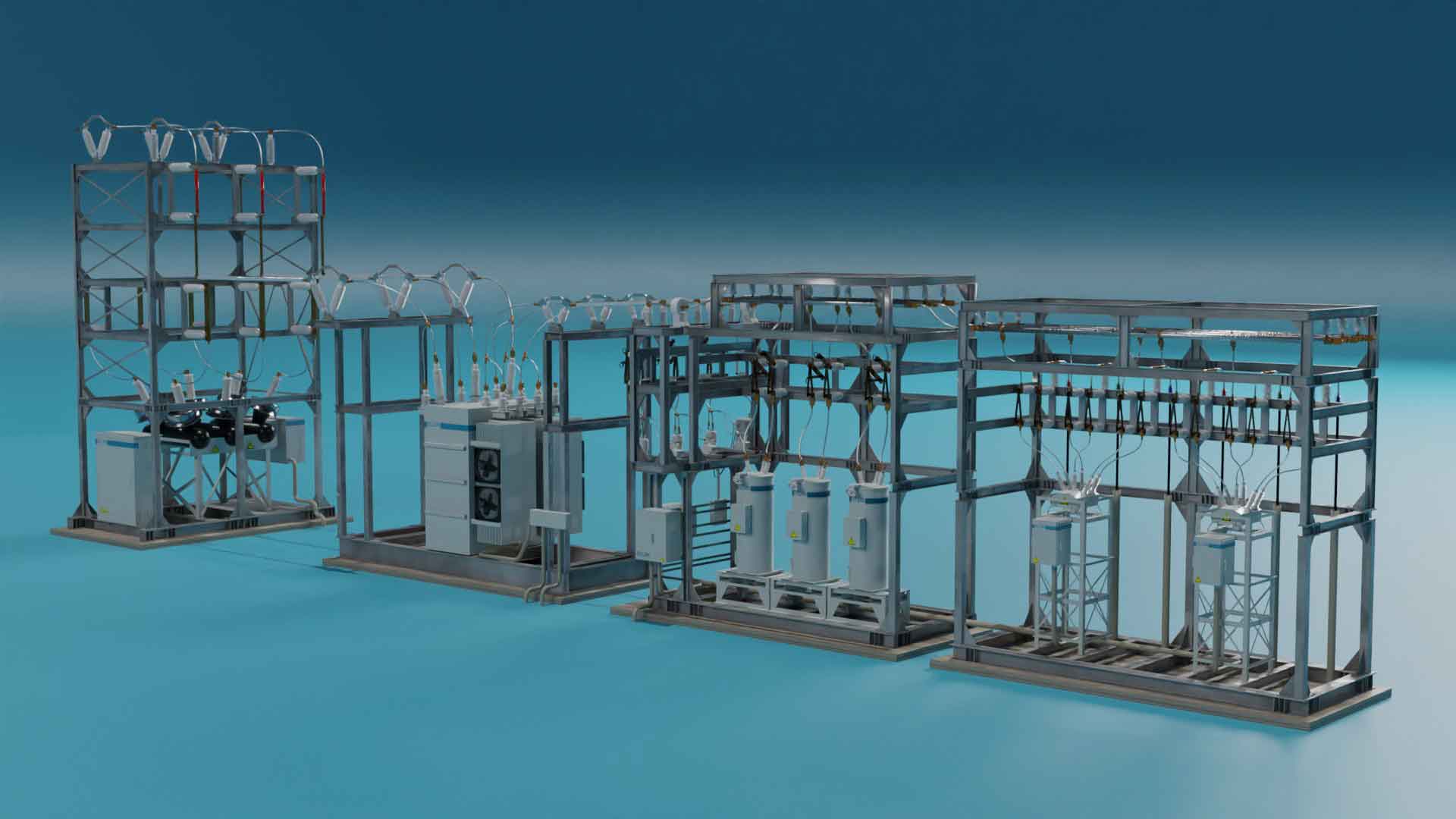
A modern hyperscale datacentre campus does not plug into a distribution line like a shopping centre. It requires a dedicated high-side substation—typically 230 kV or 345 kV—with multiple step-down transformers, banks of switchgear, and a control house that looks, from the air, like a small industrial plant. The lead time for a large power transformer in the United States has stretched from 52 weeks to 130 weeks, according to a federal infrastructure advisory released in March 2026. The shortage, first documented by the Department of Energy in 2024, has been exacerbated by constrained domestic manufacturing capacity—there are fewer than ten facilities in North America capable of producing the large power transformers required for substation-class service—and by competition from transmission projects queued ahead of datacentre loads in the same supply chain.
The commission is pushing to get data centres onto the grid, and fast. The high-stakes move could tip the balance of regulatory power against the states.— POLITICO, reporting on FERC's large-load rulemaking, April 2026
Into this breach stepped the Federal Energy Regulatory Commission. On 16 April 2026, FERC Chairman Mark Christie announced that the commission would complete a sweeping rulemaking on large-load interconnection by its June open meeting—a schedule that one commission staffer described, in a piece published by POWER Magazine, as "the fastest-moving docket since Order 1000." The rulemaking, formally designated RM25-7, proposes to do three things: establish a federal timeline for large-load interconnection studies that pre-empts slower state-level processes, require datacentre developers to post financial commitments earlier in the queue, and—most contentiously—allow FERC to designate "national interest corridors" for datacentre transmission where state utility commissions have blocked or delayed siting approvals.
The politics of that third provision are ferocious. State utility commissioners in Virginia, Ohio, and Indiana—all states with substantial datacentre development pipelines—have argued that FERC lacks the statutory authority to override state siting decisions, and that doing so would shift the cost of new transmission from the datacentre developers who benefit from it onto the broad base of residential and commercial ratepayers. The cost-shifting question is not hypothetical. A new 230 kV substation of the kind debated in Prince William County costs between $40 million and $80 million, depending on the transformer configuration and the length of the transmission tap. Under current interconnection rules in most ISOs, the developer pays for the network upgrades assigned to their project—but the assignment is itself a subject of negotiation, study, and frequent litigation. Developers argue they are being asked to pay for grid upgrades that benefit the entire system. Utilities argue that the datacentre load is the reason the upgrades are needed.
This argument is playing out in county commission chambers, public utility commission hearing rooms, and state legislatures from Richmond to Austin. In Texas, the legislature is considering a bill that would require datacentre developers to pay the full cost of any transmission upgrades triggered by their interconnection requests, including upgrades that benefit other loads—a standard known as "but-for" cost causation. In Virginia, Dominion Energy's 2026 integrated resource plan includes $9.3 billion in transmission spending attributed to datacentre load growth, a figure the company proposes to recover through a rider on its industrial tariff. The rider has drawn opposition from the state's manufacturing sector, which argues that it effectively constitutes a tax on all large industrial customers to subsidise grid infrastructure for a handful of hyperscale tenants who could, quite comfortably, pay for their own substations.
The question of who pays is inseparable from the question of who waits. An interconnection queue is not a first-come, first-served line. It is a series of studies that can be terminated, refiled, or leapfrogged by projects with faster permitting, better engineering, or political backing. A datacentre developer who can commit to paying for a substation upgrade upfront—without waiting for the ISO to complete a cost-allocation study—can shave eighteen months off its interconnection timeline. That capability is not evenly distributed. The hyperscalers have it. The colocation operators and the enterprise datacentre developers, by and large, do not.
What the local substation says about the schedule is, increasingly, the only thing that matters. In Loudoun County, Dominion Energy's 2025 system impact study for the Arcola substation expansion found that without a new 230 kV transformer and a reconductored transmission line, the existing substation would exceed its thermal rating by 2028—even with only the contracted load already approved. The expansion, Dominion estimated, would take until 2031 to complete. Every datacentre project behind Arcola in the queue now carries a note in its financial disclosures: power delivery subject to substation upgrade schedule, not guaranteed before 2032.
The result is a geographic resorting of the datacentre buildout. Sites that can deliver substation capacity quickly—because a utility already has a transformer on order, because a transmission line was built with spare capacity a decade ago, because a county commission has pre-zoned industrial land adjacent to an existing switchyard—are commanding premiums that have no precedent in industrial real estate. In parts of Indiana and Ohio, farmland adjacent to 345 kV transmission corridors is trading at multiples of its agricultural value, not because anyone wants to farm it, but because the interconnection queue for those corridors is three years shorter than the queue for sites in Northern Virginia.
That question will be answered, at least in part, by FERC's June 2026 rulemaking. If the commission finalises the large-load interconnection rule on schedule, it will impose a 180-day federal timeline for interconnection studies on projects above 100 MW—a standard that would effectively override the multi-year queues in PJM and MISO. If it also asserts federal siting authority for datacentre transmission corridors, it will have done something no federal energy regulator has attempted since the Energy Policy Act of 2005. The rule's success or failure will turn on whether a majority of the commission believes the statutory record supports that assertion. The commission has three Democratic appointees and two Republican appointees. The Republican chairman is the rule's primary advocate.
In the meantime, the queue itself is becoming a kind of market—opaque, bilateral, and largely unregulated. Developers who hold queue positions are quietly selling them to developers who do not, at prices that reflect the capitalised value of eighteen months' avoided delay. A queue position behind a substation with available transformer capacity in PJM's AEP zone traded, in March 2026, for $12 million. The transaction was structured as an asset sale—"interconnection rights"—and disclosed in a footnote to a quarterly filing. No ISO tariff explicitly authorises such trades, but no tariff explicitly prohibits them either. The practice has become common enough that interconnection consultants now speak of "queue liquidity" as a market indicator alongside power-purchase agreement prices and land values.
The substation, in this telling, is no longer a piece of utility hardware. It is a financial instrument—a call option on a future grid connection whose strike price is set not by a market but by a rate case, whose expiration date is determined by a transformer lead time, and whose value is underwritten by the simple fact that there are 811 projects behind it in the queue and not nearly enough copper on order to connect them all. On 19 June 2026, FERC will convene its open meeting in Washington. The large-load interconnection rule is docket item E-1. The commissioners will take their seats at ten o'clock in the morning.
Read next